
When I was about eight, I decided that the most wonderful thing, next to a human being, was a book.
–Margaret Walker, in Brian Lanker, I Dream a World (1989)
Category Archives: Education
What You Missed
What You Missed That Day You Were Absent from Fourth Grade
by Brad Aaron Modlin
Mrs. Nelson explained how to stand still and listen
to the wind, how to find meaning in pumping gas,
how peeling potatoes can be a form of prayer. She took
questions on how not to feel lost in the dark
After lunch she distributed worksheets
that covered ways to remember your grandfather’s
voice. Then the class discussed falling asleep
without feeling you had forgotten to do something else—
something important—and how to believe
the house you wake in is your home. This prompted
Mrs. Nelson to draw a chalkboard diagram detailing
how to chant the Psalms during cigarette breaks,
and how not to squirm for sound when your own thoughts
are all you hear; also, that you have enough.
The English lesson was that I am
is a complete sentence.
And just before the afternoon bell, she made the math equation
look easy. The one that proves that hundreds of questions,
and feeling cold, and all those nights spent looking
for whatever it was you lost, and one person
add up to something.
The Soul Reaching
Leave a reply
“Even when reading is impossible, the presence of books acquired produces such an ecstasy that the buying of more books than one can read is nothing less than the soul reaching towards infinity.”
– A. Edward Newton

The Job of Parents
“The job of parents is to model. Modeling includes how to be a man or woman; how to relate intimately to another person; how to acknowledge and express emotions; how to fight fairly; how to have physical, emotional and intellectual boundaries; how to communicate; how to cope and survive life’s unending problems; how to be self-disciplined; and how to love oneself and another. Shame-based parents cannot do any of these. They simply don’t know how.”
–John Bradshaw, Healing the Shame that Binds You
The Best Thing
“The best thing for being sad,” replied Merlin, beginning to puff and blow, “is to learn something. That’s the only thing that never fails. You may grow old and trembling in your anatomies, you may lie awake at night listening to the disorder of your veins, you may miss your only love, you may see the world about you devastated by evil lunatics, or know your honour trampled in the sewers of baser minds. There is only one thing for it then — to learn. Learn why the world wags and what wags it. That is the only thing which the mind can never exhaust, never alienate, never be tortured by, never fear or distrust, and never dream of regretting. Learning is the only thing for you. Look what a lot of things there are to learn.”
–T.H. White, The Once and Future King
Visual Comprehension and Justification
The MRI indicated a lesion worth a deeper look. The tech marked my breast in one room using an ultrasound machine that was new. When the radiologist attempted to locate it in the biopsy room, she spent a half an hour trying to find the exact location of the suspicious lesion. At one point I murmured, “So much flesh…” and she gently said, “No. This machine isn’t as new or as good as the one in the other room.” As time passed, though, I began to feel self-conscious and uncertain. I mean, if it’s so hard to find, should I even be there at all? The equipment, time, and expertise cost a great deal of money. If it’s so small, maybe I’m wasting all that. Just because they can see something on the MRI doesn’t mean it’s necessarily a big deal. I said something about this, and the doctor assured me (as of course she would) that certainly it’s worth looking at. She also said that yes, the highly sensitive machines and tests sometimes can find something that turns up benign, but that to be sure is better. Still, I had this feeling of wasting resources. What helped me feel like further testing is justified was a) that the doctor said if it were her breast, she’d pursue it and b) once she knew I’ve had atypical hyperplasia before she was adamant I do it (an MRI breast biopsy).
Yet sometimes it helps to actually measure something and compare. The suspicious lesion is 6 x 8 x 4 millimeters. So I went through my art supplies and found something that fits those dimensions. Then I compared this to a dime (see picture). The visual impact was persuasive. While this is not a huge lump, it is not microscopic either. It is not small, when one considers the breast. It is real, and it wasn’t there a year ago. I spent a few hours reading up on breast cancer and radiology terms. If I wasn’t convinced before that this is worth taking seriously, I am now. And yes, if it’s benign, it’s still worth checking.
The point of having this technology and being identified as high risk (42.5% lifetime chance) is to stay on top of changes so they don’t become big lumps, by which time the diagnosis is invasive cancer and/or possible metastasis requiring mastectomy, lymph node dissection, chemotherapy, and radiation. The point is that if caught early, prognosis is excellent. It’s far more costly (to insurance and to me) to wait for a lump to become palpable and treat it.
Intellectually I know that I am worth time, attention, and resources. Yet it was showing myself the physical dimensions of this lesion that settled it.
In 2011, I had a lesion that required surgical biopsy. It was 5 mm (don’t know all dimensions), and they ended up taking a not-small chunk of my breast with it. The pathology report indicated atypical ductal hyperplasia — meaning that abnormally shaped cells were reproducing at a faster than normal rate in my milk duct. It was precancerous, and thus major trouble was nipped in the bud. So yes, this suspicious lesion found by the MRI (but not a mammogram) merits a closer look.

Learning to Be an Includer
Experiencing bullying at school is traumatic. When a child comes from a loving, stable family with empathetic parents, it is still hard on a child. When a child comes from a family system that is authoritarian or neglectful, the distress is even worse; often there is bullying ongoing in the home as well, and the people from whom a child would get support don’t provide it.
As a parent, when my child encounters “mean girl” (or “mean kid”) behaviors, I struggle often with my own wounds from childhood. I did not have an empathetic, supportive family, because bullying also occurred within our home. All the parts of myself that I call “young stuff” — that didn’t get needed support — burst to the surface. Sometimes I parent from a state of panic and urgency. I’m working on this.
This article, Raising Girls Who Are Includers Instead of Mean Girls, felt timely and wise. I related to the author’s experiences in childhood and enjoyed reading how those experiences created in her a desire to become an “includer.”
She wrote a list of stories she hopes our daughters will someday say as they reflect on how we supported them during their struggles. I’m sharing here so I can return to it, to read and remind myself of my aspirations.
I hope all our girls will someday share stories like:
~ “My mom would listen to me as she stroked my hair, as she lingered with me and I shared what was happening and how I felt.”
~ “My mom wouldn’t jump in and try to fix it. She wouldn’t freak out and panic out of her own fears and hurts and unconscious stuff she was holding. She would sit with me and ask me for my ideas and what I needed. She would wait and listen – listen to what’s said and unsaid, creating safe space for me to navigate the inner landscape of my own feelings and heart so that the right actions for me to take would arise from within me.”
~ “My parents would advocate for and alongside me in situations that required adult intervention. They wouldn’t act out of fear or anger. They would wait and discern and pray and watch.”
~ “My mom wasn’t about ‘sweeping me up and saving me.’ She was about empowering me. She knew when to step in front of me and be the mama bear, protecting me. And she knew when to sit behind me or alongside me, abiding with me.”
~ “I learned to say, “THAT’S NOT OK!” and “Stop” and “I am walking away now.”
~ “I learned how to see clearly. I learned to not think there was something wrong with ME. I learned to not turn on myself but rather have regard for myself.”
~ “I learned to name with compassion – for myself and others – what is happening. I learned to name it, state it, and own my response.”
~ “I learned ways of working through difficulties with other girls and women in ways that honor and regard each girl and woman’s body, feelings, experiences and needs.”
~ “I learned to find my tribe of women. I learned to ask for help. I learned to be with others who uplift and honor each other.”
~ “I learned to speak up. I learned to speak up for myself and for others in the face of injustice – on the playground, in the hallways between classes in middle school, or in international peace negotiations.”
~ “I learned to be an includer. I learned to mindfully abide with whatever I am experiencing within my own inner landscape. And from such a place of inclusion, I learned to include and walk beside others.”
-Lisa McCrohan
Step by Step
We need to remember that an appreciation for challenge, and a belief that we can find a way to change, learn and grow, can’t itself be fixed in place. Instead, we all struggle with fear and discouragement at times. Sometimes we run toward new experiences. Sometimes we have to find a way to learn something we really did not want to learn. Sometimes, some part of us is always on the floor, sobbing: “I can’t. I’m bad at this. I’ll never get it.”
So how do you raise a child with a growth mind-set, along with a nice healthy appreciation for where it came from and the will to keep it strong? By applying the encouraging messages of the growth mind-set to yourself. I’ll borrow, out of context, another phrase from Dr. Dweck: “The point isn’t to get it all right away. The point is to grow your understanding step by step. What can you try next?”
-K.J. Dell’antonia, ‘Nice Try!’ is Not Enough
Avoidance
Here is my self-talk: “I’m done. I’m done with so many books on my shelves that I’ve owned for decades and not read yet. Done with books I’ve read once and have no intention of reading again.”
I’ve purged two grocery bags of books from my shelves. I engage in a little dance with the books that remain, telling myself that some of them I will probably use sometime (they number in hundreds). It’s an interesting experience to look at a book and decide whether it departs, and why.
Books represent security to me — the idea that if I read enough, learn enough, I can control life. I can create safety. The idea that I don’t know enough, and that words and ideas will impart wisdom. I’m not judging myself for having spent the money on the books. They will find their homes. Yet it is time — Life is telling me — to interrupt this impulse and learn to BE with whatever arises that makes me uncomfortable.
Sometimes I tell myself I need to purchase a book because I cannot borrow it from the public library even via interlibrary loan (I like to read somewhat uncommon titles). At the root of this story, however, is again, the reflexive movement toward the familiar role of student. I delay action and avoid discomfort by returning to a role I know so intimately.
When I moved from Syracuse to Austin, I owned a personal library of 800 books. I couldn’t afford to move them all. I culled them severely and shipped only the books that generated the strongest connection within me, about 100. Over the years I’ve had the space and means to accrue more books. I want to engage with life differently. I own 1,311 books. It’s time to unburden myself.
How to Handle Worksheet Homework
When your child greets you at the end of the school day crying, “I’m stressed! I have yesterday’s worksheet to finish and today’s and the spelling homework! I hate school!” — that is disquieting. After six hours of sitting (with 35 minutes of total recess) and doing what one is told, to end the day with anxiety is a recipe for learning to hate school.
I did not push Bean to do the worksheets, but she decided to complete them. They were easy — tracing and printing the letters C, D, E, and F, on two sides of a paper. Could that time have been better spent? Could she have played, or helped make dinner, or gone for a walk? Yes, but Bean was worried about submitting blank sheets. I asked more about how homework is collected. In past classes, all the folders were put in a bin, and a parent helper or the teacher looked at it. In this year’s class, the folders are kept on the students’ desks. At mid-morning, a student helper collects the pages from each student to bring to the teacher or adult helper to review.
This requires producing papers on the spot, in front of everyone; it will be obvious when a student has nothing to turn in. So, I created a document that we’ll staple to any worksheets, and Bean will have something to submit. (To save paper, there are multiple forms on one sheet.) We’ll circle all the applicable activities for that day.

This post is also related to yesterday’s post, To Do Homework, or Not to Do Homework?
To Do Homework, or Not to Do Homework?
It’s the beginning of the school year. Several friends on Facebook posted laments about homework and their children’s resistance. So I thought I’d write my thoughts down. Some of these were extracted from a letter I saw on someone’s blog awhile back. But first, our history of homework:
In TK, the teacher assigned two double-sided pages of worksheets each week: a total of 4 pages weekly. Students took them home Monday and submitted them Friday. I stood over Bean’s shoulder and made her do them. This was a struggle. They also took home picture books to read and were required to do something creative (a drawing, a re-telling) for class. Bean did those willingly. We had to keep a reading log as well, which I managed.
In Kindergarten, the teacher sent worksheets home daily, two double-sided pages, Monday through Thursday: a total of 16 pages weekly. The teacher never looked at it, because I and other parents did homework check-in and corrected it. Bean resisted doing homework, and I began to question its necessity. By December, I decided I was sick of the fight and of being the bad guy, so I stopped pushing her to do it. Her learning didn’t suffer. The teacher chided her for not doing it, but I no longer felt a responsibility to enforce it. There was also a book project similar to the one in TK, which she enjoyed, and a reading log, which I filled out.
In 1st grade, on Tuesdays her teacher sent home a packet of 12-13 double-sided pages, which were due the following Monday: 24-26 pages a week. I told the teacher my position on homework — it’s unnecessary and busy work. She accepted that. However, I wanted to be a good class parent, so I started the year by pushing Bean to do it, and if I sat with her and scribed, she would. But there were still fights. About a month in we stopped doing it. Twenty minutes of reading daily was expected (but not a reading log), and Bean did this, as well as an online reading program called Raz Kids. With Raz Kids, her reading took off. She loved earning points to decorate her Raz Rocket, and that love flowed over into regular books.
This year in 2nd grade, Mrs. L sends home one double-sided page Monday through Thursday: so far, 8 pages a week. If there is class work that is not completed in the alotted time, that is sent home as well. Bean has done them willingly, without prompting or help. They are “busy work” sheets — tracing and printing letters, simple math, connect the dots. Teacher also sends a spelling word list with a menu of activities to do with the words to help them learn. I like the menu: there are options to write stories using the words, spell them with scrabble tiles, cut out letters and tape them, write the words with your finger in rice, etc. We’ll see how the homework progresses through the year. There will be a reading log, which I have decided to let Bean manage as well. If Bean begins to get frustrated and not want to do the worksheets, I’m inclined to let it go, unless she is struggling with the material.
I’ve become aware of something: parents have power and choice. Just because the teacher sends homework home (in the form of worksheets), doesn’t mean we have to force it. No one will give us a failing grade as parents; it won’t go down on our permanent records. And our children won’t fail, either. As long as they are making progress with what’s being taught in the classroom, there is no need to add to the school day with more worksheets. Enough is enough.
And here is the body of the letter I have at the ready, just in case. Feel free to adapt and use this.
Dear Teacher,
My daughter is excited to be in your class. She loves learning and looks forward to what the year holds. Each school year brings new routines, and I’d like to address homework. I’m reluctant about its use in elementary school for a number of reasons.
- From the reading I’ve done, for young children (under around age 14-15 years) there is no scientific research that supports the inclusion of homework in their extra-curricular activities. Indeed, “there is no evidence that any amount of homework improves the academic performance of [primary school] elementary students” (Cooper, 1989, p. 101). Cooper (one of the most respected homework researchers in the world) indicated that while he was personally pro-homework, there appears to be no academic advantage for children to do homework. In many studies the relationship between homework and “learning” (often defined as grades or standardized test scores) is negative.
- My child is involved in a number of after school activities — chorus, art, and swimming — that enrich her life, teach skills, and generally make for full days. I would prefer she do these activities after a six hours of didactic learning and not stress over additional homework. We also believe that playtime and outdoor time is a form of learning and very necessary.
- We have found that homework in the form of daily or weekly worksheets is a source of stress and strife in our home. Since she does worksheets at school, as long she is making progress, we haven’t pushed this. I have not seen evidence to support the belief that homework helps students develop the characteristics it is often suggested will be useful, such as ability to organize time, develop good work habits, think independently, and so on.
- There are two types of homework we do encourage and require. First is daily reading. We read daily as parents to Bean, and Bean reads on her own. We don’t require a minimum time limit on the reading or dictate the number of pages to be read. This removal of autonomy turns reading into a chore rather than a pleasure. Nor do we push for her to record pages read or summaries of what she read. Reading is for leisure and enrichment.
- The other form of “acceptable” homework is related to projects from school that interest Bean. We actively encourage research, projects, writing (stories, poems, essays, and speeches). This helps children in information gathering, critical thinking, logical formatting of content, and presentation skills. Plus it gets them actively “discovering” in their learning, and sinks much deeper than much other “busy” work.
We hope you understand that our position on homework is meant to encourage our daughter’s love of learning. Let us know how we can support this process at home.
Sincerely,
For a suggestion on how to handle worksheet homework, read this post as well.
============================
From this:

To this!

Our First Wildlife Rescue
Late Sunday morning, I was wiping the kitchen counter and thinking about what I would do with Bean that day. We were getting a late start and had not gone to church. In my left eye’s peripheral vision I noticed motion. I looked over, and there sat a little Western Screech Owl on a table next to Bean’s play house. Our neighbors have a huge evergreen tree, and at night I’ve heard owl hoots on occasion.

I gasped a little. He was tiny! And gorgeous. I grabbed my camera and carefully moved to the screen door. I took photos through the screen. He lifted his wings and flapped once, going nowhere. I crept closer and slid the screen door open. He didn’t move. I snapped more photos. I took a step closer. He just… sat. I said hello. One wing hung a little askew. I thought: He’s injured or sick.

Then Bean came out, and I said, “Be very quiet, and look! Watch the owl while I get the pet carrier.” I hurried to the garage to fetch it, and when I returned, he was still there. Bean talked softly to him, telling him how beautiful he was. I grabbed leather gloves from my garden chest and put them on. Then I moved slowly to him, expecting him to fly, or try to get away, or fight. He didn’t move a feather.

So I gently lifted and put him into the cat carrier. While I called the Wildlife Center of Silicon Valley to learn their hours, Bean crooned to and told him stories. She named him Tecolote. We arrived at the center and they took him in, saying we could call the next day to learn what happened. Bean was very proud to help rescue the owl.

I called this morning. He has no injuries or illness. He’s just young! Barely past fledgling stage at 146 grams. He’s gripping with his feet, has good tail control, is eating, is pecking at handlers (good defenses). They’ll keep him awhile longer to ensure he has the skills to survive and release him!

The Risk of Assumption
Last year in first grade, Bean adored her teacher. Her teacher was wonderful, warm, funny, and had high expectations. She loves kids.
At the end of the year, though, Bean began saying that her teacher hated her. This total 180 in her perception startled me. She also said she didn’t love her teacher anymore. Bean even told strangers — while being sworn in as a Junior Ranger, for example, when the ranger asked her if she liked school — “Yeah, but my teacher hated me.”
I met with her former teacher today for coffee, because we also became friends over the past year. This teacher was assigned to teach second grade next year, so there was a possibility that Bean would have her again. I told Mrs. G about Bean’s story, and she was surprised, puzzled, and concerned. Now, my girl can hold a super glue grip on a grudge, and I was puzzled too but had made a shoulder-shrug peace with it.
This afternoon I told Bean, “Hey, I saw Mrs. G today for coffee!”
Bean: “Why?”
Me: “Because we’re friends. I mentioned to her that you think she hates you. She was sad about that, and surprised. She said, ‘I love Bean!’ What could have I done?'”
Bean: “Well… I’ll tell you what happened. [pause] I told Mrs. G, ‘Next year I really hope I get a different teacher.’ And she said in a stern voice — but maybe it was just her accent — ‘Well, then I’ll make sure you’re not in my class next year.’ And so I thought she hated me.”
Ohhhhhhh! Wow! So I had the opportunity to clarify, and say that Mrs. G was actually giving Bean what she wanted. Bean said yes, she understood, but it was the stern voice. And I pointed out that sometimes people have a serious tone of voice but that it doesn’t mean they are mad. Bean is very sensitive to sternness — it makes her anxious and then she becomes defensive, or even goes on the offense, to protect her feelings. (Her assumption is similar to the phenomenon of bitchy resting face. Sometimes women are assumed to be angry, unfriendly, or bitchy because they aren’t smiling and sparkling. Here is something women with BRF would like you to know.)
After this, Bean said, “Tell Mrs. G I must have misunderstood. And that I think she understands that sometimes you have to move on.” I asked if she thought Mrs. G still hates her. “No,” she replied, “I think she feels loving to me. When can we have a play date with her daughter?”

Math Before Coffee
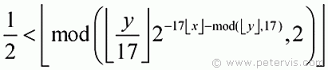 Math is a language. You can learn bit by bit, or you can learn by immersion. I suspect the former is a more successful process. However, this morning my brother tweeted about “fun with math” and linked to a video about the “everything” number. It’s about Tupper’s Self-Referential Formula.
Thus began my introduction to a “simple” formula that can plot itself on a graph. It can also be used to draw any other two-dimensional image.
I mentioned this to Hub, and who looked up the term; this led to a comment, “He’s cheating! He’s using mod and floor.” WTH does that mean?
Now, this is usually where I start feeling dumb and intimidated. But I admitted not knowing, and thus learned that “mod” is short for modular. Basically, it is the remainder in a long division problem. The mod (modular operator) of 5 divided by 2 is 1. Modular arithmetic — who knew?
On to floor and ceiling. Floor refers to mapping a real number to its next lower integer: the floor of 7.1 is 7. The floor of 7.8 is also 7. Ceiling refers to mapping a real number up to its next higher integer: the ceiling of 7.1 is 8. The ceiling of 7.8 is 8. This is different function from rounding. If I round 7.1, the answer is 7; if I round 7.8, the answer is 8. I am told this is used in computer programming and math.
As for the formula, it’s related to computer graphics. Hub went on to tell me about SIGGRAPH, which stands for Special Interest Groups on GRAPHICS and Interactive Techniques. It’s a group of computer professionals who spend their time creating the graphics you see on your computer, phone, tablet, movies, robotics, in emerging technologies, as well as what is used in research. He also suggested I look up the Utah Teapot and Lenna.
Martin Newell, a graphics researcher, created a mathematical model of an ordinary teapot in order to create a 3D computer model. It has since become a standard reference object in the graphics community. Go look at it. I’m amazed.

As for Lenna… it is an image of a woman looking coyly over her shoulder, and it is used as a standard test image for high resolution color image processing experiments. Its detail, shading, texture, and flat regions make it a good subject. As for the source of the image? It’s from a Playboy centerfold. Some controversy is associated with the use of the image because of the underlying sexism. Read more here.
I can’t say I learned actual math this morning, but I did come away with new knowledge. And all before I’d had my morning coffee. (Which I still haven’t had, because I just had to sit down and get this out of my head.)
For the Love of Math
As a child, I loathed math. From the very earliest — first grade — it confounded and intimidated me. I felt stupid. My father, being an elementary teacher, sought to bolster my learning by doing flashcards for addition and subtraction. In order to perform and please him, and my teacher, I memorized the cards. I didn’t really understand 7 + 4 = 11. And so I didn’t understand the process of numbers. In later elementary grades I remember struggling with area and perimeter, multiplication and long division. I felt utterly unintelligent.
In ninth grade, I fought with algebra. It didn’t help that the teacher was an older woman who radiated vulnerability, which meant the students disrespected her and little teaching happened. I began to skip class. I would go to the resource center after school for help. When we got to word problems, I discovered I was able to do them with help from the resource teacher, and I felt a measure of accomplishment.
In tenth grade it was geometry. The teacher was a gruff old man who terrified me. I’d look at the book and none of it made sense. I couldn’t understand, and the fact that I struggled reinforced the feeling of failure. And so, I began skipping that class too. Except the school sent home a letter to my parents. I was required to stay after school to work in a small group with the teacher. And to my surprise, I found him less scary, and I began to understand a bit more. But math remained oblique to me.
I remember cramming for the Geometry Regents exam with my brother-in-law the weekend before the exam. I feared failing it, since that meant I’d have to do summer school, which would mess up the family camping plans. If I failed, I assumed the wrath of my father would obliterate me. I took the exam. I struggled. Afterward I cried, certain that I hadn’t passed. The next day, the teacher proctored the Biology Regents exam. He roamed down the rows of kids, and as he came to me, he leaned over and whispered, “You passed. You got 65%.” Oh, glory! Bless him for sparing me the torment of waiting to find out.
In our state the requirement for math was a minimum of two years. In my senior year I took “practical math,” also considered math for dummies. It was basic arithmetic, percentages, fractions, and so on. I did it to fill out my schedule.
And after that I ran from math as far and fast as I could for many years. In my mid-20s, I returned to college full-time to finish my B.A. in psychology. My first semester included a statistics course that met three times a week at 8 a.m. The teacher gave a weekly “quiz” — 30 multiple choice questions that were actually very challenging. My first one came back with a grade of D.
I panicked. I needed to pass this! So I decided I would get all the help I could. His office hours were from 7-8 a.m. So before the next test, I was in his office with questions. He patiently helped me, and suddenly the heavens opened and the light of understanding beamed upon me — wait, no. Not really. But I understood more, and I got a B on the next test. There were 14 tests in that class. I read the text, calculated the problems, and studied diligently for each test. When I received the grade of B at the end, I was really proud of myself.
The following semester I took a general math class. I learned about the Euler method, and sequencing, and a bunch of other stuff I’ve forgotten now. I worked hard in that class, and I earned an A.
Since then, I haven’t needed much math. And I’m still daunted by it. I can’t do basic calculations in my head; I still use my fingers, or write things down. But as a parent, I have kept my mouth shut about this. I have not talked about my dislike of math, or my struggles with it, because I believe that math can be learned. It takes effort. I know that now, and I proved in the college courses I could do the work.
The other day, Bean said, “I HATE math!!” Oh, dear. In the past we had done Bedtime Math, which she enjoyed and felt confident doing. But we got lazy about it. Upon returning to it, I noticed she was distracted, not really trying to understand the questions. She would then sense my frustration with her (for not trying) and quit, saying, “I’m stupid.”
Bean has a streak of perfectionism in her and a tendency to conclude that if she doesn’t understand something, the problem is inherent to her. She assumes math ability is a fixed quality — she is just not good at math, period. How interesting, because she is actually very bright, and learning has always been fun in our family. According to her teacher, she is performing well in math. I look at her worksheets and see correct answers. So, what is going on?
I made a comment on Facebook, and a friend of mine who is a teacher contacted me privately. She offered me some suggestions worth sharing.
First, she commented that Bean doesn’t see me doing math. I’m her biggest role model. I read avidly, but never do math puzzles, for example. Hmm.
Next, it is not uncommon for girls to absorb attitudes about math from other people — at school, peers have a lot of influence.
Then she told me about some resources:
- I can download Noyce problems of the month from Inside Mathematics and try them myself. Last year, our school offered the Problem of the Month for kids to work on, and Bean enjoyed it. From the website, it says,
“Problems of the Month are non-routine math problems designed to be used schoolwide to promote a problem-solving theme at your school. Each problem is divided into five levels of difficulty, Level A (primary) through Level E (high school), to allow access and scaffolding for students into different aspects of the problem and to stretch students to go deeper into mathematical complexity.”
So, she can do the beginning levels with me, and I can take on the rest. Hey, I might even enjoy them!
- Greg Tang Math: who on earth is Greg Tang? From the Scholastic book website, his biography says,
“Greg Tang was tutoring math in his daughter’s class when he noticed something interesting about the dominoes they were using. Each white dot had a pencil mark on it, which meant the children had been counting them one at a time. Mr. Tang taught them to look for patterns instead, and to add and subtract groups of dots in order to calculate the dominoes’ value quickly. From there, he developed a new method of teaching arithmetic in a visual and spontaneous way. His method teaches both computational and problem-solving skills, and is so fun and challenging that children forget they are learning math! He believes that all kids are capable of doing well in math, and he has a mission to make math a natural part of every child’s life. He has successfully taught his method to children from ages five to ten.”
Greg has a number of cleverly titled math workbooks for kids, such as The Grapes of Math, Math Potatoes, and Math-terpieces. His website offers games and puzzles.
- Jo Boaler, professor of mathematics at Stanford University. A search for her connected me to a free online course: How to Learn Math: for Students. (There is one for teachers and parents as well, to help them provide support, but it costs tuition.) The description says, “If you have had past negative experiences with math this will help change your relationship to one that is positive and powerful.” So I enrolled Bean. She is very excited to be taking a course at Stanford University!
I read a lot of griping about Common Core math on social media and in the news. Yet the way I was taught did not teach me to understand at a deeper level. I memorized functions and did not learn connections. I learned to do without understanding the reasons. When I saw this video, Common Core Math Explained, I could see the appeal. It is my hope that I recover from my past negative encounters with mathematics by re-learning math as Bean learns.
When Bean was five months old, we started going to Music Together classes. Prior to this, I could not carry a tune. I couldn’t start a song on key without music leading me. But we listened — over and over and over, hundreds of times, to the CDs. As a result, I internalized the sounds. I learned audiation, which “takes place when we hear and comprehend music for which the sound is no longer or may never have been present.” Now I can sing pretty confidently. I accomplished growth in the area of music, and I’m looking forward to the same with math.
Good Advice
I saw this clip, and I think it’s so valuable!
Lying and Defiance in Children
The topic of defiance has popped up in my life in several places recently, and so today I share some reflections on it.
When I did my practicum as a therapist in training, I worked at a private mental hospital. In my work with children, they would sometimes describe a home life that sounded unreal, because the details were horrific. Some of these kids, to all appearances, came from “normal” middle-class lives. So I wondered: Could they be telling the truth? Are these kids making up stories? What is real?
I came to a conclusion. The question about truth or lies is a distraction from the underlying need. For some reason, the child is telling this story. It is an expression of need for safety, connection, love. There is a place for determining whether abuse is really occurring, but in a therapy session the goal is to be a loving, open presence with the other soul. To be concerned about whether the child is “pulling one over on me” would not serve.
I also worked with defiant children. Fundamentally, a defiant child is a deeply frightened child. Kids with a tendency to defy authority have strong wills; this quality is neutral. In fact, a strong will can provide energy and discipline to accomplish many goals.
There may be no outwardly apparent reason for a child to be terrified. Some of this is innate to personality. Or, there may be additional exacerbating factors: loss of a parent, abuse, instability at home. The bottom line is the child is afraid and protecting herself or himself by refusing connection.
This type of personality is very challenging to one’s patience. It isn’t easy to reach these souls. It is tempting to call such a child a bad seed, to want to punish and force his will to conform. This won’t work. The only approach is to build trust and connection, which these children are slow to respond to but desperately need.
One resource I found helpful in my work, and even in my personal life, is the book by Dr. Stanley Greenspan: The Challenging Child: Understanding, Raising, and Enjoying the Five “Difficult” Types of Children . His approach of “floor time” with kids — spending 30 minutes a day of time on the floor, playing whatever the child chooses — is an excellent way to build connection. You can also learn more at his website.
Be Mighty, Be Daring
I enjoy creating in so many ways. My friend L (mom of one of Bean’s friends) and I are developing an informal girl group. After spending many years driving to see friends (which we’ll continue doing) we want to create friendships and develop deeper connections in the neighborhood.
After careful consideration, we decided to forgo Girl Scouts for a number of reasons:
- They require parents having contact with girls to take training (online and in-person) and get fingerprinted. Our intention is to create an informal group of people we know and trust and make it easier for mothers to be involved.
- Secondly, GS is divided by age, and we believe there are benefits to girls interacting across multiple age and grade levels. We hope the girls will be involved as they grow up and develop good friendships.
- Lastly, we want to avoid the pressure of selling things to raise funds. We prefer to focus on developing activities and sharing the cost rather than have our activities defined by how much money the girls earn.
We plan to meet monthly. We have ideas of home-based activities to do; we also want to incorporate outings. For outings, each parent pays for her children and herself (if there are fees). To cover supplies for at-home activities, we suggest a nominal annual amount per child. We are researching the supplies and calculating costs.
While we want to have fun, we’re reaching beyond play dates. Our goal is to help our daughters become vibrant, confident, and engaged with the world. We want to nurture the development of their minds, souls, and bodies (and mother earth), and foster qualities such as integrity, curiosity, resiliency, and creativity. We are using several resources for ideas (adjusting for age with some activities):
A Mighty Girl
The Daring Book for Girls & The Double-Daring Book for Girls
What Do You Stand For? A Kids Guide to Building Character
So the girls and moms have a unifying element and develop a sense of belonging, we’re looking for inexpensive yellow t-shirts (a color that is sunny and gender-neutral). The quote we’re using is from Shakespeare: “Though she be but little, she is fierce.” That will be on the front, and on the back will be our group name: Mighty Daring Girls.
Our first meeting is March 2, and we have 8-9 girls interested!

Look Inside
One of my daughter’s favorite performers are Peter, Paul, & Mary, and one of her favorite songs by them is called Inside.
Tonight I was scanning Facebook and came across a link from A Mighty Girl. A Mighty Girl is an excellent resource of zillions of ideas, toys, book titles, articles and more to help girls to grow up confidently. They shared a link from the Huffington Post of a letter from a father to his daughter about society’s hyper-focus on physical appearance.
In the article, Words From a Father to a Daughter (In the Makeup Aisle), Flanagan wrote:
When you have a daughter, you start to realize she’s just as strong as everyone else in the house — a force to be reckoned with, a soul on fire with the same life and gifts and passions as any man. But sitting in this store aisle, you also begin to realize most people won’t see her that way. They’ll see her as a pretty face and a body to enjoy. And they’ll tell her she has to look a certain way to have any worth or influence.
But words do have power and maybe, just maybe, the words of a father can begin to compete with the words of the world. Maybe a father’s words can deliver his daughter through this gauntlet of institutionalized shame and into a deep, unshakeable sense of her own worthiness and beauty.
He concludes by asking, “Where are you the most beautiful? On the inside.” The article is worth reading, bookmarking, printing to share. A Mighty Girl also posted links to resources on their Facebook page; I’m sharing them here:
To help girls understand more about the impact of the media messages they encounter related to beauty and body image, check out “All Made Up: A Girl’s Guide to Seeing Through Celebrity Hype to Celebrate Real Beauty” for ages 10 to 14 and “Body Drama” for ages 15 and up.
For a diverse selection of body image-related books for Mighty Girls of all ages focused on fostering a positive self-image, visit our “Body Image” section.
For books for parents that address body image issues, including the helpful guide “101 Ways to Help Your Daughter Love Her Body,” visit our “Body Image / Self-Esteem” parenting section.
And, to learn about a few of our favorite books that celebrate the special father-daughter bond, visit our post “A Father’s Love: A Mighty Girl Celebrates Fathers”.
And to reinforce the message (and because it’s a fun song), I’m sharing Inside here.
The link to the video is here.
Building With Stories and Tools
Introducing the Cat Walker, designed and created by Bean. It was engineered to exercise a cat while transporting other beings. (In this case, it’s Benjamin Cranklin the Cat hauling two Katinka the Dolphin Ballerinas.) She made this using her GoldieBlox toys.

The field of engineering consists roughly of 13 % women and 87% men. A couple of years ago, Debbie Sterling, an engineer, asked herself the question of why more girls aren’t interested in engineering, and how to get them excited about the skills related to it. I recall her Kickstarter video mentioning that girls love stories. They aren’t drawn just to build something for the sake of building. Girls like characters and plot. So Sterling set out to create a construction toy that would appeal to girls by giving them stories that incorporate spatial skills, teach engineering principles, and boost confidence in problem-solving.
I contributed to the Kickstarter campaign and ordered the first set, GoldieBlox and the Spinning Machine. The focus is on the skill concept of a belt drive. It contains a storybook, 5 animal figurines, 1 pegboard, 5 wheels, 10 axles, 5 blocks, 5 washers, 1 crank, 1 ribbon. Bean loves playing with it. The biggest attraction is the five animals; they excite her imagination, and she incorporates the GoldieBlox pieces in all sorts of ways with her other toys. Other times she plays just with the pieces (as shown above) and creates things on her own.
Sterling’s company has subsequently produced two more toys. One is called GoldieBlox and the Parade Float; its skill concept is wheel and axel. The other — just released — is GoldieBlox and the Dunk tank, with a focus on hinge and lever mechanics.
We’ve also been pleased with Lego Friends. Bean considered Legos a “boy toy” and avoided them. As soon as the Friends line was introduced she became eager to play with them. Again, the appeal is in the story and characters. (And it thrills her father, who loves Lego and really wanted to share it with her.)
I really appreciate Debbie Sterling’s vision and am delighted there are engineering toys with special appeal to girls. And of course, boys are welcome to play with them (and they do)! The company website states that they will be introducing male characters in the future, and that “everyone is encouraged to discover engineering with Goldie and her friends.” These toys are available at Target, Toys R Us, and Amazon.
If the embed doesn’t work, here is the link: The Launch Video.