How to Handle Worksheet Homework

When your child greets you at the end of the school day crying, “I’m stressed! I have yesterday’s worksheet to finish and today’s and the spelling homework! I hate school!” — that is disquieting. After six hours of sitting (with 35 minutes of total recess) and doing what one is told, to end the day with anxiety is a recipe for learning to hate school.

I did not push Bean to do the worksheets, but she decided to complete them. They were easy — tracing and printing the letters C, D, E, and F, on two sides of a paper. Could that time have been better spent? Could she have played, or helped make dinner, or gone for a walk? Yes, but Bean was worried about submitting blank sheets. I asked more about how homework is collected. In past classes, all the folders were put in a bin, and a parent helper or the teacher looked at it. In this year’s class, the folders are kept on the students’ desks. At mid-morning, a student helper collects the pages from each student to bring to the teacher or adult helper to review.

This requires producing papers on the spot, in front of everyone; it will be obvious when a student has nothing to turn in. So, I created a document that we’ll staple to any worksheets, and Bean will have something to submit. (To save paper, there are multiple forms on one sheet.) We’ll circle all the applicable activities for that day.

Worksheet Alternatives

This post is also related to yesterday’s post, To Do Homework, or Not to Do Homework?

To Do Homework, or Not to Do Homework?

It’s the beginning of the school year. Several friends on Facebook posted laments about homework and their children’s resistance. So I thought I’d write my thoughts down. Some of these were extracted from a letter I saw on someone’s blog awhile back. But first, our history of homework:

In TK, the teacher assigned two double-sided pages of worksheets each week: a total of 4 pages weekly. Students took them home Monday and submitted them Friday. I stood over Bean’s shoulder and made her do them. This was a struggle. They also took home picture books to read and were required to do something creative (a drawing, a re-telling) for class. Bean did those willingly. We had to keep a reading log as well, which I managed.

In Kindergarten, the teacher sent worksheets home daily, two double-sided pages, Monday through Thursday: a total of 16 pages weekly. The teacher never looked at it, because I and other parents did homework check-in and corrected it. Bean resisted doing homework, and I began to question its necessity. By December, I decided I was sick of the fight and of being the bad guy, so I stopped pushing her to do it. Her learning didn’t suffer. The teacher chided her for not doing it, but I no longer felt a responsibility to enforce it. There was also a book project similar to the one in TK, which she enjoyed, and a reading log, which I filled out.

In 1st grade, on Tuesdays her teacher sent home a packet of 12-13 double-sided pages, which were due the following Monday: 24-26 pages a week. I told the teacher my position on homework — it’s unnecessary and busy work. She accepted that. However, I wanted to be a good class parent, so I started the year by pushing Bean to do it, and if I sat with her and scribed, she would. But there were still fights. About a month in we stopped doing it. Twenty minutes of reading daily was expected (but not a reading log), and Bean did this, as well as an online reading program called Raz Kids. With Raz Kids, her reading took off. She loved earning points to decorate her Raz Rocket, and that love flowed over into regular books.

This year in 2nd grade, Mrs. L sends home one double-sided page Monday through Thursday: so far, 8 pages a week. If there is class work that is not completed in the alotted time, that is sent home as well. Bean has done them willingly, without prompting or help. They are “busy work” sheets — tracing and printing letters, simple math, connect the dots. Teacher also sends a spelling word list with a menu of activities to do with the words to help them learn. I like the menu: there are options to write stories using the words, spell them with scrabble tiles, cut out letters and tape them, write the words with your finger in rice, etc. We’ll see how the homework progresses through the year. There will be a reading log, which I have decided to let Bean manage as well. If Bean begins to get frustrated and not want to do the worksheets, I’m inclined to let it go, unless she is struggling with the material.

I’ve become aware of something: parents have power and choice. Just because the teacher sends homework home (in the form of worksheets), doesn’t mean we have to force it. No one will give us a failing grade as parents; it won’t go down on our permanent records. And our children won’t fail, either. As long as they are making progress with what’s being taught in the classroom, there is no need to add to the school day with more worksheets. Enough is enough.

And here is the body of the letter I have at the ready, just in case. Feel free to adapt and use this.

Dear Teacher,

My daughter is excited to be in your class. She loves learning and looks forward to what the year holds. Each school year brings new routines, and I’d like to address homework. I’m reluctant about its use in elementary school for a number of reasons.

  • From the reading I’ve done, for young children (under around age 14-15 years) there is no scientific research that supports the inclusion of homework in their extra-curricular activities. Indeed, “there is no evidence that any amount of homework improves the academic performance of [primary school] elementary students” (Cooper, 1989, p. 101). Cooper (one of the most respected homework researchers in the world) indicated that while he was personally pro-homework, there appears to be no academic advantage for children to do homework. In many studies the relationship between homework and “learning” (often defined as grades or standardized test scores) is negative.
  • My child is involved in a number of after school activities — chorus, art, and swimming — that enrich her life, teach skills, and generally make for full days. I would prefer she do these activities after a six hours of didactic learning and not stress over additional homework. We also believe that playtime and outdoor time is a form of learning and very necessary.
  • We have found that homework in the form of daily or weekly worksheets is a source of stress and strife in our home. Since she does worksheets at school, as long she is making progress, we haven’t pushed this. I have not seen evidence to support the belief that homework helps students develop the characteristics it is often suggested will be useful, such as ability to organize time, develop good work habits, think independently, and so on.
  • There are two types of homework we do encourage and require. First is daily reading. We read daily as parents to Bean, and Bean reads on her own. We don’t require a minimum time limit on the reading or dictate the number of pages to be read. This removal of autonomy turns reading into a chore rather than a pleasure. Nor do we push for her to record pages read or summaries of what she read. Reading is for leisure and enrichment.
  • The other form of “acceptable” homework is related to projects from school that interest Bean. We actively encourage research, projects, writing (stories, poems, essays, and speeches). This helps children in information gathering, critical thinking, logical formatting of content, and presentation skills. Plus it gets them actively “discovering” in their learning, and sinks much deeper than much other “busy” work.

We hope you understand that our position on homework is meant to encourage our daughter’s love of learning. Let us know how we can support this process at home.

Sincerely,

For a suggestion on how to handle worksheet homework, read this post as well.
============================

From this:

reading brown bear brown bear

To this!

more reading

Phoning It In

I’ve been doing the bare minimum for the household recently. And I feel like I’ve checked-out in the mothering department a bit too. Escaping into good novels and such. It’s the doldrums of summer. I spent today going through my cookbook, sorting herbs and spices, and taking inventory of the pantry. This way I can get my mojo back when school starts next week.

“Planning complex, beautiful meals and investing one’s heart and time in their preparation is the opposite of self-indulgence. Kitchen-based family gatherings are process-oriented, cooperative, and in the best of worlds, nourishing and soulful. A lot of calories get used up before anyone sits down to consume. But more importantly, a lot of talk happens first, news exchanged, secrets revealed across generations, paths cleared with a touch on the arm. I have given and received some of my life’s most important hugs with those big oven-mitt potholders on both hands.”

— Barbara Kingsolver, Animal, Vegetable, Miracle: A Year of Food Life

broccoli quiche

Our First Wildlife Rescue

Late Sunday morning, I was wiping the kitchen counter and thinking about what I would do with Bean that day. We were getting a late start and had not gone to church. In my left eye’s peripheral vision I noticed motion. I looked over, and there sat a little Western Screech Owl on a table next to Bean’s play house. Our neighbors have a huge evergreen tree, and at night I’ve heard owl hoots on occasion.

DSC02671

I gasped a little. He was tiny! And gorgeous. I grabbed my camera and carefully moved to the screen door. I took photos through the screen. He lifted his wings and flapped once, going nowhere. I crept closer and slid the screen door open. He didn’t move. I snapped more photos. I took a step closer. He just… sat. I said hello. One wing hung a little askew. I thought: He’s injured or sick.

DSC02675

Then Bean came out, and I said, “Be very quiet, and look! Watch the owl while I get the pet carrier.” I hurried to the garage to fetch it, and when I returned, he was still there. Bean talked softly to him, telling him how beautiful he was. I grabbed leather gloves from my garden chest and put them on. Then I moved slowly to him, expecting him to fly, or try to get away, or fight. He didn’t move a feather.

DSC02683

So I gently lifted and put him into the cat carrier. While I called the Wildlife Center of Silicon Valley to learn their hours, Bean crooned to and told him stories. She named him Tecolote. We arrived at the center and they took him in, saying we could call the next day to learn what happened. Bean was very proud to help rescue the owl.

DSC02680

I called this morning. He has no injuries or illness. He’s just young! Barely past fledgling stage at 146 grams. He’s gripping with his feet, has good tail control, is eating, is pecking at handlers (good defenses). They’ll keep him awhile longer to ensure he has the skills to survive and release him!

DSC02691

The Risk of Assumption

Last year in first grade, Bean adored her teacher. Her teacher was wonderful, warm, funny, and had high expectations. She loves kids.

At the end of the year, though, Bean began saying that her teacher hated her. This total 180 in her perception startled me. She also said she didn’t love her teacher anymore. Bean even told strangers — while being sworn in as a Junior Ranger, for example, when the ranger asked her if she liked school — “Yeah, but my teacher hated me.”

I met with her former teacher today for coffee, because we also became friends over the past year. This teacher was assigned to teach second grade next year, so there was a possibility that Bean would have her again. I told Mrs. G about Bean’s story, and she was surprised, puzzled, and concerned. Now, my girl can hold a super glue grip on a grudge, and I was puzzled too but had made a shoulder-shrug peace with it.

This afternoon I told Bean, “Hey, I saw Mrs. G today for coffee!”

Bean: “Why?”

Me: “Because we’re friends. I mentioned to her that you think she hates you. She was sad about that, and surprised. She said, ‘I love Bean!’ What could have I done?'”

Bean: “Well… I’ll tell you what happened. [pause] I told Mrs. G, ‘Next year I really hope I get a different teacher.’ And she said in a stern voice — but maybe it was just her accent — ‘Well, then I’ll make sure you’re not in my class next year.’ And so I thought she hated me.”

Ohhhhhhh! Wow! So I had the opportunity to clarify, and say that Mrs. G was actually giving Bean what she wanted. Bean said yes, she understood, but it was the stern voice. And I pointed out that sometimes people have a serious tone of voice but that it doesn’t mean they are mad. Bean is very sensitive to sternness — it makes her anxious and then she becomes defensive, or even goes on the offense, to protect her feelings. (Her assumption is similar to the phenomenon of bitchy resting face. Sometimes women are assumed to be angry, unfriendly, or bitchy because they aren’t smiling and sparkling. Here is something women with BRF would like you to know.)

After this, Bean said, “Tell Mrs. G I must have misunderstood. And that I think she understands that sometimes you have to move on.” I asked if she thought Mrs. G still hates her. “No,” she replied, “I think she feels loving to me. When can we have a play date with her daughter?”

Bean presentation

The Face of a Miserable Student

Contented Dazzlement

I sit on the chair with the cat, Smokey, a soft gray comma curved against my leg. I notice cool air skimming my bare toes. I feel sleepy, hypnotized by the steady march of the wall clock’s second hand. What should I write? What does the world want to hear?

I could be, should be, doing chores: vacuuming, laundry, culling unnecessary plastic objects from the closets.

To an observer, I’m doing nothing. Yet I feel so full, like the Mississippi river, fluctuating underneath with powerful currents of possibility.

In the past few months I’ve been following the still, small voice within. It’s as though I am knitting a complex lace shawl with many colors. I knit the pattern for a few repeats, and then I pause until the next part of the pattern becomes clear and knit that. When I look back, I see the design more clearly. The question is which color thread to pick up next, and how to weave it into my life.

“Statistically, the probability of any one of us being here is so small that you’d think the mere fact of existing would keep us all in a contented dazzlement of surprise.”

–Lewis Thomas

sillouehette

Car Talk – But Not the NPR Show

The other day Bean and I were headed to Popeye’s for supper. The car started, but it wouldn’t shift into gear. Hub was able to override a safety mechanism to force it into gear and drove it to our local Honda dealer. They thought it was a switch failure, and since the car is warrantied, they replaced it. Car didn’t work. So they replaced another part. Car still didn’t work.

This morning, we found out what’s wrong. Somewhere in Wyoming, a little critter like the one below managed to crawl under and into our car, probably to sleep in a warm spot. And then it proceeded to chew all the insulation off the wiring on the transmission harness. This is causing systems to short out all over the car. We are lucky this didn’t happen until after we got home.

Because a problem like this is fairly rare, the dealer has to order the part. It might take a week to arrive — the day before our next camping trip. Then they have to take the entire transmission out to replace the harness, and there is no estimate as to time yet. However, we did get an estimate for the repair: roughly $2,100. Ouch!! Thank goodness for car insurance.

Between the trailer part falling over on the way to Wyoming — which Hub rigged a fix for since he’s that kind of guy — and this, I chuckle. So much for camping as a budget friendly vacation! Oh, but it was worth it.

golden mantle squirrel

Ubiquity

“One of the strangest things about life is that it will chug on, blind and oblivious, even as your private world – your little carved-out sphere – is twisting and morphing, even breaking apart. One day you have parents; the next day you’re an orphan. One day you have a place and a path. The next day you’re lost in the wilderness.

And still the sun rises and clouds mass and drift and people shop for groceries and toilets flush and blinds go up and down. That’s when you realize that most of it – life, the relentless mechanism of existing – isn’t about you. It doesn’t include you at all. It will thrust onward even after you’ve jumped the edge.”

-Lauren Oliver

The other day as I trimmed a twisting vine that had wrapped around my young maple tree, I marveled at the persistence of life. How did the vine know, or perceive, the tree branches in order to wrap around them? Some vines entwined in the fence lattice. A few tendrils hung loose, waving in the air, uncommitted. They had not found their destination yet.

I relentlessly pulled all the tendrils to free the tree. I did this knowing that at some point I’ll do it again. Life creates itself and follows its own expression. In the form of plants, it expresses the vine and tree. In the form of my own body and soul, it expresses in writing, art, relationships, interaction, all filtered through the consciousness that’s been shaped by this body and its experiences.

When I die, and the consciousness that is specific to this body and its life leaves, where does it go? I don’t know. But I find comfort in the fact that life itself continues, and I tell myself a story that this “me” will join a bigger consciousness capable of witnessing dimensions I cannot conceive. Or maybe there is nothing. What a mystery!

Enlightenment Through a Cat

God has come into my life. Now, don’t click away. Don’t let that word shut you down. I might not mean what you think I mean. It’s not a word I’ve used in my life for years. Stay with me while I meander through my story.

1797566_4931336779397_929380257796196028_n

This is Smokey. He’s been around a long time. He was in the neighborhood when we moved into the house five years ago. He belongs to no one and everyone. For years, I would scratch behind his ears and say hello, and then I’d go on with my life. Someone fed him. Someone gave him shelter in bad weather. But he was just around, and I did not seek him, nor did he seek me. (Of course, my Stella cat was still with us until January 2014.)

In January, Smokey began hanging out in our back yard. He would sleep in our garden. He liked to pop bubbles with Bean. He starting sitting on my lap. He allows me to trim his nails. Even though we didn’t feed him, he stuck around. Last month, I began feeding him. I did this after he brought me a live bird he’d caught and delivered to my feet. So now he gets two meals a day.

11024708_4843941554571_6699924667769600965_n
11015481_4843942274589_6696675537004441444_n-1

I made him a little shelter when rainstorms came. But mostly, he likes to sleep on me or the mulch.

He was injured in early April, so I took him to a vet. He didn’t want to go, but once there he chilled in the exam room waiting for the doctor. I’ve never seen a cat so mellow at a vet’s office.

11121769_4963036371867_8193321224057923090_n

My husband is not open to having another pet, so for now, Smokey is not permitted in the house. He strides right in the front door some mornings, though, clearly telling us he wants to be ours. I usher him out.

The other day as I sat on my patio with Smokey on my lap, this thought arose: “Every afternoon, God takes a nap on my lap.”

IMG_20150423_132111
IMG_20150423_132010

Where did that come from? I don’t know, but it felt true and real. Last Saturday morning after I fed him, I reflected on the morning. And one sentence that came was, “I fed God breakfast, and now he has gone to stroll the neighborhood, looking after all the world.”

Oh my goodness. Yes. God sought me out. God has chosen me. God loves me, and I love God. This word — God — is loaded with so much history for me. It evokes vastly different meanings for people, and so I avoid using it. But this is what IS in my life. This cat. His arrival, his presence, is a call to sit and be quiet. An invitation to intimacy. I recognize God in my life. THIS is what it means to have a relationship with God!

IMG_20150429_155619

Extending that metaphor, I experience God everywhere. In every person, animal, plant, and rock. God is everything and everywhere. God is found in acts of care, and God is found in simple being. My goodness! Now I get what namaste means! Yeah, yeah, I’d always known what it meant, but now I experience it in my being.

11156414_4997330029187_605680426074845492_n

I have used many words to suggest what is divine in my life: Presence, the Mystery, Buddhamind, Spirit, Being, Ground of Being, Life, Chi, Love. They allude to what I mean; they can only suggest. Just as the a photo of the moon is not the moon, a word is not the thing it references. Something as multi-faceted as the Universe can be explored through science, math, literature, and art, but it cannot be totally integrated by the human mind. So we need shorthand, a word or a number, like X, to represent the holy mystery of All That Exists and our relationship with it. Lately, that “something” is the word God. So, God it is.

Checking In

When I feel at loose ends, sometimes I pull this series of questions out and check in.

Outside my window the street sounds fade. Cool air settles on the grass and patio, bringing a gentleness with it. Distant yips and howls tell me the coyotes are roaming.

I am thinking about what I just heard on the news about the sardine population collapsing, which has prompted a halt on fishing season for them. Officials say over 90% of seal pups died this year because of starvation; they had no sardines to eat. I eat sardines often and feel both guilt and selfish concern about what this will do to price and availability. This news coincides with my having finished a book — captivating and dire — called The Sixth Extinction, by Elizabeth Kolbert. Human activity has triggered enough environmental change that we may be moving into a new epoch, from Holocene to Anthropocene.

I am thankful for ordinary life. My neighborhood cat-who-is-not-quite-my-cat whom I feed and pet; Bean’s marvelous and spirited self; social media connections; quietude; coffee, and books.

I am wearing black jeans and a black shirt, which is unusual for me, and it feels like too much of one color.

I am creating new connections in my brain now that I’m playing more with numbers. I’m also writing poetry, and making a little art.

I am hearing the hum of silence; my laptop hard drive, the refrigerator, a distant car motor, the high pitch of plugged-in electronics. It has a walled-in aspect to it, and is vastly less restful than the silence of camping outdoors.

I am remembering twenty years ago. My father recently sent me letters I’d written to him in 1995, after I moved to Austin. In these letters I talked about the growth of the Internet, and how that would create major change in the world. I was on a search for a new career, and very torn about my varied interests.

I am going to feel some regret in the morning for staying up this late.

I am reading poetry by Lucille Clifton and Gwendolyn Brooks, and I’m about to dive into a novel, The Diamond Lane.

I am hoping to motivate myself to clear my workspace so I can make some more collages.

On my mind is the fact that I’ve committed to co-leading the Project Cornerstone program at school next year, and I have many ideas as to how to increase community awareness and involvement with it.

Noticing that I’ve been avoiding exercise again, and indulging in more food, and forgoing tracking this.

Pondering these words: growth mindset and fixed mindset, coined by Carol Dweck.

One of my favorite things is snuggling in bed with Bean at the end of the day, singing a lullaby to her.

From the kitchen I’ve been cooking a variety of crockpot meals: chicken tortilla soup, pork roast, red beans, pot roast.

Around the house I’ve been culling items that get little use and trying to stanch the flow of paper that floods us weekly. I’m also still unpacking and sorting from the camping trip.

A few plans for the rest of the week: Friday will be an errand day. Saturday I have a SoulCollage® session from 9:30 a.m. – 1:30 p.m., after which I will take the car to get a smog test. Sunday is church, and then the Mighty Daring Girls will meet to make masks. Then I’ll roll into the next week with training at Project Cornerstone, taking Bean to choir practice, and all the usual routines of the school week.

Here is picture I am sharing of an ATC I recently made.

ATC abstract

Math Before Coffee

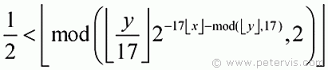
Tupper's Self-Referential FormulaMath is a language. You can learn bit by bit, or you can learn by immersion. I suspect the former is a more successful process. However, this morning my brother tweeted about “fun with math” and linked to a video about the “everything” number. It’s about Tupper’s Self-Referential Formula.

Link here.

Thus began my introduction to a “simple” formula that can plot itself on a graph. It can also be used to draw any other two-dimensional image.

I mentioned this to Hub, and who looked up the term; this led to a comment, “He’s cheating! He’s using mod and floor.” WTH does that mean?

Now, this is usually where I start feeling dumb and intimidated. But I admitted not knowing, and thus learned that “mod” is short for modular. Basically, it is the remainder in a long division problem. The mod (modular operator) of 5 divided by 2 is 1. Modular arithmetic — who knew?

On to floor and ceiling. Floor refers to mapping a real number to its next lower integer: the floor of 7.1 is 7. The floor of 7.8 is also 7. Ceiling refers to mapping a real number up to its next higher integer: the ceiling of 7.1 is 8. The ceiling of 7.8 is 8. This is different function from rounding. If I round 7.1, the answer is 7; if I round 7.8, the answer is 8. I am told this is used in computer programming and math.

As for the formula, it’s related to computer graphics. Hub went on to tell me about SIGGRAPH, which stands for Special Interest Groups on GRAPHICS and Interactive Techniques. It’s a group of computer professionals who spend their time creating the graphics you see on your computer, phone, tablet, movies, robotics, in emerging technologies, as well as what is used in research. He also suggested I look up the Utah Teapot and Lenna.

Martin Newell, a graphics researcher, created a mathematical model of an ordinary teapot in order to create a 3D computer model. It has since become a standard reference object in the graphics community. Go look at it. I’m amazed.

As for Lenna… it is an image of a woman looking coyly over her shoulder, and it is used as a standard test image for high resolution color image processing experiments. Its detail, shading, texture, and flat regions make it a good subject. As for the source of the image? It’s from a Playboy centerfold. Some controversy is associated with the use of the image because of the underlying sexism. Read more here.

I can’t say I learned actual math this morning, but I did come away with new knowledge. And all before I’d had my morning coffee. (Which I still haven’t had, because I just had to sit down and get this out of my head.)

For the Love of Math

As a child, I loathed math. From the very earliest — first grade — it confounded and intimidated me. I felt stupid. My father, being an elementary teacher, sought to bolster my learning by doing flashcards for addition and subtraction. In order to perform and please him, and my teacher, I memorized the cards. I didn’t really understand 7 + 4 = 11. And so I didn’t understand the process of numbers. In later elementary grades I remember struggling with area and perimeter, multiplication and long division. I felt utterly unintelligent.

In ninth grade, I fought with algebra. It didn’t help that the teacher was an older woman who radiated vulnerability, which meant the students disrespected her and little teaching happened. I began to skip class. I would go to the resource center after school for help. When we got to word problems, I discovered I was able to do them with help from the resource teacher, and I felt a measure of accomplishment.

In tenth grade it was geometry. The teacher was a gruff old man who terrified me. I’d look at the book and none of it made sense. I couldn’t understand, and the fact that I struggled reinforced the feeling of failure. And so, I began skipping that class too. Except the school sent home a letter to my parents. I was required to stay after school to work in a small group with the teacher. And to my surprise, I found him less scary, and I began to understand a bit more. But math remained oblique to me.

I remember cramming for the Geometry Regents exam with my brother-in-law the weekend before the exam. I feared failing it, since that meant I’d have to do summer school, which would mess up the family camping plans. If I failed, I assumed the wrath of my father would obliterate me. I took the exam. I struggled. Afterward I cried, certain that I hadn’t passed. The next day, the teacher proctored the Biology Regents exam. He roamed down the rows of kids, and as he came to me, he leaned over and whispered, “You passed. You got 65%.” Oh, glory! Bless him for sparing me the torment of waiting to find out.

In our state the requirement for math was a minimum of two years. In my senior year I took “practical math,” also considered math for dummies. It was basic arithmetic, percentages, fractions, and so on. I did it to fill out my schedule.

And after that I ran from math as far and fast as I could for many years. In my mid-20s, I returned to college full-time to finish my B.A. in psychology. My first semester included a statistics course that met three times a week at 8 a.m. The teacher gave a weekly “quiz” — 30 multiple choice questions that were actually very challenging. My first one came back with a grade of D.

I panicked. I needed to pass this! So I decided I would get all the help I could. His office hours were from 7-8 a.m. So before the next test, I was in his office with questions. He patiently helped me, and suddenly the heavens opened and the light of understanding beamed upon me — wait, no. Not really. But I understood more, and I got a B on the next test. There were 14 tests in that class. I read the text, calculated the problems, and studied diligently for each test. When I received the grade of B at the end, I was really proud of myself.

The following semester I took a general math class. I learned about the Euler method, and sequencing, and a bunch of other stuff I’ve forgotten now. I worked hard in that class, and I earned an A.

Since then, I haven’t needed much math. And I’m still daunted by it. I can’t do basic calculations in my head; I still use my fingers, or write things down. But as a parent, I have kept my mouth shut about this. I have not talked about my dislike of math, or my struggles with it, because I believe that math can be learned. It takes effort. I know that now, and I proved in the college courses I could do the work.

The other day, Bean said, “I HATE math!!” Oh, dear. In the past we had done Bedtime Math, which she enjoyed and felt confident doing. But we got lazy about it. Upon returning to it, I noticed she was distracted, not really trying to understand the questions. She would then sense my frustration with her (for not trying) and quit, saying, “I’m stupid.”

Bean has a streak of perfectionism in her and a tendency to conclude that if she doesn’t understand something, the problem is inherent to her. She assumes math ability is a fixed quality — she is just not good at math, period. How interesting, because she is actually very bright, and learning has always been fun in our family. According to her teacher, she is performing well in math. I look at her worksheets and see correct answers. So, what is going on?

I made a comment on Facebook, and a friend of mine who is a teacher contacted me privately. She offered me some suggestions worth sharing.

First, she commented that Bean doesn’t see me doing math. I’m her biggest role model. I read avidly, but never do math puzzles, for example. Hmm.

Next, it is not uncommon for girls to absorb attitudes about math from other people — at school, peers have a lot of influence.

Then she told me about some resources:

  • I can download Noyce problems of the month from Inside Mathematics and try them myself. Last year, our school offered the Problem of the Month for kids to work on, and Bean enjoyed it. From the website, it says,

    “Problems of the Month are non-routine math problems designed to be used schoolwide to promote a problem-solving theme at your school. Each problem is divided into five levels of difficulty, Level A (primary) through Level E (high school), to allow access and scaffolding for students into different aspects of the problem and to stretch students to go deeper into mathematical complexity.”

    So, she can do the beginning levels with me, and I can take on the rest. Hey, I might even enjoy them!

  • Greg Tang Math: who on earth is Greg Tang? From the Scholastic book website, his biography says,

    “Greg Tang was tutoring math in his daughter’s class when he noticed something interesting about the dominoes they were using. Each white dot had a pencil mark on it, which meant the children had been counting them one at a time. Mr. Tang taught them to look for patterns instead, and to add and subtract groups of dots in order to calculate the dominoes’ value quickly. From there, he developed a new method of teaching arithmetic in a visual and spontaneous way. His method teaches both computational and problem-solving skills, and is so fun and challenging that children forget they are learning math! He believes that all kids are capable of doing well in math, and he has a mission to make math a natural part of every child’s life. He has successfully taught his method to children from ages five to ten.”

    Greg has a number of cleverly titled math workbooks for kids, such as The Grapes of Math, Math Potatoes, and Math-terpieces. His website offers games and puzzles.

  • Jo Boaler, professor of mathematics at Stanford University. A search for her connected me to a free online course: How to Learn Math: for Students. (There is one for teachers and parents as well, to help them provide support, but it costs tuition.) The description says, “If you have had past negative experiences with math this will help change your relationship to one that is positive and powerful.” So I enrolled Bean. She is very excited to be taking a course at Stanford University!

I read a lot of griping about Common Core math on social media and in the news. Yet the way I was taught did not teach me to understand at a deeper level. I memorized functions and did not learn connections. I learned to do without understanding the reasons. When I saw this video, Common Core Math Explained, I could see the appeal. It is my hope that I recover from my past negative encounters with mathematics by re-learning math as Bean learns.

When Bean was five months old, we started going to Music Together classes. Prior to this, I could not carry a tune. I couldn’t start a song on key without music leading me. But we listened — over and over and over, hundreds of times, to the CDs. As a result, I internalized the sounds. I learned audiation, which “takes place when we hear and comprehend music for which the sound is no longer or may never have been present.” Now I can sing pretty confidently. I accomplished growth in the area of music, and I’m looking forward to the same with math.

The Dance

For Swap-bot, I joined a project that required writing a sestina.

According to the Academy of American Poets:

“The sestina follows a strict pattern of the repetition of the initial six end-words of the first stanza through the remaining five six-line stanzas, culminating in a three-line envoi. The lines may be of any length, though in its initial incarnation, the sestina followed a syllabic restriction. The form is as follows, where each numeral indicates the stanza position and the letters represent end-words:

ABCDEF
FAEBDC
CFDABE
ECBFAD
DEACFB
BDFECA
(envoi)(tercet) BE. DC. FA.
The envoi, a tercet, must contain two of the repeated words per line.”

So, here is what created itself within me.

The Dance

There I stood, waiting for the express
While pondering ways to renew
my flagging spirit, which struggled to climb
life’s mounting challenges, when I saw you, serene,
your hands moving in the air, a kind of dance —
the glorious joy on your face making you rich.

Gazing around, I noticed the world’s colors were rich.
In each person I sensed the soul’s desire to express,
to enter into the dance.
I felt that I could summon the energy to renew
and make myself serene
like an arbor trellis with those roses that climb.

To reach far, to stretch toward goals that require I climb —
this makes life worthwhile, and I feel rich.
In these moments, my heart beats serene.
I vibrate with life and tremble to express,
to evolve, to embrace impermanence and thus renew
life’s eternal dance.

So, which steps will we choose to dance?
Will it be the hustle, the two-step, the fandango climb?
Or maybe a slow waltz, to allow our breathing to renew
while rhythmically moving to the beat, slow and rich.
Perhaps we will lean in to share a kiss, to express
what tantalizes us as we attempt to appear serene.

We might do this under the silver light of the moon, serene
in the movement of the dance
and the people watching — their murmurs will express
how desire steeps, distills, intensifies, like the climb
of mercury trapped in a glass tube, the red rich
like blood, like the lungs give oxygen to renew.

And after we untwine ourselves, we turn within to renew
the relationship with the One who never leaves, the serene
companion who understands money does not make one rich;
nor does having it guarantee an invitation to the dance
and that life is often one painful, slogging climb
to an illusory summit that cannot contain all we express.

The koan: how to renew attention, surrender to the dance
or rest serene, no longer compelled to grasp or climb,
sitting in life’s rich mystery, waiting on emptiness to express.

–Kathryn Harper

dancers

How to Fall in Love

I know the eyes are the windows to the soul or whatever, but the real crux of the moment was not just that I was really seeing someone, but that I was seeing someone really seeing me. Once I embraced the terror of this realization and gave it time to subside, I arrived somewhere unexpected.

I felt brave, and in a state of wonder. Part of that wonder was at my own vulnerability and part was the weird kind of wonder you get from saying a word over and over until it loses its meaning and becomes what it actually is: an assemblage of sounds.

So it was with the eye, which is not a window to anything but a rather clump of very useful cells. The sentiment associated with the eye fell away and I was struck by its astounding biological reality: the spherical nature of the eyeball, the visible musculature of the iris and the smooth wet glass of the cornea. It was strange and exquisite.

Mandy Len Catron

Easier Said Than Done

“We say to the confused, Know thyself, as if knowing yourself was not the fifth and most difficult of human arithmetical operations, we say to the apathetic, Where there’s a will, there’s a way, as if the brute realities of the world did not amuse themselves each day by turning that phrase on its head, we say to the indecisive, Begin at the beginning, as if the beginning were the clearly visible point of a loosely wound thread and all we had to do was to keep pulling until we reached the other end, and as if, between the former and the latter, we had held in our hands a smooth, continuous thread with no knots to untie, no snarls to untangle, a complete impossibility in the life of a skein, or indeed, if we may be permitted one more stock phrase, in the skein of life.”

– José Saramago