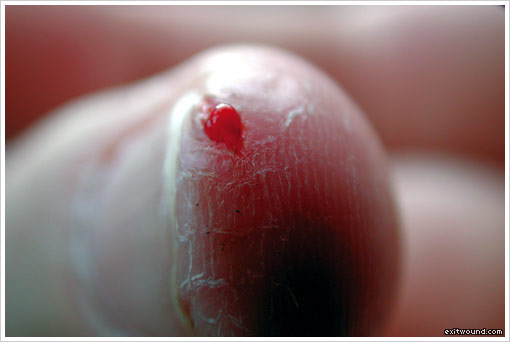
One scarlet pearl forms
like a secret emerging
from a holy place.
–Kathryn Harper
One scarlet pearl forms
like a secret emerging
from a holy place.
–Kathryn Harper
A white rabbit is pulled out of a top hat. Because it is an extremely large rabbit, the trick takes many billions of years. All mortals are born at the very tip of the rabbit’s fine hairs, where they are in a position to wonder at the impossibility of the trick. But as they grow older they work themselves ever deeper into the fur. And there they stay. They become so comfortable they never risk crawling back up the fragile hairs again. Only philosophers embark on this perilous expedition to the outermost reaches of language and existence. Some of them fall off, but others cling on desperately and yell at the people nestling deep in the snug softness, stuffing themselves with delicious food and drink.
“Ladies and gentlemen,” they yell, “we are floating in space!” But none of the people down there care.
“What a bunch of troublemakers!” they say. And they keep on chatting: Would you pass the butter, please? How much have our stocks risen today? What is the price of tomatoes?
-Jostein Gaarder, Sophie’s World: A Novel About the History of Philosophy
Blessing the boats
(at St. Mary’s)
may the tide
that is entering even now
the lip of our understanding
carry you out
beyond the face of fear
may you kiss
the wind then turn from it
certain that it will
love your back may you
open your eyes to water
water waving forever
and may you in your innocence
sail through this to that
I have posted this quote before, but it’s useful to have a reminder:
On Writing Poetry
Considering the ways in which so many of us waste our time, what would be wrong with a world in which everybody were writing poems? After all, there’s a significant service to humanity in spending time doing no harm. While you’re writing your poem, there’s one less scoundrel in the world. And I’d like a world, wouldn’t you, in which people actually took time to think about what they were saying? It would be, I’m certain, a more peaceful, more reasonable place. I don’t think there could ever be too many poets. By writing poetry, even those poems that fail and fail miserably, we honor and affirm life. We say “We loved the earth but could not stay.”
–Ted Kooser
I’m sharing this after reading Maezen’s post of today.
For much of my life I’ve wandered on a spiritual journey without knowing quite where to go. One of the paths I began to explore in the late 1990s was meditation. I took a Vipassana meditation class, read books, and occasionally pretended to be serious about it. In 2003 I began this blog in part because of this interest (and in part because I had a therapy practice), although in my “About This Blog” section I made it clear I was not a Buddhist, lest readers feel mislead or take issue with my less-than-Buddhist perspectives. Having plummeted down the path of conservative Christian fundamentalism twice in my life — and driven loved ones away in the process — I’ve been reluctant and cautious about further pursuits.
In 2006, out of nowhere (and everywhere) a woman contacted me after reading my blog. She had read about my attempts to get pregnant, the miscarriages, the misgivings. She had recently published a book and asked if I would be interested in a complimentary copy. I said yes, although I couldn’t bring myself to read it for quite awhile. Once I was pregnant with Bean, I did read it, devoured it with gratitude and gusto, and I repeatedly returned to that book for comfort and wisdom.
That woman’s name is Karen Maezen Miller. She is a Zen Buddhist priest, a wife, and a mother. I credit her with helping me remain sane and growing into motherhood. After Bean was born and began to exhibit colic, I was panicked and beside myself with agony. Bean wasn’t sleeping. Hub was doing his best but he wasn’t sleeping either. I was terrified I’d do something wrong. Many emails sailed between us — me writing laments, she responding with love. And even though we’d never met, Maezen offered a gift: to come up one weekend and help out with Bean so Hub and I could rest. We talked on the phone to discuss it, and it turned out that this was enough at the time; just knowing the offer was sincere and standing and hearing her voice in the wilderness helped.
I’d seen Maezen subsequently three times; in 2008 she and her daughter visited me and Bean briefly just before Bean’s first birthday; in 2009 at the Mother’s Symposium and 2010 at a one-day retreat. I read her second book. I pondered her thoughts about the importance of having a teacher. And finally, last weekend, I had my first weekend ever away from home and Bean. I drove to Sierra Madre to spend the weekend with Maezen and her family; I also attended a beginner’s meditation class and a dharma talk at Hazy Moon Zen Center. And there it dawned on me that I already have a teacher — Maezen! — and that without realizing it I’d become a student.
It is time to commit. It is time to practice. So I’d like to introduce my new best friend, the “cushion of kindness,” as Maezen calls it. The technical name is zafu. And when I sit on my zafu, this is called zazen. This is where the revolution takes place. Facing a blank wall, alone, silent, counting my breaths, and being awake.

I am not yet in a position of making a formal commitment. That will come when it comes. It is not lost on me that one of my favorite quotes, which I encountered in 1998, is by Hui-Neng, a Zen monastic from the 7th/8th century. “The secret is within your self.” It’s been there all along, waiting for me to look, and see.
The other watershed quote that inspired me to move from Syracuse to Austin in the early 90s was by Sir Edmund Hilary, organizer of a Mount Everest Expedition, and it too rings familiarly as I observe what is changing. The snippet that motivated me I have italicized, but the entire quote is priceless.
“Until one is committed there is hesitancy, the chance to draw back, always ineffectiveness. Concerning all acts of initiative (and creation), there is one elementary truth, the ignorance of which kills countless ideas and splendid plans: that the moment one definitely commits oneself, then Providence moves too. All sorts of things occur to help one that would never otherwise have occurred. A whole stream of events issues from the decision, raising in one’s favour all manner of unforeseen incidents and meetings and material assistance, which no man could have dreamt would have come his/her way. I learned a deep respect for one of Goethe’s couplets: What ever you can do, or dream you can; begin it. Boldness has genius, power and magic in it.”
My next trip to Sierra Madre will probably be later in the summer or fall, when they offer a three-day retreat at the center. So, hello world! My name is Kathryn and I am, at last, “abuddha” (awake).
Time is very precious. Do not wait until you are dying to understand your spiritual nature. If you do it now, you will discover resources of kindness and compassion you didn’t know you had. It is from this mind of intrinsic wisdom and compassion that you can truly benefit others….Moment by moment, we should look at life as if it were a dream unfolding….In this relaxed, more open state of being, we have the opportunity to gain the infallible means of dying well, which is recognition of our absolute nature.
–Chagdud Tulku Rinpoche
Today Bean asked, “What is a symbol?”
I tried to answer. A symbol is a small picture that represents a thing that has a certain meaning. The letter T for the “t” sound, for example. Words are symbols. A red light is a symbol, telling people to make their car stop at it, while a yellow light means to slow down and a green one to go. A logo — like the eagle on the side of the mail truck — is a symbol for the company that is called the U.S. Postal Service. A picture of a heart means love. Candy canes are symbols for Christmas.
Then she asked, “What is the symbol for the universe?”
Wow! I told her there are many symbols — religious ones, scientific ones, artistic ones — but that the universe was sooooooo big that no one symbol can completely show what the universe is or means.
That seemed to satisfy her for that moment. More stuff for that growing brain to think about!

Husband and I are best described as agnostic. I grew up Catholic but am no longer practicing, and I do not agree with/believe/follow the creed. However, we are trying to ensure Bean grows up with an awareness of what this season is about beyond Santa (though Santa is special too, and about love). We read her books, such as Room for a Little One and This is the Stable. They are sweet books conveying the story of a special baby’s birth in humble circumstances. We also listen to a lot of carols, traditional and modern.
So we were listening to a song by Sean Colvin about Mary’s journey to Bethlehem. These days, Bean wants to know what every song is about. She asked about the song. I said it’s about a girl named Mary who journeyed a long way and had a baby in a Bethlehem stable and named him Jesus. Then she asked, “Who’s Jesus?”
Ummm… I said, “Jesus was a person who grew up to teach people to love each other, to be kind and compassionate and to forgive each other.”
That’s sufficient for a three-year-old, right? Then she asked, “What is Jesus’ Daddy’s name?”
Gulp! “Many people think a being named God is Jesus’ Daddy. But Joseph the carpenter was Mary’s husband and raised Jesus as his own son.” I’m the embodiment of finesse, I tell you!
Curiosity sufficiently sated for the moment, she moved on to another topic. She keeps me on my toes!
To continue with my exploration (see this and this), I’m posting some thoughts from Singh’s book. I’m not certain I have the energy to do more than quote her, as I’m emotionally buffeted by some personal family issues lately (on both sides of our family).
So, we are born and we grow. We encounter “splits” in our being as we develop and the ego grows. Who we are narrows into mostly mind. We focus on developing language, rationality, competency within our world. Language is so powerful, so immersive, that we tend to forget we are in it. We mistake it, and thought, for reality. Our culture, the biosocial band, is a filter of myths, stories, and worldview that we are born into. We have not only a self, but a self-image. The ego is “an identity that conceives of itself as a separate and inner entity, existing inside the body somewhere in the region of the head, and assumes it is commanding the body from on high.” Singh continues:
We all believe and act as if our identity were something with substance, with reality, and with enduring characteristics. In point of fact, however, our identity is nothing more than who we think we are at any moment in time, a compendium of inner desires, aversions, memories, and tightly interwoven beliefs. Identity is something that exists only in being conceived.
We talk to ourselves incessantly to establish a sense of our existence. We narrate our lives, issue judgments, articulate opinions, engage fantasies, and chatter to ourselves constantly in our heads. We believe our identity is our name, occupation, relationships, diplomas, biography, etc. We are capable of introspection and self-reflection.
When the adolescent ego begins to look at itself, it encounters an existential abyss of fundamental dimension. When it begins to look inside, it knows that it is, but hard as it tries, it can never quite grasp what exactly it is. In some vague and slightly nauseating, slightly terrifying way, the mental ego senses its incompleteness, the flimsiness of illusion upon which it is constructed. The abyss is quickly side-stepped.
And where do we go as we dodge away? We embark upon the identity project.
The identity project, which arises at first out of defensiveness against terror, becomes a lifelong endeavor. We choose a persona (or several over time) and focus on becoming that. It might arise from our profession or relationships. For example, I was a a perpetual student and later a therapist. I was a single woman and am now a wife and mother. We work to solidify and secure these concepts of ourselves. And you know what? We achieve great things in this.
The level of ego is an elevated and encompassing level of consciousness — quite an achievement for our evolving and beloved species. Certainly, hosannas can be shouted for what we have achieved in our identity projects wiht the use of our faculties and talents. We have become capable, technological selves, acting upon the world in ways that further our own evolution. We have quintessentially lifted ourselves by our bootstraps.
And yet, we also create our own dramas, our own suffering. We are embroiled in the soap opera, forgetting that we are not the show. We are more than that, but we have forgotten.
Most of us plateau here, until we are informed that we are terminal and have a short time to live. Then we face the fact that we (as defined by our ego) are not in control. Nor are we complete or whole. While this terrifies us, it is actually good news. We’ll get to go home. And for some of us, we find a way to go home before we leave our bodies, through a dedication to meditation over many many years.
This is an extremely simplified synopsis of the journey into ego in Singh’s book. As I read it, I had an understanding that exploded between my eyes (in my third eye?). I get what Jesus meant. He was trying to enlighten people, to help them understand that this is not all that is, but that as long as we cling to our “treasures on earth,” we’ll not see this. His death was a way of showing what the ego must endure — its annihilation — which is required before we can transcend to unity with the Ground of Being. And I knew this, growing up I understood this, but it was laden with fear and ideas of hell and punishment and worthlessness. Later on it was tarnished by the stupidity of the simplistic “born again” prayers/positions espoused by the churches I was in. It was like buying eternal life insurance. Say these words and all is forgiven, but the focus on “being saved” from my sins and from damnation was misleading and eventually rang hollow for me.
The mental ego must die before true life, whole life, heaven, nirvana is found. And everybody will enter whole life, find unity, because every body dies. Buddha said it. Jesus said it. Many prior and subsequent mystics and philosophers have said it. The message is we each will get there, and we don’t have to wait until we are dying to do so (or to try). We can arrive at enlightenment; we can be born again. What does that really mean? What is that really like? What is transpersonal consciousness? What is connection with the Ground of Being/God/Unity? The ego, the identity we cling to, is deeply established. It must actually confront its fear of death (which pretty much qualifies as hell for me) as we travel the path of return. We will only know as we go.
I don’t even know if I should be writing all this here. It’s not polished. I’m tired and have little time for finesse. But that’s what I’ve got, folks.
If you were raised in the Christian tradition, read this prayer below and see if it rings true for you, and if it seems familiar.
Radiant One, You shine within us, outside us —
even darkness shines when we remember.Focus your light within us — make it useful!
Create your reign of unity now!
Create in me a divine cooperation: from
many selves, one voice, one action.Help us fulfill what lies within the circle
of our lives; each day we ask no more, no less.Loose the cords of mistakes binding us as we
release the strands we hold of others’ guilt.Don’t let us enter forgetfulness,
the temptation of false appearances.Truly — power to these statements —
may they be the ground from which
all my actions grow.
The above is a translation of the Lord’s Prayer from the original Aramaic. I find it liberating, and fascinating to see a greater truth in this version than in the stilted (though much simpler to memorize) version I grew up with. This was synthesized from a book of various interpretations entitled Prayers of the Cosmos: Reflections on the Original Meaning of Jesus’s Words, by Neil Douglas-Klotz. For a line-by-line comparison, see below. Continue reading
This is a rough and unrefined condensation of some of what I’m reading. I don’t claim to have answers but I will write without tenuousness. I’m not entirely sure of all the concepts and am not seeking debate. I’m just looking to sort it out for myself here.
———
I am going to die someday. Sooner or later, fast or slow, it will happen. I was raised in a religion that depicted heaven, purgatory, and hell, and I felt fear. I left that religion and in my early 30s was bound up in it again, until the absolutism of the dogma and some epiphanies in graduate school prompted me to part ways entirely. I’ve been inarticulate about dying and what happens since then.
I used to wonder what I was before I was born. An atheist will simply say that we just did not exist, and after we die, we just won’t exist. Aside from the terror my ego feels (how can I not exist? what happens to me?), I know there is something else beyond this life. But before I can get to that understanding for myself, I need to understand how I came to be where, what, and who I am now.
We start out within the Ground of Being. We are part of it. The Ground of Being is life, and it is non-life. It is consciousness and not-consciousness. It is energy, it is matter. As Douglas Adams titled his book, it is Life, the Universe, and Everything. Before we are born we are part of it. This is a pre-ego state, a state of preconsciousness, a state of undifferentiation and no individuation. We are raw material.
So how to we get to where we are, with identities and attachments and all that this life entails?
In Singh’s book, she writes:
As we emerge out of the Ground of Being and into the physical world as a separate life-in-form, “trailing clouds of glory,” we are in a preegoic, prepersonal state. At birth we are only minimally differentiated from the Ground of Being. Inner and outer realities remain somewhat fused initially, and all awareness lies inarticulate, still partially embedded in the Ground of Being.
We start out this way, and at first we are all body: hunger, fatigue, touch, instinct. If you’ve ever been with an infant you know this. Then the remarkable changes happen as the infant’s brain grows, as concept and words develop. We develop a sense of self: me, mine, and of other, not-me. Babies start out unaware of separation and then become a aware. The First Dualism emerges on the journey to the ego.
We develop a sense of space and what is and is not ours. We realize where we end and another begins, the gap between subject and object. Then the Second Dualism develops: the sense of time, an awareness of past, present, and future, life and death.
The First Dualism, the first boundary, separates us from the experience of wholeness. Anxiety appears, as does repression and defensiveness.
Primal repression is a psychological as well as physical posture that, inwardly, begins to seal off or repress pure, inpouring Energy, the animating power of the Ground of Being. The Ground of Being, with its enchantment and ability to engulf, begins to be perceived as threatening.
Thus in our early childhood we close off our connection to the Source from which we came. We continue to split ourselves in early to middle childhood by forging a distinction between mind and body, the Third Dualism. “We lose our deep integrity, the unity of body and mind, which is the unity of feeling and attention — the ability to be present.” Our mind is given more authority as a judge or filter of reality. And then the Fourth Dualism arises: The split between persona and shadow, that is, between the person we believe we are, that we accept, that we show the world, and all the other parts of us that we disown, dislike, judge, fear, and hide from ourselves and others.
And this, according to the Christian theology I grew up with, completes our ejection from the Garden of Eden. We are part of the garden (Ground of Being), we are born, then we taste knowledge (the Dualisms, development of ego), which separates us from unity with the Ground of Being. I just don’t buy the crap about Eve (woman) being the one who fell to the temptation first (does it really matter?), and I don’t think of the “fall” as really All That Bad. It is just what is, and it is part of our evolution, our journey, through the experience we are having in this form and function, in this physical world.
And now my child is calling from her nap, and I must dash.
Back in 2004, when my father-in-law was gravely ill, I happened across a book that I was compelled to buy: The Grace in Dying: How We Are Transformed Spiritually as We Die, by Kathleen D. Singh. I began to read it, and in the introduction the author suggested that if the reader was in the process of dying or reading this because a loved one is dying, to do the following: know that you are safe, all is well, and put the book down.
I took her advice. Four months later my father-in-law died, and I was with him for his last week nearly 24/7. It was a daunting, draining experience. I watched him take his last breath. In the process of his dying, it occurred to me that it seemed much like a labor. And having had a child since, I know it is indeed labor. But what, I wonder, is in the process of happening? Is dying just dying? The lights simply go out? What happens to the entity called “me, myself, or I”; is it really annihilated?
Or is it a transition, a birthing into something else?
I was raised religiously and have traversed a varied spiritual path. In recent years I’ve applied the term “atheist” to myself, though “agnostic” is probably more accurate. I do not need “god” as humans are able to articulate the term; I believe the universe is marvelous, and science is a way to explore it all, and isn’t that miracle enough? I am drawn to Buddhism, particularly Zen Buddhism, although I have not become a practitioner yet.
However, I did have a remarkable experience back in 1996 that at the time, I believed (as much as I could believe, which was really a process of trying to convince myself to believe) was the Holy Spirit. When I left the Christian religion (for the second time in my life), I categorized the experience as an anomaly, as an experience of self-hypnosis or psychological wish fulfillment.
I was a member of a conservative, bible-based, fundamental Christian church. The story behind the path that led me to that after years of atheism can be read here. Anyhow, one Saturday evening I remained after service. It was common for members to remain and pray with each other. This was a church where people sometimes experienced the “baptism of the Holy Spirit,” evidenced sometimes by people speaking in tongues (seeming to babble) and being filled with the Spirit, evidenced by joyous, continuous laughter. Not hysterics, not banshee laughing, just a robust laugh as one would do watching a funny show.
One evening a woman sat on the floor experiencing this laughter. I observed awhile, curious. Another woman came over and asked, “Would you like to join and be filled with the Holy Spirit?” I answered yes, but expressed a worry that it wouldn’t “take.” She said, “Just trust. Let thoughts and worries go and just be with whatever is.”
I sat next to the spirit-filled woman, put my hand on her arm, closed my eyes, and waited. To my wonder, I felt a tingling warmth from her enter my hand and flow up my right arm into my body. Whatever words I summon to describe the experience won’t do it justice, but here goes: As I was filled with this feeling, I felt light, both weightless and incandescent. I began to feel a laugh bubbling up in me. I allowed it to come forth. I sat for however long, bathed in this energy, laughing gently, feeling joy. At the same time, I also felt a part of me was still there, observing. I was not generating or creating this. Nothing was forced by me. At the same time, I did not feel “possessed” or taken over; I still felt I had agency. It was an experience unlike anything I’ve known before or since.
At some point I felt satiated, full, and decided I was done. I removed my hand from the woman’s arm and opened my eyes. I felt new. I felt connected, united with myself and with everything. As I walked, my feet connected in a way that felt like I was the earth and the earth was me. I had a feeling of well-being, life, and love. This feeling remained with me for many hours. After the night’s sleep, it had dissipated. I did not seek this encounter again, and one year later I came to terms that I did not agree with aspects of this church’s dogma and no longer wanted to pretend I did. But I remembered this experience and cherished it awhile.
Then life happened, and the incident faded. Whenever I thought about it, I lumped it in the “I’m not certain what that was but it probably wasn’t real” category. Except… it felt real, and it still resonates like an authentic experience, an encounter with the energy that makes up the universe. While I don’t believe in an anthropomorphic god, I do believe there is something that makes the universe go, something science does not explain completely yet, that it is real, we are made of it, and that we can access a connection with it. (As Carl Sagan said, “We are star stuff.”)
And now I have reopened Kathleen Singh’s book to face the question of dying, of what it’s about and what might follow. The experience I had in 1996 was a glimpse. My hunch is that this connection is possible, is accessible via meditation practice over many years, and that it is our destination at the moment the body dies. As I read her book I will process some of my reactions here.
Television news is like a lightning flash. It makes a loud noise, lights up everything around it, leaves everything else in darkness and then is suddenly gone.
–Hodding Carter
This song gives me chills every time I hear it. Before I met my husband, I lived on the edge this song describes. (We are incredibly fortunate and grateful for that.) I also used to work with (i.e., provide social services to) people whose lives were rife with the challenges that he sings about. And there is a blogger I know and admire who works and serves people in the situations he sings about and somehow keeps her sanity. This is for all of them and for her. (If the video doesn’t show and play for you, click this link to see it.) Turn up the volume, close your eyes, and really listen. Then, if you can, do something to help somebody, somewhere. Here are a couple of places to start:
Love anything and your heart will be wrung and possibly broken. If you want to make sure of keeping it intact you must give it to no one, not even an animal. Wrap it carefully round with hobbies and little luxuries; avoid all entanglements. Lock it up safe in the casket or coffin of your selfishness. But in that casket, safe, dark, motionless, airless, it will change. It will not be broken; it will become unbreakable, impenetrable, irredeemable. To love is to be vulnerable.
–C.S. Lewis
In reading Eckhart Tolle’s books, I am reminded that we shore up our egos with stories. Unfortunately, ego can be a monumental obstacle to real peace, real being. At one point in my life, it was very important to me to tell people my story: of where I came from, my family dynamics, the struggles I had, the battles I fought. I wanted to be understood. That is, I wanted to be praised, pitied, cosseted. The older I get, however, the less important all that seems. Perhaps it’s interesting as family history, but it really isn’t vital to how I’m to live now. Or at least, it need not be.
I was given a subscription to The Sun, and I always savor the last few pages, including the section called Sy Safransky’s Notebook (he’s the editor). From the March 2010 edition:
I left my story in a barn so someone else could keep milking it. I left my story in the fitting room; it didn’t fit me anymore. I left my story at the hospital because it wouldn’t stop bleeding. I left my story at the rest stop; it needed a rest. I left my story at the body shop because it always wanted a different one. I left my story with some cash so it could never say, “Poor me.” I left my story without saying where I was going because I didn’t want it to follow me; it never even noticed I was gone.
–Sy Safransky
I just heard a fascinating interview on Fresh Air with Judith Shulevitz as the guest.
She has written a book about the history of the Jewish sabbath and also included a memoir about her own journey into keeping Sabbath customs. I found her lyrical and articulate, and her views impressed me. What I especially appreciate is the concept of resting as a community, and of stepping back from our attempt to manipulate and control the world for one day.
For one day each week, the Sabbath encourages us to enter into a moment outside of ordinary time and all the cares associated with it. I can’t do her ideas justice; it’s worth a listen.
Even for an agnostic such as me, it was worth a listen. And now I want to read the book. It resonates the way the Unplug campaign did. I found that the weekend I unplugged for one day, I felt more centered. Last weekend I did not unplug, and I felt I hadn’t even had a weekend!
Go here for more information and to listen to the interview.
See link if video isn’t showing.
This is one of the most inspiring and compelling video snippets I have seen in a long time. Please take a moment to go to his site and watch it!
Motivational Message by Nick Vujicic
Maybe I’ll buy the DVD.
Last night I saw a movie based on a book called Half the Sky, written by Nicholas D. Kristof and Sheryl WuDunn. Their work through this book and Nicholas’s New York Times column is an effort to galvanize the world to pay attention to women’s rights all over the world. I could get on my soapbox and provide statistics about poverty, sexual abuse, maternal death, but I think sharing my reflections about one story might be more compelling. Before I do, though, I will share one statistic with you: globally, at least one in three women are beaten or sexually abused in her lifetime. Since I myself am among the group of “one in three” (although I don’t discuss it often here), I want to focus on how one woman has catalyzed major change in her culture.
I want to talk about Woineshet, a young woman who was featured in short film directed by Marisa Tomei. She transformed her experience of being brutally raped into a forum for changing her culture for the betterment of women and therefore, also of men. In Ethiopian villages a common practice — which has been upheld by the law — is that of men raping women and girls, who are then usually forced into marriage with their attackers. As a result of making the offer of marriage later, men cannot be prosecuted for their attacks. In one village, about 70 percent of the marriages found their genesis in this practice.
Woineshet was 13 when she was raped. She journeyed two days for a physical exam in order to provide proof for authorities, only to be told that her virginity was in doubt because the wound looked old. Her attacker was arrested and released on bail; then he abducted Woineshet again and held her for a month, forcing her to sign a marriage certificate before she escaped. Before a judge — who suggested that she was fortunate that her attacker wanted to marry her even though she was no longer a “fresh virgin” — she replied to the question of whether she would marry her rapist with the simple answer: “I refuse.”
She has since, with the steadfast help of her father, gone on to complete her basic education and is pursuing a law degree. She has pursued her case through the legal system in order to win the right for women to prosecute their attackers. What is more heartening, however, is her work to educate people to effect change in the culture which supports this practice.
There is a scene in the film where Woineshet has visited a village, and the men and women gathered to hear her story. A young woman who was forced into marriage after her rape spoke about how she felt. She was unhappy; she wanted to have an education; she wanted to be someone; she was angry. Then the man who attacked her — her husband — spoke from his perspective, of how his actions made him feel like a successful man. It is tempting to feel outrage toward him, but instead I felt something else: hope. I listened to this man talk about how he felt at the time, and how he has come to understand how devastating his actions have been. And he offered to apologize to the woman he’d hurt, and kissed her feet. I realize those actions don’t “make it all better,” but that’s not the point. This enlightenment must occur for change and healing to occur. He cannot undo his actions, but he can atone. Person by person, culture changes. Woineshet is an example of resilience and perseverance at the young age of 21; imagine how she might improve the world throughout her lifetime.
Join the movement: Half the Sky. Women aren’t the problem; they’re the solution, along with men.