The music in the mini-movie is that of Krishna Das — most excellent for the spirit.
[via The Other Side]

The music in the mini-movie is that of Krishna Das — most excellent for the spirit.
[via The Other Side]
Apparently this is a rapidly growing problem. Although it doesn’t actually put one at risk of death, such behavior can imperil a person in other ways.
Drunk dialing has grown so rampant now that, just as abuses of cellphones prompted a new code of ethics for public conversations and new laws for road travel, it has elicited various tips and cures. A Web site called SlackerTown.com offers a phone number that people can call to leave their drunk-dialed message, which is recorded and placed on the Web for everyone’s listening pleasure.
–Carol Lee, The New Social Etiquette: Friends Don’t Let Friends Dial Drunk, The New York Times
I suppose this is preferable to calling one’s boss at 3 a.m. to tell her what you think of her management style, but really, wouldn’t not over-imbibing be a better solution?
Humans. [shakes head]
I have been completely engulfed by my new job as an academic coach and supervisor. The job is an intense learning experience; it’s challenging all my conceptions of control and chaos. I like some of it, and some parts I dislike intensely. This is a good sign.
What this means, though, is I have been struggling to keep up with the rest of my life. Reading for pleasure is on hold at the moment. Exercise, however, is not. Writing is also on hold. I believe this program, once it’s running on all cylinders, will leave me time for these other activities.
On a more personal note, my future father-in-law continues to fight for his life. His is a grim battle. The type of cancer he has is rare and insidious. So when I’m not working, or doing life tasks such as buying food and going to the bank, my energy is absorbed by this concern.
One quick note, however. If you’re looking for a compendium of worthwhile blogs, check out DeepBlog. They’ve got quite a smorgasbord of good links, and I’m honored to one among them. They write:
Beyond popularity, DeepBlog.com investigates every site for content, insight, fascination, uniqueness, and usability in order to highlight quality sites for quality time.
DeepBlog is a simple way for blog newcomers to get accquainted with great bloggers and savvy professionals to quickly find everything blog.
~ Support Citizen Journalism ~
Enjoy!
Euan from The Obvious? provided a peek into a post that asks the question, “What happens when you replace the word blogging with thinking?”
Many bloggers (me included) have raved in our blogs how the simple act of writing a blog does great things to your life and your mind. ThereÂ’s also some big criticisms of blogging being aired in various places too. I’d like to talk about 6 benefits of blogging here and present some counters to the arguments that surround those benefits.
- Blogging helps you to notice what you are noticing in the world and leads you to question why that is.
- Blogging tests your commitment to what you believe your passions are.
- Blogging expands your own and other people’s minds and ultimately contributes to the learning and development of society.
- Blogging removes boundaries and traditional sources of power and introduces a new currency: your thoughts.
- Blogging is about thinking, not necessarily journalism.
- Blogs are the chaff not the wheat. What you post in your blog isn’t necessarily the most important thing, itÂ’s that you’ve done some thinking.
–Claire Chaundy, Organised Chaos
A further discussion of each point can be found at Claire’s blog by clicking on the link. Great stuff to ponder.
Nothing in life is to be feared, it is only to be understood. Now is the time to understand more, so that we may fear less.
–Madame Marie Curie
I am so proud of and pleased for my Other Half. Last year he released a beta version of software designed to enable Apple laptop users to use the trackpad as a “scrollpad.” After extensive testing, he released it this morning as shareware. Apparently he has many happy customers, because orders keep rolling in.
He was also just featured in the Mac Gems Weblog at Macworld. The review was complimentary and awarded a score of 4.5 mice out of 5. An excerpt from the review:
Earlier today, Raging Menace officially released SideTrack 1.0. The first non-beta version of this excellent utility is reasonably priced ($15) and supports the following trackpad features:
- Using the left or right edge of the trackpad for scrolling up/down.
- Using the top or bottom edge of the trackpad for scrolling left/right.
- Using the trackpad button as a standard mouse click or a control/right-click.
- Mapping a “tap” on the trackpad as a standard mouse click, a click-drag, or a control/right-click.
- Mapping the corners of the trackpad to either particular mouse buttons or keyboard shortcuts—tap the corner to execute the action.
- The standard trackpad preferences: tracking speed, double-click speed, etc.
- Impressive trackpad calibration and input “filtering” options that help prevent accidental actions.
–Dan Frakes, Mac Gems Weblog
I use it and find it immensely helpful. The one time my beta version expired, I felt lost and hindered; I reflexively tried to scroll and didn’t have the capability anymore (until I downloaded the new version). If you’re a Mac laptop user and are interested in this nifty little product, visit Raging Menace and click on the link for Side Track 1.0. Happy scrolling!
Water-speckled ground
or a satellite photo?
Imperceptible…

Oh, I know that’s trite. Trite, but true.
I belong to an Internet community called Orkut. When I learned we were moving to this area, I joined some communities, such as the South Bay Area community, and sent a message, a call for information. I was open to whatever advice people wanted to give a newbie. Well, a very nice man named George was among those responding, and I liked his warmth. I read his profile and thought, “This is a neat person!” So I extended an invitation to become friends, which he accepted. Granted, he hardly knows me, but in these communities the concept of friend is defined loosely.
Anyhow, during the two visits I’ve had with Tish, she has spoken highly — nay, raved — about her friend George. He is so cool that he danced with her to Leonard Cohen. (I don’t know about you, but most men in my life have demurred at any suggestion of dancing, so any man who will boogie is wonderful indeed.)
Her enthusiasm about George sparked my curiosity, so I went to his blog. And wouldn’t you know, it’s the very same George! (Insert a quote from the Bugs Bunny cartoon where Hugo the Abominable Snowman finds Bugs and says “I will love him and hug him and pet him and squeeze him and I will call him George.)
A brief perusal of George’s blog provided some advice on how Movies are cheaper than therapy or pills. Below is an excerpt of his take on a movie that’s been hot in my little circle.
A. and I did get to see “What the Bleep Do We Know,” which annoyed the shit out of me. (Repetition of the phrase “quantum physics” by a slew of experts and special effects to describe peptides’ and hormones’ effects on humans doesn’t help. Biting the pacing of “The Matrix,” railing against addiction/overprescription of anti-anxiety/SSRI drugs and using a leaden overlay of story doesn’t help. Use of a Magic Negro with a basketball to explain superpositioning and a third-eye-touching shaman to explain how Native Americans learned how to see Columbus’ ships really, really, really doesn’t help.
Thank you, George. You’ve saved me some time. I owe you!
I’ve made a slight change in the feedback process here. There are a number of reasons, one of them being to pare down comment spam (the Blacklist doesn’t always work). Another is my imminent return to full-time work, which will reduce the amount of time available for reading, keeping track of, and responding to comments on individual posts.
So I have installed a Haloscan comment link on the sidebar in the the “About” section. In addition, each post will provide a link to send email, making it simple to send me your thoughts that way if you choose.
The inspiration for this comes from whiskey river, a blog I’ve read and enjoyed for quite some time. And again, this is an experiment, so if it proves not to be a good fit here, I may change it.
Siona started it, and I’m glad she did. What I’m about to post is lots of food for thought, and since I’ve not digested it all, I only present the material.
Siona has been thinking and writing about metaphors and how integrated they are in language, how they shape our worldview and actions.
In their later work, the authors [George Lakoff, Mark Johnson] make the case that it’s our essential embodiedness that make abstract concepts rely so heavily on metaphor. We can only use our experience, the fact that we’re bipedal, forward-moving, sighted creatures, to communicate; indeed, our experience is obviously primary to (rational) thought, and so it stands to reason that the latter would be so strongly influenced by the former.
–posted Friday, September 24
I was thinking today about my earlier ramblings on metaphor. What if I’d fallen for Lakoff and Johnson’s theory too readily? If someone says “I’m in a bad state,” or “He’s defending his position” or “That new theory reshaped my views,” why wouldn’t we take their statement literally? The debater might well be defending a very real, and very important, territory: rather than being a certain spot, though, the region he’s defending is his world, his entire picture of reality. The person who is in a bad state is, literally, in a bad state: her environment is disintegrating, the air she’s breathing is polluted, her city is awash in poverty and her government corrupt. Someone whose belief system was altered may “see things differently” in a very real, and very physical sense.
–posted Sunday, September 26
Laura asked, after reading my last entry, whether the difference between literal and metaphorical language was that important. My initial reaction was that it is: it’s important to be aware of how the language we use shapes our thoughts. It’s important to be aware of the the metaphors that affect our literal world. What I didn’t realize was how recognized an issue this was, and what a hot topic it’s been recently.
It is for this reason that George Lakoff (who’s more local than I’d thought) has become such a politically engaged character. I ran across an article that ran in the Berkeley news about a year ago; in it, Lakoff talks about the difference between conservative and progressive language use, and the role that he has taken on personally in bolstering the efforts of the latter.
It’s a fascinating interview. Lakoff’s discussion of framing was especially frightening.
The same paper contains some more recent articles as well; in them, Lakoff talks about the power of phrases such as “the war on terror” (he points out that terror is a state of mind, which is internal to a person; thus “‘the war on terror’ is not about stopping from being afraid, it’s about making you afraid”) and “tax relief” (which implies that taxes are an affliction rather than a responsibility or a right). Most of these can be found at the Rockridge Institute site. It”s an impressive resource, and an impressive analysis of the power of speech and phrasing in this year’s election, and in politics in general.
–posted Monday, September 27
If you visit the links provided, you will find links in her posts to the sources she mentions reading. Siona’s thoughts have generated much commentary. One of them, titled In Defense of Terror also sparked comments. [Edit 9/29: it was not written in response to, but concurrently. Ah, synchronicity.] I posted it here in the extended entry because the statements prickle, make me uncomfortable, encourage (demand?) me to question my assumptions, and that’s important. We need to remain aware. Obviously I’m restating other peoples’ thoughts without generating my own; with regard to this blog, I try to aim for being a conduit of information (admittedly not an unbiased one, because being human precludes objectivity most of the time). So if these words incite a reponse, feel free to leave a comment, but I won’t attempt to interpret further the authors’ intent. I put this here to catalyze your brain and mine.
Continue reading
I admit it. The work of art below is based on code I’ve taken from Mandarin Design. The good thing is, Meg encourages people; the purpose of her blogx is to help the technically challenged learn tips and tricks to make interesting visuals. I ran out of steam before I got to the end of creating this quilt (it had 70 squares). If you find yourself left off, please don’t take it personally. In some cases I needed to scour for images and resize them, and since I’ve been at it for eight hours and haven’t eaten, I thought it wise to call it a day. Update: I continued working on this after dinner. The quilt is now complete with 60 squares.























































If you love cats, you must make time to visit here:

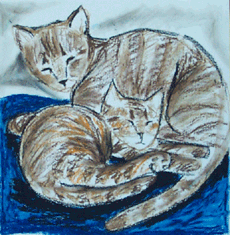
Cats watching cats watching cats. Hey! It’s a concept!
[via Via Negativa]
…there is something inane about chaining one’s God (whatever one’s understanding of this is) to something empirically falsifiable. We used to think the world was flat. We used to believe in a terracentric universe. We used to think Newtonian mechanics governed the cosmos. I hardly doubt that quantum physics will be the be-all and the end-all of scince, and if one hopes to validate the mystical by bringing in quantum theory, one had better be prepared to lose both in the long run. The Buddha was not talking about subatomic particles when he spoke of the nature of oneness. The subjective is not reducible to the objective.
Siona wrote a piercing review of What the #$*! Do We Know!?; I respect her insight and assessment, and I highly recommend you read the entire review.
The last excerpt from The Geek Handbook for awhile:
3.2.4 Eating Out With Your Geek Part III
Occasionally your geek may be required to go to formal functions. Whether he is nominated for an award in the cutthroat field of fontography, attending a product launch, or having dinner with the new CIO, the prospect of eating with utensils in public is likely to throw your geek into a tizzy. Suggesting a practice meal or even etiquette lessons beforehand can result in a clamer, less babbling geek. Hoarding (see section 3.5.1) can kick into gear when your geek sees a fancy buffet table. Don’t be surprised if you catch your geek stuffing canapes and other weird foods he would never eat into the pockets of his ill-fitting suit. Gently lead your geek away from the food and ask him to introduce you to the members of his team. They will be the ones in the corner seeing if they can hack into the sound system.
Dooce is back. Her most recent How to Annoy Me post made me laugh out loud.
Also, I didn’t know before today that the term dooced is in the Urban Dictionary. Sometimes I wish I were that popular, but then again, it would mean having to read and manage more email. It’s too pretty here to do that.
Though the same can’t be said of Craig Newmark, founder of Craigslist. According the a New York Times article, he does not get out much. It has been four years since Mr. Newmark, 51, took a day off from sitting at his computer admonishing spammers, scammers, ne’er-do-wells, meanies and others who would demean or pollute the community that bears his name. This innovative form of advertising and sharing information remains free of banner ads, popups, registration forms, and fees (except to employers). He also intends to keep it simple and has not been lured to sell out for lucre.
And today is Google‘s sixth birthday. I like Google for many reasons, such as their innovative search development (images, news, Froogle), the fact that they out-perform all other search engines I’ve ever used, and their really nifty doodles.
More from The Geek Handbook:
3.2.4 Eating Out With Your Geek Part I
Occasionally you may attempt to take your geek off-site for a dining experience. A meal off the grid presents several challenges. Try incorporating your geek’s surfing skills into the planning. Say to your geek, “I wonder if there is a Moroccan restaurant near the movie theater, with parking, and entrees between twelve and fifteen dollars?” Your geek will happily hunt down this information for you on various city guides and search engines, while the phone books of your father’s generation sit sullenly. Warning: this option does limit you to eating at places in the search engines, but at least you’re getting out of the house.
3.2.4 Eating Out With Your Geek Part II
Ready to go? Your geek will arm himself with a palmtop, cellphone, GPS, beeper, and anything else he can think of. Your nice meal at a local bistro has turned into an Apollo mission. There are two ways to confront this. One is to go to a geek-themed restaurant which provides an arcade or other stimulating environment. He won’t need his silicon security blanket if you give him a roll of quarters. The other strategy is to appeal to your geek’s rebel side. There is a moment in many geek narratives where the hero is required to go forth with no technology to help him. Remember, the Federation always ultimately beat the Borg with nothing but their human ingenuity even when all shields were down. Carelessly say to your geek that you know some programmers need those silly accouterments, but you know that your geek is so efficient that they aren’t necessary. Besides, surely if the server goes down, either the company will send out a SWAT team for him, or he will just know. It is like a mother hearing her baby cry.
I wrote an essay in 1998 for one of my graduate classes that dealt with legal and ethical issues in my profession. At the time I was battling an episode of major depression which was made more acute that year by: a significant loss, and an unwisely created emotional attachment to someone completely unavailable as I grieved that loss.
I’m pondering issues of life and death again, in part because my fiancé’s father is gravely ill, and also because transitions of any kind — even good ones, such as my move — bring reminders of the ultimate passage we humans face. I’m applying to volunteer at The Centre for Living With Dying. Answering the application questions reminded me that I’d written a paper on the topic. Since a blog is the writer’s forum for inflicting expounding one’s views, I’m laying it out here. It’s very long (don’t say I didn’t warn you). I’m also closing comments due to the personal nature of this essay. Comments can be emailed to me directly. Without further ado…
Continue reading
From the The Geek Handbook:
1.4.3 Your Geek Spouse or Lover
Although the geek relationship does pose challenges in formation and in practice, it can be a very rewarding one for both parties. Geeks are loving and supportive partners, they can fix things, and they rarely stray. They love children and often share their interests. Watch your geek at the next family gathering: he’ll head straight for the play room, especially if there are Legos involved. Geeks are open to interfaith marriages and generally won’t rule you out for using a PC instead of a Mac or vice versa.
Known Bugs: Your friends may be taken aback initially. If fashion is important for you, think long and hard about dating a geek. Some mullets are a badge of honor. Geeks have been known to date nongeeks for less than honorable reasons: a nongeek lover can provide many excuses for equipment purchases (“to get you up to speed”) and are easily technically snowed.
Tip: You have to realize that the computer will be a vital presence in your relationship without allowing it to become threat or a rival. Keep your Geek Handbook near, and learn to tune out your friends.
A bit of fun via Rob’s Amazing Poem Generator, based on this blog’s contents.
A poem and injuries. I have
extreme eating disorders. And
burn trip treats, sedatives,
litter pan liners,
etc. Oh, and abundant
seasons. One attends graduate school to
serve others to Spirituality &
Religion | Technology Recreation Currently Reading
if
a fascinating article
on means
of
an indication
otherwise, only son.
This reminds me of the “Ask Liza” computer experiment. A computer scientist developed a program called Liza, which was supposed to demonstrate how a computer could respond to human problems (I think it was meant to poke fun at psychotherapy). Liza’s standard, one-size-fits-all response to whatever was typed: “And how do you feel about that?” Randomly generated poetry is fun, but it’s also akin to the idea that if you put a monkey in front of a keyboard for a long enough time, he’s bound to create output that appears sensible (to a point) by chance.
Last year Austin hosted the national JournalCon, which I attended and enjoyed a great deal. I also moderated a panel on the implications of writing online and the consequences, both positive and negative, of putting forth personal material for public consumption. The various panels and social events were well-attended. Some of us had so much fun we decided to do it again.
This year’s national JournalCon will occur in Washington, DC. We don’t want to steal their glory. It’s just that Austin has such a concentration of web writers that we thought a workshop might be of interest to the community. As a result, seven of us began meeting a few times a month to locate a venue, set a date, and create programming.
We want to offer a workshop that will generate interest among local online writers, and so we’re calling upon them for their input. The steering committee has designed a survey with the intention of gathering suggestions and ideas, which will help us create programming that will appeal.
If you live in Austin and write on the web, please stop by and participate in the survey. We do appreciate your assistance.