Category Archives: Social Science

Where Are The Heroes?

Euan Semple raises a question and provides food for thought, quoting another blogger. He excerpts from Laughing Knees:

But so many of the stories from the news are cloaked, as always, in the myths of “heroism” and “doing great deeds for country” and the “selflessness of the young men and women who serve our country”. I’ve read and reread the words over and over again, trying to find in myself the empathy for such abstract and fervent emotions, but, perhaps because I am not American, I just can’t look at the photo of Pat Tilman and feel that he is anything other than a young man whose death will cause suffering for those who knew him and further paints the picture of the war in Afghanistan as nothing more than an arrogant and empty fiasco that the American government has all but forgotten. I cannot find it in myself to see him as a hero. I cannot see it in myself to see anyone as a “hero”.

All this reminds me of a poem from a class on Vietnam Film & Literature I took. It speaks for itself.

Dulce Et Decorum Est

Bent double, like old beggars under sacks,
Knock-kneed, coughing like hags, we cursed through sludge,
Till on the haunting flares we turned our backs
And towards our distant rest began to trudge.
Men marched asleep. Many had lost their boots
But limped on, blood-shod. All went lame; all blind;
Drunk with fatigue; deaf even to the hoots
Of disappointed shells that dropped behind.

GAS! Gas! Quick, boys!– An ecstasy of fumbling,
Fitting the clumsy helmets just in time;
But someone still was yelling out and stumbling
And floundering like a man in fire or lime.–
Dim, through the misty panes and thick green light
As under a green sea, I saw him drowning.

In all my dreams, before my helpless sight,
He plunges at me, guttering, choking, drowning.

If in some smothering dreams you too could pace
Behind the wagon that we flung him in,
And watch the white eyes writhing in his face,
His hanging face, like a devil’s sick of sin;
If you could hear, at every jolt, the blood
Come gargling from the froth-corrupted lungs,
Obscene as cancer, bitter as the cud
Of vile, incurable sores on innocent tongues,–
My friend, you would not tell with such high zest
To children ardent for some desperate glory,
The old Lie: Dulce et decorum est
Pro patria mori.*

–Wilfred Owen

*It is sweet and fitting to die for one’s country.

Owen fought in World War I and died seven days before the Armistice at age twenty-five.

Impressionable Young Minds

As one who is an older sister, I remember having to watch the words I used. Jette has a story to share, and it made me laugh and laugh and laugh:

It has been nearly 15 years since the event my family calls the Horse Piss Incident, and I would like to tell this story plainly and clearly so that it can be established once and for all that it was not my fault.

That ought to entice you to read it!

Making Contact

In which Jen of What’s Brewing has a random conversation

I chuckled at the encounter, yes. But another thing that makes me smile is that this is a story about an effort to connect. I relate. Working out of my home is fairly insulating, and I’ve needed to become purposeful about interaction as I run errands. Part of being truly present involves really absorbing what my eyes and ears encounter, and that is more likely to happen when I slow down enough to converse with people.

The Psychology of Samsara

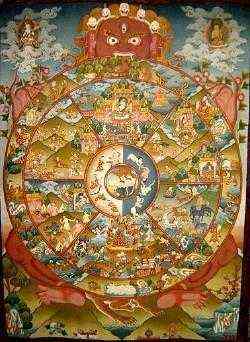
In Thoughts Without a Thinker, Mark Epstein very neatly pulls together various theories of psychotherapy and the aspects of Samsara, the Wheel of Life. This wheel depicts the Six Realms of Existence, through which souls cycle through rebirth. They are: the Human Realm, The Animal Realm, the Hell Realm, the Realm of the Hungry Ghosts, the Realm of Jealous Gods or Titans, and the God Realm. Psychotherapy, he writes, is concerned with reintegrating missing pieces of our experience from which we’ve become estranged. He continues:

This concern with repossessing or reclaiming all aspects of the self is fundamental to the Buddhist notion of the six realms. We are estranged not just from these aspects of character, the Buddhist teachings assert, but also from our own Buddha-nature, from our own enlightened minds. We have ample opportunity to practice the methods of re-possessing or re-membering that are specifically taught in meditation, for we can practice on all of the material of the six realms, on all of the sticking points in our minds. If aspects of a person remain undigested — cut off, denied, projected, rejected, indulged, or otherwise unassimilated — they become the points around which the core forces of greed, hatred, and delusion attach themselves. They are black holes that absorb fear and create the defensive posture of the isolated self, unable to make satisfying contact with others or with the world.

Epstein gives examples connecting theory to realm. Freud et al focused on exposing the animal nature of the passions, such as the Hell-ish nature of paranoia, aggression, and anxiety; insatiable longing (later termed oral craving) depicted by Hungry Ghosts. Humanistic psychotherapy focuses on “peak experiences,” akin to the God Realms. Cognitive, behavioral, and ego psychology can be seen in the competitive Realm of the Jealous Gods. And the Human Realm is the parallel to the psychology of narcissim and questions of identity.

This helps me to understand why I’m uncomfortable when asked what theoretical framework I use in my therapy. Each addresses an important aspect of living, but none of them has ever seemed to completely address all aspects. Therefore, I’ve never wanted to “settle” on just one. This also explains (to me) why I have been intrigued by and drawn to Buddhism for many years. As I developed my professional identity, Buddhism seemed the most inclusive framework. To see the connections made between Eastern and Western thought infuses me with interest.

I’ve only recently settled in to read this book, and it promises rich sustenance.

Menstruation, Rites of Passage, and Culture

The American attitude toward sexuality has a paradoxical nature. Media blasts us in all forms that sex is the nectar of life, and while perhaps it is, it neglects to teach us what it means to be a sexual person. Millions of people, especially children, acquire vast and damaging misconceptions about sex. Conversely, parents seek to diminish media influence by discouraging sexuality, often by ignoring the topic altogether; these parents fear that candid discussion about sex will convey approval for pre-marital sex. So, they withhold information or deliver it with accompanying feelings of shame. Along with lessons on sex, attitudes toward one’s body are conveyed. Men must be muscular and tough; women must be svelte and gorgeous. Beyond the issue of surface beauty lies the attitude one holds toward one’s gender.
Continue reading

Lord Knows What They’ve Got In Mind

I don’t blog much about political issues here, and any approach is likely to be oblique. As I surfed the web today, I happened across a Shel Silverstein poem that struck me as a perfect depiction of the past four years’ trend in the White House. Satire is a political act. This post is my part.

They’ve Put a Brassiere On a Camel

They’ve put a brassiere on a camel,
She wasn’t dressed proper, you know.
They’ve put a brassiere on a camel,
So that her humps wouldn’t show.
And they’re making other respectable plans,
They’re even even insisting the pigs should wear pants,
They’ll dress up the ducks if we give them the chance
Since they’ve put a brassiere on a camel.

They’ve put a brassiere on a camel,
They claim she’s more decent that way.
They’ve put a brassiere on a camel,
The camel had nothing to say.
They squeezed her into it, i’ll never know how,
They say that she looks more respectable now,
Lord knows what they’ve got in mind for the cow,
Since they’ve put a brassiere on a camel.

©1981 Evil Eye Music Poem and drawing by: Shel Silverstein

Only Shared Footsteps & Silence

This is particularly lovely to me, and rings true.

But it’s not the same, a friendship of correspondence, a friendship of words. Once you’ve walked alone together, in silence, with a dear, true friend, there’s so much more to say than words can capture. Open mouth, already a mistake. Sometimes only shared footsteps and sun-drenched silence can sum up one’s true sentiments.

–Lorianne Schaub, Hoarded Ordinaries

I Think He’s A Roommate Of Mine

I remember one evening when Ambivalence and I sat down to enjoy a nice dinner on the porch. The phone rang, and he jumped out of his chair to answer it. When he came back to join me at the table, the soup was cold, and his mind was preoccupied with programming details. It was useless trying to talk to him. The only way I could gain his attention was to make a scene. Before I realized it, we were once again engaged in a power struggle, and my irritation gave him the advantage. He was clear that it was only my problmen that I needed consistency, and added that the soup tastes best when it’s lukewarm.

As you know, the relationship went on like that for years. As soon as I would start to organize my life without him, beautiful love letters appeared in my mailbox. When I grew fond of our weekends in the country, he became indifferent. It took me a long time to figure out that for him indecision is a desired form of suspense. This game of yes/no/maybe intrigues him. It left me exhausted, and I can see that it is beginning to give you a nervous stomach.

–Ruth Gendler, The Book of Qualities

Existential Theory

One of my favorite therapists and writers is Irvin Yalom, a man of great insight who tells captivating stories. I’ve read nearly all of his books, one of which briefly discusses the aspects of existential psychology. He wrote quite a tome dealing with it in great detail, but I’ll be quoting from the prologue of Love’s Executioner.

On Death

As we grow older, we learn to put death out of mind; we distract ourselves; we transform it into something positive (passing on, going home, rejoining God, peace at last); we deny it with sustaining myths; we strive for immortality through imperishable works, by projecting our seed into the future through our children, or by embracing a religious system that offers spiritual perpetuation.

We know about death, intellectually we know the facts, but we — that is, the unconscious portion of the mind that protects us from overwhelming anxiety — have split off, or dissociated, the terror associated with death.

A nightmare is a failed dream, a dream that, by not “handling” anxiety, has failed in its role as the guardian of sleep. Though nightmares differ in manifest content, the underlying process of every nightmare is the same: raw death anxiety has escaped its keepers and exploded into consciousness.

…though the fact, the physicality, of death destroys us, the idea of death may save us.

On Freedom

Freedom means one is responsible for one’s own choices, actions, one’s own life situation. Though the word responsible may be used in a variety of ways, I prefer Sartre’s definition: to be responsible is to “be the author of,” each of us being thus the author of his or her own life design. We are free to be anything but unfree; we are, Sartre would say, condemned to freedom. Indeed, some philosophers claim much more: that the architecture of the human mind makes each of us even responsible for the structure of external reality, for the very form of space and time. It is here, in the idea of self-construction, where anxiety dwells: we are creatures who desire structure, and we are frightened by a concept of freedom which implies that beneath us there is nothing, sheer groundlessness.

Some people are wish-blocked, knowing neither what they feel nor what they want. Without opinions, without impulses, without inclinations, they become parasites on the desires of others. Such people tend to be tiresome.

Other patients cannot decide. Though they know exactly what they want and what they must do, they cannot act and, instead, pace tormentedly before the door of decision.

Decision invariably involves renunciation: for every yes there must be a no, each decision eliminating or killing other options (the root of the word decide means “slay,” as in homicide or suicide).

On Isolation

One experiences interpersonal isolation, or loneliness, if one lacks the social skills or personality style that permit intimate social interactions. Intrapersonal isolation occurs when parts of the self are split off, as when one splits off emotion from the memory of an event.

One’s efforts to escape isolation can sabotage one’s relationships with other people. Many a friendship or marriage has failed because, instead of relating to, and caring for, one another, one person uses another as a shield against isolation.

Beware of the powerful exclusive attachment to another; it is not, as people sometimes think, evidence of the purity of love. Such encapsulated, exclusive love — feeding on itself, neither giving to nor caring about others — is destined to cave in on itself. Love is not just a passion spark between two people; there is infinite difference between falling in love and standing in love. Rather, love is a way of being, a “giving to,” not a “falling for”; a mode of relating at large, not an act limited to a single person.

On Meaning

The search for meaning, much like the search for pleasure, must be conducted obliquely. Meaning ensues from meaningful activity; the more deliberately we pursue it, the less likely we are to find it; the rational questions one can pose about meaning will always outlast the answers. In therapy, as in life, meaningfulness is a byproduct of engagement and commitment, and that is where therapists must direct their efforts — not that engagement provides a rational answer to questions of meaning, but it causes the questions not to matter.

This encounter, the very heart of psychotherapy, is a caring, deeply human meeting between two people, one (generally, but not always, the patient) more troubled than the other. Therapists have a dual role: they must both observe and participate in the lives of their patients. As observer, one must be sufficiently objective to provide necessary rudimentary guidance to the patient. As participant, one enters into the life of the patient and is affected and sometimes changed by the encounter.

Patienthood is ubiquitous; the assumption of the label is largely arbitrary and often dependent more on cultural, educational, and economic factors than on the severity of pathology. Since therapists, no less than patients, must confront these givens of existence, the professional posture of disinterested objectivity, so necessary to scientific method, is inappropriate. We psychotherapists simply cannot cluck with sympathy and exhort patients to struggle resolutely with their problems. We cannot say to them you and your problems. Instead, we must speak of us and our problems, because our life, our existence, will always be riveted to death, love to loss, freedom to fear, and growth to separation. We are, all of us, in this together.

An Instance When Waffling Is Good

Lately I haven’t written much, because, well, my personal life has been a bit crappy of late, and I’m distracted. Therefore, I am deeply, sincerely grateful when I read posts by people like Chip on the small joys of life.

The Waffle House is great. First off, they specialize in waffles. I mean waffles, man. How freaking cool is that?

I love everything about the place, from the food on the menu to the unpretentious atmosphere. When you go to an IHOP or Denny’s, you get a feeling that the menu was designed by a marketing agency and subject to rigorous focus group evaluation. At the Waffle House, it’s like some crazy guy sat down and thought, “What other weird shit can we mix in with them hash browns?”

The bizarrely complicated menu is a graphic designer’s slow-motion trainwreck accident. This is a restaurant that caters primarily to bleary-eyed travelers and tipsy late night partiers. You know, people with malfunctioning higher-level brain functions. The Waffle House makes them sort through a menu more complex than any I’ve seen. It’s cruel, and I like that.

The whole post made me smile. Thanks, man.

Another Perspective Of Trust

Trust is the daughter of Truth. She has an objective memory, neither embellishing nor denying the past. She is an ideal confidante — gracious, candid, and discreet. Trust talks to people who need to hear her; she listens to those who need to be heard; she sits quietly with those who are skeptical of words. Her presence is subtle, simple, and undeniable.

Trust rarely buys round-trip tickets because she is never sure how long she will be gone and when she will return. Trust is at home in the desert and the city, with dolphins and tigers, with outlaws, lovers, and saints. When Trust bought her house, she tore out all the internal walls, strengthened the foundation, and rebuilt the door. Trust is not fragile, but she has no need to advertise her strength. She has a gambler’s respect for the interplay between luck and skill; she is the mother of Love.

–Ruth Gendler, The Book of Qualities

What Is Trust?

Naive trust is the promise of security – a pact destined to be broken by a universe whose only constant is change. Authentic trust is an expectation of change. Trust is another word for expectation.

When I think about my closest friends, I’m acutely aware of the implicit expectation that they will change, they will evolve, and alas, they will surprise me. Counting on that is authentic trust – trust that is aligned with the reality of impermanence. Only with arms of authentic trust can I embrace the Infinite.

–Jack Ricchiuto of gassho

Bittersweet Blessing


The Consecration of Coffee

One day of god
drinking coffee in my patio
nothing is normal–
   not the calla
   with its penis of gold
   nor the iris
   like purple lava
   a volcano spills.
I find in the depths of the cup
chasubles embroidered
with black moths
& red stains–
   the sun fires
   a scintillation of silver bullets
   & of candles drowned–
      there is blood in its shine.
I place the cup on its saucer
with a most tender care
as if it were a chalice
& say the litany:
      Guatemala
      Nicaragua
      El Salvador
& one side of my heart
tastes white & sweet
like cane sugar
   & the other,
      like coffee,
        bitter & black.

–Rafael Jesús González

Thank You, David Weinberger

As an avid blogger and user of the Internet for ten years, I have marveled at the changes in information availability and social connection. Riding the wave of early adoption, I’ve been invited (and joined, out of curiosity) various Artificial Social Networks (ASNs) such as Friendster, Flickr, and Orkut.

In each case, I’ve set up my profile and then mostly abandoned the ASN. I’m not sure what they’re for. Friendster focuses on dating, and I don’t need this. Flickr’s application annoys me, so that removes incentive to use it. Orkut, of all of them, I like the most, because it offers an idea of community that I like in theory. However, in reality, I don’t gain much. One ends up spreading wide and thin. I can be a member of 24 communities, but really, what’s the point? There are more connections to manage, and they all remain superficial. It encourages dilettantism.

All the people in my online community I can contact in other ways. I’m not that interested in the superficiality of “meeting” people with whom I’m unlikely to get farther than clicking “Yes, this is a friend.” Seems as though the purpose of these networks is to graphically depict the number of people in our lives, a sort of Internet yearbook, so we can reassure ourselves that we exist, are important, even though we are small fish in a huge pond.

I came across an article by Mr. Weinberger in which he articulated several compelling reasons why to be wary of these ASNs. Then he provided the most basic criticism of all. I quote liberally from his article, which published in Journal of Hyperlinked Organization:

First, they attempt to recreate our social network by making us be explicit about it. But our social bonds are necessarily implicit. Making social relationships explicit uproots them, distorts them and can do violence to them. Just try describing your child to someone, with your child in the room.

Second, ASNs make us be precise about that which is necessarily messy and ambiguous. This not only leads to awkward social moments (Am I a friend yes-no of some person I met once and don’t know if I like?), it also reinforces the worst idea of our age: The world is precise, so our ambiguity about it is a failure.

Third, they inculcate the stupid belief that relationships are commutative. LinkedIn is especially guilty of this. I have been C in a five-term series that A initiated in order to contact E, which means someone I don’t know asked someone I marginally know to introduce him to someone I kind of know who maybe knows someone I don’t know at all. The formal name for this is “using people.”

Fourth, the fact that they require explicitness in public about relationships guarantees that they will generate inordinate amounts of bullshit. For example, some ASNs let you write “testimonials” about your friends, a feature destined to encourage flattery and sucking up. Worse, they don’t let you refuse testimonials as part of your profile, so I’ve had to to explain to a handful of people why I’m not accepting the sweet sentences they spent time putting together.

And his last point?

Look, I want to say to the Friendsters of the world, we already invented a social network for friends and strangers. It’s called the Internet. Why are you privatizing it? Why do we need a proprietary sub-network to do what the Internet has already done in an open way? … I don’t like this thing coming along that implies that the existing social networks on the Internet — my social networks, the ones that constitute my social world — are so inadequate that some badly designed system with a derivative name (enoughster with the “sters” alreadyster!) sweeps the Net like photos of Janet Jackson’s poppin’ fresh wardrobe malfunction. What’s a matter, the Net wasn’t good enough for you?

He then describes a couple of new applications in development that will enable people to voluntarily provide information they want to share with the world in general, without having to join these specialized, protectionist, closed networks ad infinitum. One of these projects is Friend of a Friend, or FOAF, (a file you can put on your site) that will assist people in searching for and finding people who share a particular set of characteristics, among other things.

I’m pleased as punch to have found the reasons for my ambivalence clarified.

[via Weblogsky]