Category Archives: Quotes

First Pet Food, Then Toothpaste, Now Toys

Jeebus.

The latest recall, announced last week, involves 1.5 million Thomas & Friends trains and rail components — about 4 percent of all those sold in the United States over the last two years by RC2 Corporation of Oak Brook, Ill. The toys were coated at a factory in China with lead paint, which can damage brain cells, especially in children.

Just in the last month, a ghoulish fake eyeball toy made in China was recalled after it was found to be filled with kerosene. Sets of toy drums and a toy bear were also recalled because of lead paint, and an infant wrist rattle was recalled because of a choking hazard.

Over all, the number of products made in China that are being recalled in the United States by the federal Consumer Product Safety Commission has doubled in the last five years, driving the total number of recalls in the country to 467 last year, an annual record.

It also means that China today is responsible for about 60 percent of all product recalls, compared with 36 percent in 2000.

Much of the rise in China’s ranking on the recall list has to do with its corresponding surge as the world’s toy chest: toys made in China make up 70 to 80 percent of the toys sold in the country, according to the Toy Industry Association.

As More Toys Are Recalled, Trail Ends in China

You can sign up on the Consumer Product Safety Commission’s automated notification system at the commission’s Web site (www.cpsc.gov) to stay on top of which toys are being recalled.

I Am Not a Chocolate Frosted Sugar Bomb*

I took the three-hour glucose test and…

I passed!! My fasting baseline was 90, which I was told is very good. I didn’t bother getting the rest of the scores; I’m pleased enough to know I passed. I can assume my scores at each hour fell below the maximums listed (from BabyCenter.com):

Abnormal Scores
Fasting: 95 mg/dl or higher
One hour: 180 mg/dl or higher
Two hours: 155 mg/dl or higher
Three hours: 140 mg/dl or higher

The nurse said if even one score had been abnormal they would have diagnosed me with gestational diabetes. The doctor still requires I watch my intake of sugar and carbohydrates (makes sense), which I’ve done all along. This means, however, I will give up the one thing I crave and have permitted myself up until now: Concord grape juice (100% no sugar added). I was drinking one 8 ounce glass a day; the combination of sweet and tart, and that particular taste of Concord grape, is like the Nectar of Life to me. As cravings go, it’s not a particularly bad one. Even so, I’ll be curtailing consumption.

The woman I chatted with yesterday was four months pregnant. She’d had gestational diabetes with her first child, so they were testing her early. Talking with her brought the point home that it’s not a woman’s “fault” if she has it (although poor diet surely has an effect): she’s very slim, professes to hate sugar and sweet foods (which I believe, as she’s Indian; over the years, a lot of folks I’ve met from Asia have been puzzled by the American obsession with desserts and sweets), and is a vegetarian. And yet she still had it once and might again.

I’m glad I decided to tough it out and take the test.

*One of my favorite comic strips, Calvin and Hobbes, featured a fictional cereal called Chocolate Frosted Sugar Bombs. From the website:

Calvin of Calvin and Hobbes fame has been known to eat Chocolate Frosted Sugar Bombs which Calvin says are “tasty, lip-smacking, crunchy-on-the-outside, chewy-on-the-inside, and they don’t have a single natural ingredient or essential vitamin to get in the way of that rich, fudgy taste.” Hobbes says the cereal makes his heart skip and likens this cereal to “eating a bowl of milk duds”.

Ten Zen Seconds: An Interview with Eric Maisel

A couple of months ago I was invited to participate in a “blog tour” interviewing Eric Maisel on his latest book. Since I was offered a copy of the book to review and the opportunity to ask a couple of questions tailored to my interests, I decided to join in. (Who can resist a book?) What follows is an introduction to the concepts in Ten Zen Seconds; my questions regarding how these concepts can be utilized during childbirth and in treatment of Post-Traumatic Stress Disorder are woven into the interview. Enjoy, and may you find this useful!

What is Ten Zen Seconds all about?

EM: It’s actually a very simple but powerful technique for reducing your stress, getting yourself centered, and reminding yourself about how you want to live your life. It can even serve as a complete cognitive, emotional, and existential self-help program built on the single idea of “dropping a useful thought into a deep breath.”

You use a deep breath, five seconds on the inhale and five seconds on the exhale, as a container for important thoughts that aim you in the right direction in life — I describe twelve of these thoughts in the book — and you begin to employ this breathing-and-thinking technique that I call incanting as the primary way to keep yourself on track.

Where did this idea come from?

EM: It comes from two primary sources, cognitive and positive psychology from the West and breath awareness and mindfulness techniques from the East. I’d been working with creative and performing artists for more than twenty years as a therapist and creativity coach and wanted to find a quick, simple technique that would help them deal with the challenges they regularly face — resistance to creating, performance anxiety, negative self-talk about a lack of talent or a lack of connections, stress over a boring day job or competing in the art marketplace, and so on.

Because I have a background in both Western and Eastern ideas, it began to dawn on me that deep breathing, which is one of the best ways to reduce stress and alter thinking, could be used as a cognitive tool if I found just the right phrases to accompany the deep breathing. This started me on a hunt for the most effective phrases that I could find and eventually I landed on twelve of them that I called incantations, each of which serves a different and important purpose.

What sort of hunt did you go on?

EM: First, I tried to figure out what are the most important tasks that we face as human beings, then I came up with what I hoped were resonant phrases, each of which needed to fit well into a deep breath, then, most importantly — which moved this from the theoretical to the empirical — I tested the phrases out on hundreds of folks who agreed to use them and report back on their experiences. That was great fun and eye-opening!

People used these phrases to center themselves before a dental appointment or surgery, to get ready to have a difficult conversation with a teenage child, to bring joy back to their performing career, to carve out time for creative work in an over-busy day — in hundreds of ways that I couldn’t have anticipated. I think that’s what makes the book rich and special: that, as useful as the method and the incantations are, hearing from real people about how they’ve used them “seals the deal.” I’m not much of a fan of self-help books that come entirely from the author’s head; this one has been tested in the crucible of reality.

Which phrases did you settle on?

EM: The following twelve. I think that folks will intuitively get the point of each one (though some of the incantations, like “I expect nothing,” tend to need a little explaining). Naturally each incantation is explained in detail in the book and there are lots of personal reports, so readers get a good sense of how different people interpret and make use of the incantations. Here are the twelve (the parentheses show how the phrase gets “divided up” between the inhale and the exhale:

  1. (I am completely) (stopping)
  2. (I expect) (nothing)
  3. (I am) (doing my work)
  4. (I trust) (my resources)
  5. (I feel) (supported)
  6. (I embrace) (this moment)
  7. (I am free) (of the past)
  8. (I make) (my meaning)
  9. (I am open) (to joy)
  10. (I am equal) (to this challenge)
  11. (I am) (taking action)
  12. (I return) (with strength)

A small note: the third incantation functions differently from the other eleven, in that you name something specific each time you use it, for example “I am writing my novel” or “I am paying the bills.” This helps you bring mindful awareness to each of your activities throughout the day.

Can you use the incantations and this method for any special purposes?

EM: As I mentioned, folks are coming up with all kinds of special uses. One that I especially like is the idea of “book-ending” a period of work, say your morning writing stint or painting stint, by using “I am completely stopping” to ready yourself, center yourself, and stop your mind chatter, and then using “I return with strength” when you’re done so that you return to “the rest of life” with energy and power. Usually we aren’t this mindful in demarcating our activities—and life feels very different when we do.

Here are my specific situational questions.

Situation 1: Labor and birth is a complex, physically demanding experience. There are three stages of labor, but I’ll focus one the first two.

  • Stage one has three parts: early labor, active labor, and transition.
    • During early labor, which can last 8-12 hours, typically the contractions come 5-30 minutes apart and last 30-45 seconds each.
    • Active labor is next, lasting 3-5 hours; the frequency of contractions generally increases to every 3-5 minutes and lasts about 60 seconds.
    • Transition lasts 20 minutes to 2 hours, and contractions will come every 30 seconds to 2 minutes (or they may overlap) and last about 60-90 seconds; during transition a woman may experience hot flashes, chills, nausea, vomiting. This is the point where she may be most exhausted and emotionally depleted, but she’s not finished!
  • The second stage of labor (active pushing and the baby emerging) can take anywhere from 20 minutes to 2 hours; contractions come every 3-5 minutes and will last about 45-90 seconds.

1. When contractions are coming fast and furious, is Ten Zen Seconds a sustainable practice to help with pain and energy management?

EM: I have no reports that it is, so I would love to know if it works in that situation! What I do know is that people in similarly stressful, physically demanding, uncentering situations have found the process profoundly valuable, so I think it’s fair to extrapolate and hazard the guess that it might be useful.

Of course, a different sort of breathing is already taught to mothers-to-be as the best way to breathe during the actual delivery, but in the long hours up to delivery I think that using the deep breathing-and-right thinking combination that Ten Zen Seconds teaches might prove of great value.

I would imagine that the most on-point incantations during this period would be incantation 4, “I trust my resources,” incantation 5, “I feel supported,” incantation 9, “I am open to joy,” and incantation 10, “I am equal to this challenge,” though I can imagine how the others might also prove applicable.

2. What incantations would you recommend to a woman to prepare herself before labor and to cope during labor?

EM: That depends in part what specific challenges the mother-to-be is experiencing. If she can’t seem to get herself present and can only think about this being over, she might want to bring herself back to the present and to the power of presence with incantation 6, “I embrace this moment.”

If she is filled with layers of self-doubt, about whether she can stand up to the rigors of delivery and/or the realities of parenting, I think that self-trust might be the most important thing to cultivate and using incantation 4, “I trust my resources,” might make good sense.

If she is having issues with the people around her, like her parents, her in-laws, or her mate, and really needs to table those issues for the moment so as to get on with labor and delivery with a clear mind, then using incantation 7, “I am free of the past,” might prove really valuable.

First you engage in a little self-awareness to help you determine what the issue is that you want to address, then you choose the incantation (or create the incantation) that serves that need.

3. What incantations would you suggest to her birthing coach to help him or her manage?

EM: The main tasks for the coach are to be present and to be helpful. The mother-to-be doesn’t need someone more anxious and more distracted than she is trying to help her, especially if there are some important decisions in the moment that she could use some help with.

Therefore the coach would especially benefit from employing incantation 1, “I am completely stopping,” to remind himself that this is where he needs to be, incantation 3, “I am doing my work,” to remind himself of his duties, incantation 10, “I am equal to this challenge,” to help quiet his nerves and reduce his fear of negative things happening, and incantation 12, “I return with strength,” to help remind him to return to the mother-to-be’s side with a positive, helpful attitude and requisite strength and presence.

Situation 2: Post-Traumatic Stress Disorder (PTSD) develops in response to a traumatic event. People with PTSD often have problems functioning. In general, people with PTSD have more unemployment, divorce or separation, spouse abuse and chance of being fired than people without PTSD. Vietnam veterans with PTSD were found to have many problems with family and other interpersonal relationships, problems with employment, and increased incidents of violence. There are many symptoms to this disorder, and I’d like to ask how TZS might help manage them.

  • For instance, a person might have a flashback resulting from an environmental trigger (such as a noise that reminds him or her of the trauma) and feel intense fear, helplessness, and horror again.
  • Survivors often take pains to avoid situations that may trigger memories of the traumatic event, which limits the fullness of their lives.
  • They may feel emotionally numb and isolated and are often hyper-vigilant and always “on guard” after the traumatic event.
  • These stressful psychological responses can have a deleterious impact on physical health, and they may lead people to self-medicate with substance abuse.

1. How might a survivor use the Ten Zen Seconds to manage symptoms of fear and helplessness?

EM: One of the profound tasks of healing from trauma is being able to remember the trauma without reliving the trauma. Mindfulness in general, and the techniques that I teach in Ten Zen Seconds specifically, help a person have a thought without attaching to that thought or experiencing pain from that thought.

You acquire a certain healthy, healing distance from your thoughts and can examine them objectively. As this practice deepens, you feel less fearlful, anxious, and helpless because you learn that you no longer have to run from your thoughts, as they are no longer producing pain. Even more than any particular incantation, the basic practice of mindfulness, with its orientation toward detachment and freedom, help a person recover from past trauma.

2. How might one use TZS to overcome resistance to new experiences and a tendency to isolate?

EM: There are several different approaches to this. One is to orient toward the possible pleasure that you might get from new experiences, rather than orient toward the risks involved, and for this incantation 9, “I am open to joy,” can prove very useful.

Another is to frame new experiences as necessary challenges that come with healthy, authentic living, and for this frame incantation 10, “I am equal to this challenge,” is a great tool.

A third approach is turn in the direction of trust, of trusting yourself in new situations and of trusting others not to harm you in new situations, and for this orientation incantation 4, “I trust my resources” and incantation 5, “I feel supported” are the incantations of choice.

3. What incantations would you recommend to a survivor to reduce emotional numbness and excessive vigilance?

EM: That excessive vigilance has to do with rapid and continual scanning both of the external world and the internal world of thought and worry. You are noticing things out there that might prove dangerous and also noticing passing internal thoughts about possible danger — thoughts that you could dismiss without even noticing if only you were less vigilant.

The key here is to stop — to stop all that internal and external scanning — and so the most important incantation with respect to this issue is “I am completely stopping,” remembering that embedded in that phrase is the specific idea that what you are stopping is all that scanning and all that vigilance. As you learn to actually stop, that allows room for feelings to return and numbness to lessen, as feelings had no place to land while you were doing all of that scanning.

4. Can TZS help with the involuntary physical responses that can occur, such as waking from a nightmare shaking and sweating, or having a panic attack?

EM: I don’t know the answer to this one and I would love to hear from folks who make use of the Ten Zen Seconds program and learn from them if in fact using this tool will help with these phenomena. I stand ready to learn!

Is there a way to experience this process in “real time?”

EM: By trying it out! But my web master Ron Wheatley has also designed a slide show at the Ten Zen Seconds site (http://www.tenzenseconds.com) that you can use to learn and experience the incantations. The slides that name the twelve incantations are beautiful images provided by the painter Ruth Yasharpour and each slide stays in place for ten seconds. So you can attune your breathing to the slide and really practice the method. The slide show is available at http://www.tenzenseconds.com/test_photo_slide.html.

How can people learn more about Ten Zen Seconds?

EM: The book is the best resource. You can get it at Amazon by visiting here.

Or you can ask for it at your local bookstore. The Ten Zen Seconds website is also an excellent resource: in addition to the slide show that I mentioned, there is a bulletin board where folks can chat, audio interviews that I’ve done discussing the Ten Zen Seconds techniques, and more. It’s also quite a gorgeous site, so you may want to visit it just for the aesthetic experience! I would also recommend that folks check out my main site, http://www.ericmaisel.com, especially if they’re interested in creativity coaching or the artist’s life.

What else are you up to?

Plenty! I have a new book out called Creativity for Life, which is roughly my fifteenth book in the creativity field and which people seem to like a lot. I also have a third new book out, in addition to Ten Zen Seconds and Creativity for Life, called Everyday You, which is a beautiful coffee table book about maintaining daily mindfulness. I’m working on two books for 2008, one called A Writer’s Space and a second called Creative Recovery, about using your innate creativity to help in recovering from addiction.

And I’m keep up with the many other things I do: my monthly column for Art Calendar Magazine, my regular segment for Art of the Song Creativity Radio, the trainings that I offer in creativity coaching, and my work with individual clients. I am happily busy! But my main focus for the year is on getting the word out about Ten Zen Seconds, because I really believe that it’s something special. So I thank you for having me here today!

The Whole World

For those who have come to grow, the whole world is a garden. For those who have come to learn, the whole world is a university. For those who have come to know God, the whole world is a prayer mat.

–M.R. Bawa Muhaiyaddeen

Ironic

Have you ever observed that we pay much more attention to a wise passage when it is quoted than when we read it in the original author?

–Philip Hamerton

That Blade Pressed

God is a filter, a polaroid lens that blanks out all the wild colors and fabulous detail of nature. God obliterates randomness. God kills luck. God turns sharp-edged struggle into a tiresome parable. He’s the all-purpose explanation, the always-available excuse. He’s a big shrug of the shoulders, a cosmic palms-up gesture, a rabbit’s foot, a dodge, a shot of morphine, a handful of Prozac. He’s beige. He’s boring, and he makes people boring and life boring.

Life is real. Nature is real. Death is real. It’s not shadows on a wall, it’s not an illusion or a test or a phase we pass through. Life is dangerous and exciting and that blade pressed against jugular isn’t a ticket to paradise it’s the real threat of the real end. And when you accept that, when you accept that you’re playing the game with real money, life gets so much more interesting.

God smooths the rough edges. I don’t want the edges smoothed.

— M. Takhallus, Sideways Mencken

Thanks to Euan at The Obvious? for pointing out this quote.

Spreading the Wealth

I live a good life. In fact, even when I’ve struggled to pay rent and other expenses, I have always had the luxury of running water, heating/cooling, and electricity. Food has never been scarce, nor has it ever been difficult to purchase products for my household or physical needs. I’ve had access to credit which made achieving some goals possible, such as buying a car and getting an education. I am so very blessed.

Meanwhile, here are some facts and figures to provide perspective. Half the world — nearly three billion people — live on less than two dollars a day; 20% of the population in the developed nations, consume 86% of the world’s goods. The poorer the country, the more likely it is that debt repayments are being extracted directly from people who neither contracted the loans nor received any of the money. Approximately 790 million people in the developing world are still chronically undernourished, almost two-thirds of whom reside in Asia and the Pacific. A mere 12 percent of the world’s population uses 85 percent of its water, and these 12 percent do not live in the Third World. The richest 50 million people in Europe and North America have the same income as 2.7 billion poor people. “The slice of the cake taken by 1% is the same size as that handed to the poorest 57%.” (Info from Global Issues.)

Instead of feeling guilty, I decided to do something constructive. Have you ever heard of microlending? It’s a means of assisting other people across the world by lending some of your money to them. It’s not a donation or charity. The loan is repaid. One of the organizations that facilitate the process is Kiva. From their website:

Kiva lets you connect with and loan money to unique small businesses in the developing world. By choosing a business on Kiva.org, you can “sponsor a business” and help the world’s working poor make great strides towards economic independence. Throughout the course of the loan (usually 6-12 months), you can receive email journal updates from the business you’ve sponsored. As loans are repaid, you get your loan money back.

Kiva partners with existing microfinance institutions. In doing so, we gain access to outstanding entrepreneurs from impoverished communities world-wide. Our partners are experts in choosing qualified borrowers. That said, they are usually short on funds. Through Kiva.org, our partners upload their borrower profiles directly to the site so you can lend to them.

You just visit the site and look at the businesses needing loans. You can loan as little as $25 (a night at the movies, a week of Venti lattes). You will then receive email updates on how the business is doing. Once the loan is repaid, you can withdraw the money from Kiva or lend it again. Kiva has experienced a 100% repayment rate on all businesses with completed loans. Over the past three decades, more than 100 million of the world’s poor have demonstrated a greater than 95% repayment rate in micro-loans. Yes, there is a risk you might not get your money back. But it’s not a huge amount of money to begin with. The loans are interest-free, so you don’t make money. Since these are not donations, they are not tax-deductible. Yet Kiva takes no cut of the loan either; you can donate money to help them and it’s tax deductible.

So as of yesterday I’ve financed four businesses, two of which have been fully funded. Here are the two in my portfoloio still in need of funding. You can see more businesses here. Join in and enjoy the feeling of changing lives for the better.

The Foolish Expression

I loathe the expression “What makes him tick.” It is the American mind, looking for simple and singular solution, that uses the foolish expression. A person not only ticks, he also chimes and strikes the hour, falls and breaks and has to be put together again, and sometimes stops like an electric clock in a thunderstorm.

–James Thurber

Poetry For Men

Like many men, I’m also more “practical” than my wife. It took me years to understand why a woman would want to get flowers. After all, they just die in a few days. Wouldn’t a blender be a better Valentine’s Day gift? Like flowers, poetry isn’t always meant to be practical, and this is sometimes hard for me to “get.” Sometimes there isn’t even a “point” to a poem other than it being an expression of emotion. I’m always looking for “meaning,” rather than taking the emotion in. The words, the image provoked or the music of the poem should be just enough to make a piece of writing special.

I’m learning to appreciate poetry more by reading poems, including many of the poems I see here on Poetry Thursday. It is good to be reminded that not all poems are about flowers or “girly” things, or topics that make you go out and buy a black beret. You can write poems about baseball games and pissing in the forest, and it can still be considered a poem.

–Neil Kramer, Confessions of a Poemphobe: Poetry for Men

One Good Egg

Many of you have probably deduced from my vague mentions about health that something is up with me, and it is: I’m pregnant!

The test for which I was not-so-patiently awaiting results was the amniocentesis. At my age there is a 1:23 chance of a chromosomal abnormality that can cause serious birth defects, and even death. Being pregnant hasn’t been the absolute radiantly happy time I wanted. Until now. They called this morning to tell me the tests results are normal, and that my baby is a girl. She’s due to arrive August 27. On Easter Day I’ll be 20 weeks pregnant — halfway through.

Here’s the back story. In mid-November we saw the fertility specialist to discuss our options. Because of my age he strongly encouraged us to consider oocyte donation (getting an egg from a much younger woman), because the chances of my producing enough viable eggs and conceiving in a given month via in vitro were about 10 percent. On our own, the chances of conceiving in a given month were about 2 or 3 percent.

We went home and talked. I made my peace with the idea, because I really want a child, and I really wanted to carry a pregnancy to term. My uber-stressful job was over, so I relaxed and got to working out. (I even lost 12 pounds by mid-December!)

On December 13 (one month after visiting the doc) I noticed I felt puffy, tired, and had an increased need to use the bathroom. The next day I decided to use my one home pregnancy test left over, assuming it would be a waste, but what the heck. Imagine my fragile amazement when the test showed a slightly anemic but positive result. I told Husband and we agreed we shouldn’t tell, that we should just play it down, since I’d never made it past 8 weeks before. (Of course I took another home test, and the results were even stronger the next time. We joked that the fertility specialist must be really good at what he does; all we needed was to talk with him.)

On December 14 we got the news that our landlords were giving the house to their son and were requested to move by mid-February. On December 19 we went to Syracuse for the holidays. We didn’t officially mention it, but you know families; they have radar. They knew something was up, and they inferred what. Mostly I was exhausted, but I had insomnia at my parents’.

On December 29 we returned home, and on the 30th, on schedule, the morning sickness began. Except that mine lasted all day for six weeks. I didn’t vomit often, but I often wished I would; I feel better after. And you might think that feeling nauseous would be a good weight-loss method, that no food would appeal, that you wouldn’t even want to think about food. Not me. In my experience, hunger made the nausea worse, and yet so many odors (including food) also made me feel worse. So for six weeks I thought about food more than ever as I tried to find something I could stand to eat that would nourish my body. Add to that the fact that I slept 12 hours a day, and I was pretty much useless.

Except that’s when we had to find a place to live and pack our home. So we’d go out, me with my ginger beer and Saltines, drive by properties and go in some. I’d go home and collapse into bed. Once we found a rental, the packing began. I could only manage a box or two a day. If our friends M & K had not come three weekends in a row to help, we’d have been in big trouble. All through this time I tried to take it easy on my body and not to stress mentally about the move. I was successful at that, too.

By mid-February that misery abated and I felt like a new woman. We saw the doctor February 1 and had the first ultrasound. There was a heart, beating strongly. We called the baby Little One. Little One was very wiggly. A good sign. At the March visit we heard the heartbeat by Doppler technology. Then came the amnio, which they cannot do until four months into the pregnancy. By four months, I was deeply invested emotionally and physically in this child. It’s a long time to wait for such information. (A different test could be done at 12 weeks but had a higher risk of miscarriage, which we didn’t want to take.)

While I realize there is no absolute certainty or safety, I feel confident enough to share this news with the world. Actually, pregnancy is just the beginning of realizing how vulnerable one is to the world. The gestation and birth might be fine, but there’s a big world of risk out there, and anything can happen to one’s child. As I once heard, “Making the decision to have a child is momentous. It is to decide forever to have your heart go walking around outside your body.”

Yet I couldn’t be more pleased.

[cross-posted at Knit Together]

A Kind of Magic I Can Believe In

Once upon a time, long, long ago, we had just watched magician Harry Blackstone Jr. perform marvelous feats of wizardry on television. I heard my young son ask his father, Is there really such a thing as magic? I held my breath as my husband answered. No. There’s no real magic. It’s only tricks that fool your mind and your eyes.

NO REAL MAGIC? I was disappointed. For years I’d taught my writing classes the art of incantation and enchantment. The casting of spells and charms. By words. I (and they) believed we had special power to call up feelings, knowings, a kind of sorcery. By the use of words! As I reflected on my husband’s answer, I knew he was wrong: There is such a thing as magic. A writer can cause another human being to glow or tingle or wince; to tremble, or to laugh out loud; or to weep — to experience the shine of words — and certainly that is magic, and poets are magicians of the highest order.

I had a student once who, after the death of her elderly aunt, found herself going through some old trunks in an attic. In one of the trunks she found a letter written by a great grandmother, whose husband had just taken a second wife. As my friend read this letter, in which a woman who lived 150 years ago poured out her dismay, her grief, onto a piece of paper, she wept. When we are able to touch someone else across a barrier of time, or distance or culture and make them laugh or cry, that truly is MAGIC!

–Joyce Ellen Davis, Poetry Thursday

Detachment

It is something — it can be everything — to have found a fellow bird with whom you can sit among the rafters while the drinking and boasting and reciting and fighting go on below.

–Wallace Stegner

Spirituality and Science

“Spirit” comes from the Latin word “to breathe.” What we breathe is air, which is certainly matter, however thin. Despite usage to the contrary, there is no necessary implication in the word “spiritual” that we are talking of anything other than matter (including the matter of which the brain is made), or anything outside the realm of science. …Science is not only compatible with spirituality; it is a profound source of spirituality. When we recognize our place in the immensity of light-years and in the passage of ages, when we grasp the intricacy, beauty, and subtlety of life, then that soaring feeling, that sense of elation and humility combined, is surely spiritual. So are our emotions in the presence of great art or music or literature, or of acts of exemplary selfless courage such as those of Mohandas Gandhi or Martin Luther King, Jr. The notion that science and spirituality are somehow mutually exclusive does a disservice to both.

–Carl Sagan, The Demon-Haunted World: Science as a Candle in the Dark

Religious Literacy

Last week at lunch with my friend, the topic of religion and politics came up, specifically evolution being taught in science class and the push to teach creationism or intelligent design in schools. I suggested that a comparative religions class would be a better venue to discuss matters of faith, and to explore the variety of its expressions. I also think an introductory philosophy course would be valuable. I saw the recent issue of Newsweek in which the same idea is advocated by Stephen Prothero.

The problem:

In a world where nearly every political conflict has a religious underpinning, Prothero writes that Americans are selling themselves short by remaining ignorant about basic religious history and texts, by not knowing the difference between a Sunni and a Shiite or the name of Mormonism’s holy book. “Given a political environment where religion is increasingly important, it’s increasingly important to know something about religion,” he says. “The payoff is a more involved [political] conversation.”

The Gospel of Prothero: A Boston University professor argues that Americans, though ‘spiritual,’ are woefully ignorant about religion

The suggested solution:

The book proposes a solution that is at once controversial and familiar: teach religion in public schools. Prothero believes that before graduation from high school, every American should take a Bible course and a world-religions course—dispassionate humanities courses whose purpose is not to catechize or evangelize but to educate. In colleges, he argues, we have science requirements, so why not religion? When Harvard decided recently not to make religion part of its core curriculum, “it missed an opportunity,” he says.

The Gospel of Prothero: A Boston University professor argues that Americans, though ‘spiritual,’ are woefully ignorant about religion

I would love to hear Stephen Prothero speak, but I’ll settle for reading his book, Religious Literacy: What Every American Needs to Know–And Doesn’t.

Ancient History

If you desire to drain to the dregs the fullest cup of scorn and hatred that a fellow human being can pour out for you, let a young mother hear you call dear baby ‘it.’

–T.S. Eliot

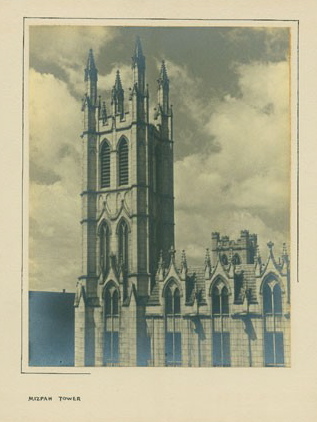
Mizpah Tower circa 1940, photographer unidentified

Mizpah Tower circa 1940, photographer unidentified

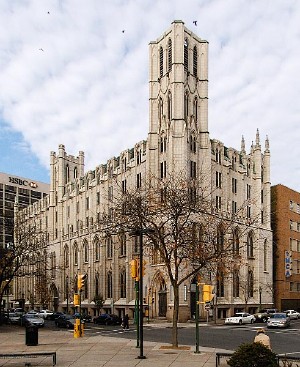
In 1983, I moved out of my parents’ home to stake my claim on adulthood. The place where I spent the next five years of my life was at a women’s hotel in downtown Syracuse called The Mizpah Tower. The First Baptist Church had it built in 1914; it was attached to the church. For many years it served as a residence for the next-door YMCA until it was converted to a women-only hotel in the 1960s. There was a front desk, and every resident was required to leave her key with the desk clerk. No exceptions. My first abode was a large room on the fifth floor facing Jefferson Street; it had a small stall shower and an ancient porcelain sink. Communal kitchens and bathrooms were shared by all residents on each floor.

After about six months, I moved to the penthouse apartment with my significant other.

mizpah tower penthouse 1984

View of our back porch

Trust me, the penthouse was not luxurious, although it afforded an interesting view of nearby buildings, seen below.

view from mizpah tower 1 1984

View of the Cathedral of the Immaculate Conception and the court house roofs

view from mizpah tower 2 1984

View of Columbus Circle

The penthouse had old windows with broken sashes, no screens, lead paint, crappy shag carpeting, ants, and radiator heating. The ambient sound was the loud hum of the elevator next to the front door. The shelves in one bedroom were unfinished plywood. The rent cost $300 a month; when it went up to $360 a month, we panicked. We lived on very little then; often a meal was macaroni & cheese with canned peas and sliced hot dogs mixed in. We didn’t own a car. To get groceries, we took a bus to the suburban Wegmans and called for a taxi ride home. We shopped big, because we couldn’t afford the $7 fare more than twice a month. We couldn’t afford real furniture either, as you can see below; my brother was visiting us, and he is reading on our “sofa.”

our fancy furniture at mizpah tower, my brother visiting 1984

In 1984, lightning struck the tower opposite the apartment. When I returned home from work, rubble was everywhere, and we were at first told we could not enter the apartment. When we finally received clearance, I spent the better part of a week trembling in fear of the tower falling on us.

mizpah tower after lightning struck it 1984

Scaffolding on the tower

The pinnacles were removed that summer.

mizpah tower rubble from removing the pinnacles 1984

Rubble from the tower removal

Later that year we moved to a fourth floor apartment that was less expensive, and because we’d had enough of living the “high life” at the top.

Because money was tight despite each of us having full-time jobs, we both got second jobs as well. Mine was to work Saturday and Sunday from 3:00 to 11:00 p.m. as the desk clerk in the hotel. Basically this involved a lot of sitting alone, reading, and occasionally getting up to take a key or hand one out. One night about 10:00 p.m., two women came in, one holding an infant. The Mizpah was a residence for single women with no dependents only. Children were never allowed, not even to visit upstairs. In the process of explaining the rules, I referred to the baby as “it,” as in, “You cannot take it upstairs to stay even one night.” I had previously referred to the infant as “the baby,” but in the confrontation I was uncomfortable, so “it” is what came out next. I didn’t know the child’s gender, and the clothing gave no clue. Oh, if looks could kill the mother would have done it a hundred times over. She scathingly mocked me for calling the child “it,” and I wound up feeling like some kind of non-feminine freak monster. So I know first-hand of what T.S. Eliot speaks. And of course she went upstairs with the baby anyway. I sure wasn’t going to call the manager or police on her.

The women who lived there were working poor, or elderly and living on a limited income, or sometimes mentally ill and on disability. Room rent was paid weekly. In many ways it was a dreary and depressing place to live, despite the ornately furnished lobby (that no one ever used). At 5:00 p.m. all the downtown stores closed, including small grocery stores. After five years, my SO and I split; I temporarily moved back to my parents’ home to pay off a debt before going to school full-time for my B.A. Not long after we moved out, the church sold the Mizpah and it closed as a residence. The church was briefly converted to an auditorium for music performances but didn’t thrive. The residental halls were abandoned, left to dust and pigeons. It sits unused to this day.

Mizpah Tower 2004, photographer David Bridges

Mizpah Tower 2004, photographer David Bridges

Extol the Gifts

When many people talk about their childhoods, they emphasize the alienating, traumatic experiences they had. It has become fashionable to avoid reporting memories of the good times in one’s past. This seems dishonest — a testament to the popularity of cynicism rather than a reflection of objective truth.

I don’t mean to downplay the way your early encounters with pain demoralized your spirit. But as you reconnoiter the promise of pronoia, it’s crucial for you to extol the gifts you were given in your early years: all the helpful encounters, kind teachings, and simple acts of grace that helped you bloom. Remember them now, please.

–Rob Brezsny