Before heading to the coast after our week of visiting with a relative, we took a couple of day trips inland. One was to Mount St. Helens (photos forthcoming), which is indelibly impressed on me because of its catastrophic eruption on May 18, 1980 (I was 16 at the time and avidly consumed all news about it). The other trip was a drive along the Historic Columbia River Highway, which winds between the Columbia river and glade after glade of waterfalls. The photo below is of the Horsetail Falls. You can expect to see lots of photos (over time) of the trip. I can’t decide which I love most: the stately, wild solitude of the mountain; the lush, verdant whispers of the forest; or the bracing, austere profile of the coast. How grateful I am to experience them all.
Category Archives: Regional
Did You Miss Me?
After 2,200 miles, we are home. We ended our trip a day early because my pregnant body said “no more!” and Husband got a mild case of food poisoning from a Dungeness crab sandwich. We were totally exhausted and relieved to sleep in our own bed again. Stella was beside herself with our return and has been glued to us, constantly purring. We had a wonderful time! It was fun to be together exploring. He truly is my best friend, and I love how easygoing the trip was. I have lots of pretty pictures, but I’ll start will a humorous one. I was almost tempted to take the sign but it wasn’t worth the price. 🙂
Road Insanity
He was driving a tanker full of 8,600 gallons of unleaded gas, and he was speeding. At one of the busiest freeway interchanges in the Bay Area — the MacArthur Maze between the Ikea store in Emeryville and the Oakland-San Francisco Bay Bridge — he crashed. The resulting fire burned so intensely it caused the road to collapse. Some 280,000 commuters use this interchange every day. Amazingly, the driver survived with second-degree burns and because the crash occurred in the middle of the night, no one else was injured. I wouldn’t want to be a commuter today.
(Photo by Noah Berger/Oakland Tribune)
The entire article can be read here.
Spreading the Wealth
I live a good life. In fact, even when I’ve struggled to pay rent and other expenses, I have always had the luxury of running water, heating/cooling, and electricity. Food has never been scarce, nor has it ever been difficult to purchase products for my household or physical needs. I’ve had access to credit which made achieving some goals possible, such as buying a car and getting an education. I am so very blessed.
Meanwhile, here are some facts and figures to provide perspective. Half the world — nearly three billion people — live on less than two dollars a day; 20% of the population in the developed nations, consume 86% of the world’s goods. The poorer the country, the more likely it is that debt repayments are being extracted directly from people who neither contracted the loans nor received any of the money. Approximately 790 million people in the developing world are still chronically undernourished, almost two-thirds of whom reside in Asia and the Pacific. A mere 12 percent of the world’s population uses 85 percent of its water, and these 12 percent do not live in the Third World. The richest 50 million people in Europe and North America have the same income as 2.7 billion poor people. “The slice of the cake taken by 1% is the same size as that handed to the poorest 57%.†(Info from Global Issues.)
Instead of feeling guilty, I decided to do something constructive. Have you ever heard of microlending? It’s a means of assisting other people across the world by lending some of your money to them. It’s not a donation or charity. The loan is repaid. One of the organizations that facilitate the process is Kiva. From their website:
Kiva lets you connect with and loan money to unique small businesses in the developing world. By choosing a business on Kiva.org, you can “sponsor a business” and help the world’s working poor make great strides towards economic independence. Throughout the course of the loan (usually 6-12 months), you can receive email journal updates from the business you’ve sponsored. As loans are repaid, you get your loan money back.
Kiva partners with existing microfinance institutions. In doing so, we gain access to outstanding entrepreneurs from impoverished communities world-wide. Our partners are experts in choosing qualified borrowers. That said, they are usually short on funds. Through Kiva.org, our partners upload their borrower profiles directly to the site so you can lend to them.
You just visit the site and look at the businesses needing loans. You can loan as little as $25 (a night at the movies, a week of Venti lattes). You will then receive email updates on how the business is doing. Once the loan is repaid, you can withdraw the money from Kiva or lend it again. Kiva has experienced a 100% repayment rate on all businesses with completed loans. Over the past three decades, more than 100 million of the world’s poor have demonstrated a greater than 95% repayment rate in micro-loans. Yes, there is a risk you might not get your money back. But it’s not a huge amount of money to begin with. The loans are interest-free, so you don’t make money. Since these are not donations, they are not tax-deductible. Yet Kiva takes no cut of the loan either; you can donate money to help them and it’s tax deductible.
So as of yesterday I’ve financed four businesses, two of which have been fully funded. Here are the two in my portfoloio still in need of funding. You can see more businesses here. Join in and enjoy the feeling of changing lives for the better.
Spring in Santa Clara, CA
Every spring the city of Santa Clara offers residents the opportunity to clean out their attics, closets, garages, yards, etc. With the exception of computer equipment, they’ll take anything you put out: construction material, refrigerators, boxes, toys, paper, garden supplies, tools, furniture, toilets and plumbing fixtures. Just use your imagination; whatever you think of they probably will take off your hands. For three weeks every year the neighborhood is a complete eyesore; people even start putting their trash at curbside weeks before their pickup date. Lots of people scavenge the discards to repurpose these cast-offs.
This scene brought to mind The Velveteen Rabbit story.
So True
It takes hundreds of nuts to hold a car together, but it takes only one of them to scatter it all over the highway.
–Evan Esar
An Invitation to Play
Shortly over a year ago I mentioned that I was going to explore a book on creativity written by Eric Maisel. I didn’t follow it daily, but I found the ideas and exercises interesting.
Well, just a few days ago I was contacted by his publicist asking me if I’d be interested in participating in a “blog tour” for his upcoming book, Ten Zen Seconds. It’s a type of marketing that seems collaborative and mutually beneficial. I thought it would be rather fun. I’ll get to know other bloggers who focus on similar interests, become acquainted with the author, and get a free book out of the deal!
In a couple of months, I will interview Eric about his book as it relates to a topic of interest to me. As I develop this I’ll keep you posted. And once the Ten Zen Seconds blog tour page is updated, I’ll post a link to that instead. It will be a trove of resources on creativity.
For general information on Eric Maisel, you might visit his website, too.
A Visit With Mother
A Visit With Mother
Playing with the ocean is a high contact sport.
Wrestle a wave, expect
to be tackled, lifted up, tossed aside,
waves sprinting and jockeying each other to shore,
cresting, swapping twelve-foot high fives.
Boys tag icy waves; cries of surprise
compete with seagulls. A toddler in pink totters toward
starlings holding their convention on the sand.
Her face beams as she waves to each bird.
You cross dry sand and it swallows your toes.
The wind slaps and pushes,
scrubs your face, bleaches your mind.
Your eyes sting and weep in the salt air.
You do not come to the beach for tranquility.
You do not come here for shelter,
but to absorb ancient energy,
feel the rhythm of waves in your blood,
swing on the tidal pendulum,
submit to the scrutiny of the bald sun,
gaze at the horizon melting into thousands
of miles of nothingness and possibility.
You come to release your illusions.
–Kathryn Harper
This, or That?
Yesterday was gray and rainy. Today the air is clean, the vista clear. It’s 55 degrees at the moment and the high is expected at 67. It’s 36 miles to Half Moon Bay, where the town has quaint cafés; the state park beach is a half mile from the town. I’m so tempted to head out. (Though it’s sure to be 5-10 degrees cooler there.)
Or, I could mail a book to a Bookmoocher, go to the bank, clean up the kitchen, devise a menu for tonight’s dinner. I could go take a walk in the neighborhood. I could head to the yarn store to knit awhile. I could pick up a book I requested at the library.
The beach will be there tomorrow. As will the post office, bank, kitchen, neighborhood, yarn store and library. Ah, decisions.
What are you in the mood for today? Which would you choose if you could?
My Spiritual Sojourn
This post is essentially an outline of the encounters I’ve had in my journey; I’m posting it here for my reference, and also for your edification. There is much that can be fleshed out. If you’d like to read in-depth about any particular segment, leave a note in the comments specifying which one. I’m not certain I will be ready to oblige you, but it might give me a starting point. I’ve been told numerous times by those I’ve shared my story with that my experiences would make an interesting book. (I really enjoyed and was inspired by Karen Armstrong’s book, The Spiral Staircase: My Climb Out of Darkness.)
1963-1976: Roman Catholic, an earnest believer (as much as a child can understand); baptized, first commmunion, confirmation. Considered becoming a nun.
1977-1981: Attended a Roman Catholic weekend seminar for teens and discovered charismatic Catholicism, which included the concept of being “born again.” Began attending a weekly prayer group for teens called Reality. These were hosted by an adult couple and teens took turns facilitating discussion, prayer, and music. Was also depressed; starting at 16 I saw a psychologist at school (which kept me tethered to this world). Was an obnoxious proselytizer of my conservative religion.
1982-1983: Began having doubts about Catholicism and God. Struggled for independence and autonomy in a household where attending church was mandatory as long as I was under my parents’ roof. Explored sexuality, first with a man, later with a woman. Drew a “line in the sand” with my father while still living at home by refusing to attend church. Moved out of the house December 1983. Entered into a monogamous relationship with a woman that I fully intended to live in commitment with the rest of my life. Began therapy at the Onondaga Pastoral Counseling Center (depression).
1984-1988: Entered my angry anti-Christian phase. I threw myself into reading novels and non-fiction works about Judaism. Voraciously read books on anthropology and psychology. Came out to my family, friends, and co-workers as a lesbian. Attended a Passover Seder held by a friend and attended Shabbat service at Temple Adath Yeshurun with her. Visited Plymouth Congregational church (which had a female minister and was accepting of gays) but could not reconcile with Christianity. Continued to struggle with depression and received counseling. My first therapist (a female) had graduated and moved on. I chose to work with a male therapist next in order to deal with my distrust of men; I made it clear how I felt and that I was gay and would not brook any attempts to “cure” me of this. He was one of the best therapists I’ve ever worked with. (Note: let me make clear that I do not believe lesbians are such because they distrust men. For me, this was an aspect of my identity, but I think there is largely an inherent biological component to sexual orientation, and it’s not a dichotomy (gay or straight) but a spectrum.)
mid-1988-1990: After five years, unresolvable problems led to the mutual and amicable dissolution of my relationship with my significant other. I was invited to move home to my parents’ house for a short while so I could pay off a large debt and apply to colleges in order to finish my B.A. Until 1988 I had enormous difficulty settling on a major, but I experienced an epiphany in a particular class that led me to commit to studying psychology. Ended therapy with the male psychotherapist at OPCC in 1989 having come a very long way. When pressed to define my sexuality, I chose bisexual. I remained agnostic and non-practicing in any religion. Took a leave from my university job to attend college full-time in Oswego. Found myself deeply lonely for many reasons. Experienced a falling-out with my parents in spring 1990 that led me to put education on hold for financial reasons. Returned to work full-time at the university. Had an unstable housing situation for awhile. Was particularly mired in depression in 1990. In May 1989, began what would become a decade long penpal relationship with a Navajo man in prison for life in Arizona; the discourse between us became a type of journal exchange. (He shared his religious experiences as a Navajo, and I read about Native American religions.) A typical letter from me was 15-20 typed single-spaced pages, and we wrote between 100-200 letters each per year. This dialogue was challenging, educational, and healing.
1990-1991: Attended a local Methodist church and talked with the pastor. Attended a friend’s Christian & Missionary Alliance church, which was very conservative, and struggled with the doctrine. Could not accept this. Reconciled with my parents. Struggled still with loneliness. Bought my first car ever, which allowed me to return to college (commuting 100 miles round trip) while working — both full-time. This increased freedom and mobility opened my life.
1992-1994: Finished my B.A. in December 1992. In January, started attending a local Unitarian Universalist church and became involved in some of the groups there. Talked with the pastor extensively about my spiritual questions; if asked, I would have said I was agnostic. I also visited several Unity church services at a friend’s invitation. Went to a Powwow held near Binghamton, N.Y. Viewed a gallery of works by Native American artists, hosted by Golden Paints in Columbus, New York. In July 1994 I moved from Syracuse, NY, to Austin, Texas. In September 1994 I was raped. Shortly after, some neighbors befriended me; they were born-again, charismatic, fundamentalist Christians. Having called the rape crisis center but not receiving help (longer story), I turned to the safety of a conservative, rigid, rule-driven religion. I revealed my return to “born again” Christianity to my family. In particular this caused a rift between my brother and me (we both lived in Austin).
1995-1997: Depression resurfaced, and loneliness lurked. Continued on the conservative Christian path with increasing difficulty. I never truly felt at home with the speaking in tongues, the arm-waving during service, the naivete of the believers. I would not attest that my past relationship with a woman had been sinful. I did not see homosexuality as the sin and abomination they purported. I did not accept creationism. I did not believe the scriptures were literally true. I was uncomfortable with the “holier than thou” attitude the churches I attended had toward maintstream Christian denominations. I was not convinced Christianity was the one, true way. Grew uncomfortable with the mandate to “witness for the lord” so that others might “be saved” — this created more barriers than bridges with “nonbelievers.” I participated in small prayer groups but found them to be superficial; for the most part, the “friendship” did not extend beyond the group. Resisted the doctrine of original sin; found that defining humans by their flaws did not help release people from their egos. It simply turned them ego-centric and narcissistic in a negative way. Found the “born again” worldview glib and began to think of it as heaven insurance. Questioned what real belief is. Quit my full-time job. Entered graduate school for counseling and experienced further dissonance; saw the movie, Chasing Amy and experienced a pivotal realization about my identity. I left the church I was involved in and forsook Christianity altogether. Whatever social community I had went with it; a lonely season followed. I felt as though I had returned to myself in a fundamental way. My depression continued; I began getting therapy with another excellent therapist and began dealing with the long-neglected impact of the sexual assault.
1998-1999: My depression worsened. Continued therapy and worked with deep issues. I put all my energy into school and excelled but barely had anything left outside of that. Lack of income led me to getting a full-time job again, so I worked and attended classes full-time. My cat died in April 1998; grief compounded the depression. Had an ill-advised affair with a scholar working in the same department at university; it ended badly. I could not let go; seeing him daily was torture. Felt incredibly alone and vulnerable. While attending a Catholic university, began a dialogue with the priest there about Catholicism that was very healing (though ultimately did not lead to reconciliation). (Interestingly, the Catholic university was most receptive to discourse about religious and philosophical matters and to the search for truth and meaning. Their religion professor defined himself as a Buddhist Catholic.) Attended mass there because I found the chapel a refuge of peace. Began reading about Buddhism and occasionally joined a small group to practice Vipassana meditation. Also began reading about quantum physics (to the degree I could understand).
In late 1998 I was assessed and prescribed medication for depression. The improvement was notable, immediate, and felt miraculous. Graduated in May 1999; one of the happiest episodes of my life. My depression abated. Ended the writing relationship with my penpal for reasons I’m not ready to disclose here yet. Since I was not certain I would ever find one man or woman who could “handle” me (it had been suggested I was more than enough for a single person, that I was “too intense”), I explored polyamory briefly with a man who was involved in similar relationships. I examined the ways in which love can be expressed and received via reading and discussion. Met Husband in October 1999. Fell in love and felt immediately at home with him. Concluded that polyamory was viable for others, not for me. (If interested, a good book to start with is The Ethical Slut.) Came to understand that I will never return to Catholicism.
2000-present: At the invitation of a friend, attended Satsang at Barsana Dahm Hindu temple. Moved in with Husband. Completed my counseling internship and passed the licensing exam. Continued to read about and explore Buddhism and also Taoism. Began to read widely about Paganism as well. Irregularly practiced sitting meditation. Discovered making art as a spiritual practice and meditation; found knitting to be similar. Continued to take medication for depression; twice attempted to titrate off them with doctor’s supervision and found in each case the depression returned. Made peace with this and accepted that for me to be healthy, medication is necessary. Moved across country (then married in 2005). Over the years, as my life has become more stable (less struggle for basic financial survival, improved mental health, self-acceptance, a healthy loving relationship with Husband), pervasive loneliness evaporated.
I participated in several workshops by Alaya called Yoga for the Emotional Body; focus was on developing skill in working with feelings to channel and contain their energies; in this way, emotions become a source of enrichment in one’s life. The experiences were life-changing. In 2004, briefly attended a church in Austin that I found combined the best of esoteric Christianity, psychology, and mysticism. This unique church is called The Church of Conscious Harmony. It was a contemplative community; I found the reverence for spirit inspiring. There is nothing like it in the Bay Area. I fundamentally do not embrace the general concept of Christianity (though I do believe there are valuable wisdom teachings in the scriptures, as in other religious writings); nor do I believe in a god. I remain undefined and uncategorized as to a particular belief system or practice. When pressed to identify what religion I am most drawn to and feel compatible with, I name Buddhism and psychology.
As I review this post, it’s clear to me a I’ve read nothing about Islam, and for the purpose of being informed that strikes me as a topic to explore. I also plan to explore more topics like Carl Sagan’s latest book, The Varieties of Scientific Experience: A Personal View of the Search for God.

Why I Haven’t Joined a Church But Still Long For Community
In the past, I’ve written here about my vague desire and intention to join a local Unitarian Universalist church for the community. For readers unfamiliar with Unitarian Universalism, it is described in Wikipedia as:
Unitarian Universalism (UUism) is a theologically liberal religious movement characterized by its support of a “free and responsible search for truth and meaning.” This principle permits Unitarian Universalists a wide range of beliefs and practices. Unitarian Universalist congregations and fellowships tend to retain some Christian traditions such as Sunday worship that includes a sermon and singing of hymns, but do not necessarily identify themselves as Christians.
Ideologically, this suits me. Members of a congregation may be Christian, Buddhist, Atheist, and so on; there is respect for the wisdom in all traditions. Most members come to this community seeking a broader framework to express and experience their spirituality. Members covenant to affirm and promote:
- The inherent worth and dignity of every person.
- Justice, equity and compassion in human relations.
- Acceptance of one another and encouragement to spiritual growth in our congregations.
- A free and responsible search for truth and meaning.
- The right of conscience and the use of the democratic process within our congregations and in society at large.
- The goal of world community with peace, liberty, and justice for all.
- Respect for the interdependent web of all existence of which we are a part.
The living tradition which they share draws from many sources:
- Direct experience of that transcending mystery and wonder, affirmed in all cultures, which moves us to a renewal of the spirit and an openness to the forces which create and uphold life.
- Words and deeds of prophetic women and men which challenge us to confront powers and structures of evil with justice, compassion, and the transforming power of love.
- Wisdom from the world’s religions which inspires us in our ethical and spiritual life.
- Jewish and Christian teachings which call us to respond to God’s love by loving our neighbors as ourselves.
- Humanist teachings which counsel us to heed the guidance of reason and the results of science, and warn us against idolatries of the mind and spirit.
- Spiritual teachings of earth-centered traditions which celebrate the sacred circle of life and instruct us to live in harmony with the rhythms of nature.
- Grateful for the religious pluralism which enriches and ennobles our faith, we are inspired to deepen our understanding and expand our vision. As free congregations we enter into this covenant, promising to one another our mutual trust and support.
However, in the nearly three years I’ve lived here, I’ve only attended a couple of churches a few times. Every step toward involvement or joining has found me resisting. I’ve wondered why that is. In this world where we barely know our neighbors, where friends live hectic lives that require elaborate coordination to socialize, joining a community is beneficial. So I’ve been pondering why I pull back. Is it that I’m lazy and don’t want to get up and going on Sunday morning?
The other evening I went to Purlescence, a yarn store my friends opened last fall, for social knitting (officially Thursday eves and Sundays). I stayed for a few hours and felt nourished. I compared my experience there with the church to see what the knitting group has that the church lacks.
In the yarn store, we talk about the mundane, our jobs, of love revealed and rebuffed, of family. We tell stories and laugh. We share concerns and are received with empathy. There is a core group of women (and one or two men) who attend regularly, but newcomers are always welcomed. There are about 8-12 in attendance. We talk about yarn, assist each other when a mistake is made, show off works in progress and finished projects. There are boisterous moments and quiet interludes. The atmosphere is casual, friendly, not intense, but at the same time, intimate. Sometimes the discussion turns to matters of spirit; it’s a fairly liberal group in that no one proselytizes; instead, discussion of meaning and spirit can be approached from many perspectives. As my relationships with these women grow, I feel that the connections will extend beyond the shop and into “real” life, where friendships will blossom and socializing happen. I believe that if I needed help, these women would coordinate efforts to provide it, and it someone else needed assistance, I would offer.
When I attend any UU church, I feel uncomfortable. I do not need to express my spirituality in a public group that follows a format: hymn singing (even liberal humanist hymns), readings, listening to a sermon, sharing joys and concerns with the congregation — all of this feels rote. Rarely have I heard a sermon which rivets my attention and provokes thought. Then there is the after-service socializing. I’m not extroverted, and making an effort to manufacture chitchat with strangers while holding a paper cup of instant coffee is not fun. Believe me, I do try. I’ve found that I feel lonely, because other members have been attending for years and tend to cluster in small groups to visit, rarely casting an eye about for a newcomer to welcome and engage.
In some churches there are covenant groups; these are groups of 6-12 people who meet regularly; groups are led by experienced facilitators. Meetings have a worship service format, and the focus is on sharing each others’ lives. There is usually a topic to discuss. It’s not a discussion or therapy group, however. The goals are to care for its members, to encourage spiritual growth, and to meet the needs for affirmation and acceptance. They rely on confidentiality and each member’s commitment to participate. They often perform a service project in the community. So this smaller, more intimate group might be just the fit. Again, there is a worship format, which feels forced to me. But who knows, I might be able to adapt.
For an ambivalent newcomer like me, follow through on the part of church members is important. The last time I attended a service, I chatted with one woman who told me there were several people interested in reviving a daytime group. She asked about my schedule, and I said that afternoons work better. She introduced me to the woman who was to coordinate it and told her about my time preference. This woman stiffly told me that the group used to meet at 10 a.m., and I said that I could be flexible; then I gave her my name and phone number and said I looked forward to hearing about the group. I never heard a peep. My life got busy. I could have called the church to follow up, but interest abated. I haven’t attended a service since, and really, you have to show up to nurture connections.
Intellectually I value the concept of community, the strength of many people who share compatible worldviews helping each other and the world around them. Yet my heart hasn’t found a nest in the churches I’ve attended, and it feels so much at home among the women whose hands make knitting needles fly.
I’ll be contemplating this, and perhaps writing more about it.
An Easy Way to Help Fulfill a Need
My mother forwarded an email with the following message.
Dear Friends:
You probably never thought of this, but women’s shelters in the U.S. go through thousands of tampons and pads monthly. Assistance agencies generally help with expenses of “everyday” necessities such as toilet paper, diapers, and clothing, but one of the most BASIC needs is overlooked — feminine hygiene products. (Who is at the helm of the funding assistance agencies!?)
Seventh Generation, a green paper products and cleaning products company, has a do-good attitude and will donate a box of sanitary products to a women’s shelter in your chosen state — just for clicking the link. Talk about easy (literally takes less than 1 minute and they ask nothing of you).
And, yes, it is Legitimate!
Confirm this is TRUE (NOT an urban legend).
Help out by clicking here.
Ancient History
If you desire to drain to the dregs the fullest cup of scorn and hatred that a fellow human being can pour out for you, let a young mother hear you call dear baby ‘it.’
–T.S. Eliot
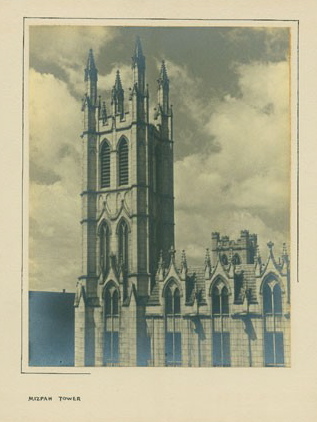
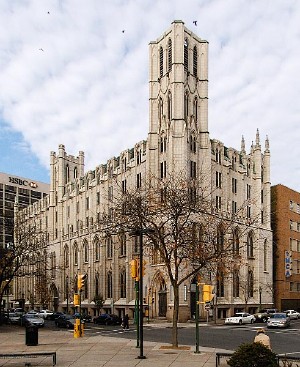
In 1983, I moved out of my parents’ home to stake my claim on adulthood. The place where I spent the next five years of my life was at a women’s hotel in downtown Syracuse called The Mizpah Tower. The First Baptist Church had it built in 1914; it was attached to the church. For many years it served as a residence for the next-door YMCA until it was converted to a women-only hotel in the 1960s. There was a front desk, and every resident was required to leave her key with the desk clerk. No exceptions. My first abode was a large room on the fifth floor facing Jefferson Street; it had a small stall shower and an ancient porcelain sink. Communal kitchens and bathrooms were shared by all residents on each floor.
After about six months, I moved to the penthouse apartment with my significant other.
Trust me, the penthouse was not luxurious, although it afforded an interesting view of nearby buildings, seen below.
The penthouse had old windows with broken sashes, no screens, lead paint, crappy shag carpeting, ants, and radiator heating. The ambient sound was the loud hum of the elevator next to the front door. The shelves in one bedroom were unfinished plywood. The rent cost $300 a month; when it went up to $360 a month, we panicked. We lived on very little then; often a meal was macaroni & cheese with canned peas and sliced hot dogs mixed in. We didn’t own a car. To get groceries, we took a bus to the suburban Wegmans and called for a taxi ride home. We shopped big, because we couldn’t afford the $7 fare more than twice a month. We couldn’t afford real furniture either, as you can see below; my brother was visiting us, and he is reading on our “sofa.”
In 1984, lightning struck the tower opposite the apartment. When I returned home from work, rubble was everywhere, and we were at first told we could not enter the apartment. When we finally received clearance, I spent the better part of a week trembling in fear of the tower falling on us.
The pinnacles were removed that summer.
Later that year we moved to a fourth floor apartment that was less expensive, and because we’d had enough of living the “high life” at the top.
Because money was tight despite each of us having full-time jobs, we both got second jobs as well. Mine was to work Saturday and Sunday from 3:00 to 11:00 p.m. as the desk clerk in the hotel. Basically this involved a lot of sitting alone, reading, and occasionally getting up to take a key or hand one out. One night about 10:00 p.m., two women came in, one holding an infant. The Mizpah was a residence for single women with no dependents only. Children were never allowed, not even to visit upstairs. In the process of explaining the rules, I referred to the baby as “it,” as in, “You cannot take it upstairs to stay even one night.” I had previously referred to the infant as “the baby,” but in the confrontation I was uncomfortable, so “it” is what came out next. I didn’t know the child’s gender, and the clothing gave no clue. Oh, if looks could kill the mother would have done it a hundred times over. She scathingly mocked me for calling the child “it,” and I wound up feeling like some kind of non-feminine freak monster. So I know first-hand of what T.S. Eliot speaks. And of course she went upstairs with the baby anyway. I sure wasn’t going to call the manager or police on her.
The women who lived there were working poor, or elderly and living on a limited income, or sometimes mentally ill and on disability. Room rent was paid weekly. In many ways it was a dreary and depressing place to live, despite the ornately furnished lobby (that no one ever used). At 5:00 p.m. all the downtown stores closed, including small grocery stores. After five years, my SO and I split; I temporarily moved back to my parents’ home to pay off a debt before going to school full-time for my B.A. Not long after we moved out, the church sold the Mizpah and it closed as a residence. The church was briefly converted to an auditorium for music performances but didn’t thrive. The residental halls were abandoned, left to dust and pigeons. It sits unused to this day.
Palm Trees and Snow
Lazy But Not
On this gray, dreary day, Husband and I still have our sweats and jammies on, and it’s nearly 3:30 in the afternoon. Our intention had been to finish unpacking the last of the boxes and to hang art work, but he got involved in a novel, and I dedicated myself to knitting new dish cloths (now my hands ache from working with inflexible cotton). I made beef stew yesterday, so we’ve no need to make effort in the kitchen. And there is still tomorrow to accomplish our tasks.
As I knitted, I was entertained (and educated) by some NPR programs. First is the always informative, witty, and downright funny Wait Wait Don’t Tell Me! which featured among its guests P.J. O’Rourke. I’m pretty well-informed this week, because I got all the answers right. The guest for the “It’s Not My Job” segment was Neil DeGrasse Tyson, an astrophysicist whose Nova shows I avidly watch. “Not My Job” is when an expert is asked questions completely out of his field, and if he wins, a selected listener gets a prize; in this case, his quiz focused on the upcoming Guns ‘n’ Roses album. He was consistent in that he got all three questions wrong, and therefore did not win the prize for the chosen listener. He was really funny and good-natured about his pop culture ignorance. (What’s amazing to me is that I got all three questions correct, even though I know next to nothing about the band.)
Next I heard This American Life with Ira Glass, and the topic was “In the Shadow of the City.” The three stories were about events and life that happen in desolate places in urban areas.
Following that show was a locally produced show, Health Dialogues. This week’s show focused on birth, and here’s the blurb:
The infant mortality rate is down, the number of premature births is up and the average age of new moms in California is at an all-time high. What are the ethical implications of pre-natal testing and concerns about Caesarean deliveries? How are changing demographics, attitudes and science affecting the birth process?
I found it interesting in general, but I was disappointed there wasn’t any time focused on the ethical concerns about pre-natal testing. If you want to hear the show (it’s one hour), click here.
And lastly I heard a fascinating piece from American Radioworks about the work Justice Thurgood Marshall did before being appointed to the United States Supreme Court. Prior to Martin Luther King, Jr., Marshall was known as “Mr. Civil Rights,” as he worked tirelessly for many years to end segregation, particularly in public schools. I had not known he was the lead counsel for the landmark case, Brown vs. Board of Education. The documentary included tape recordings of speeches he gave, interviews with people who worked with him, and commentary from people living in the south who opposed desegregation. One dismaying point made: while there are no longer any laws promoting racial segregation in schools, it continues to exist. If you want to read about this, I recommend The Shame of the Nation: The Restoration of Apartheid Schooling in America, by Jonathan Kozol. It’s a heavy, even discouraging read, but as a taxpayer and citizen, one that is important.
I’m about the press the “publish” button and see it’s just about 4:00 p.m. It’s been a lovely, quiet Saturday. I hope yours has been as well.