
Category Archives: Quotes

First Noble Truth & The Heart Of Christianity

I was raised in the Christian (Catholic) tradition. Over the years I have discovered Buddhist teachings to be compelling, and yet the roots of my spiritual origins run deep. I read a post on another blog which makes me curious to explore more the connections between Christianity and Buddhism.

Suffering, symbolized by the cross, is at the heart of Christianity. Simone Weil calls this penal suffering, suffering inflicted upon one by external force, reducing one to matter. This is a time of penal suffering — of occupying armies, of militant religions, of spineless and duplicitous politicians, of rabid crowds, of jeering, abusive soldiers. The engine of force grinds on day and night, crushing everything in its path.

Suffering is also the first noble truth of Buddhism. Dukkha: the unsatisfactoriness of conditioned phenomena. Birth, old age, illness, grief, despair, death. The vulnerable, mortal body. What is the origin of suffering ? Craving. Clinging. And cessation ? The eightfold path — right understanding, thought, speech, action, livelihood, effort, mindfulness and concentration.

Christ was the consummate Bodhisattva. One could imagine this, from the Bodhisattva vows, in the Sermon on the Mount: Beings are numberless. I vow to save them. Compassion is at the heart of both religions. We are not separate from one another. We are members of the Body of Christ. How can we, then harm one another ?

Craving. Clinging.

The incarnation. God puts on the humiliating mantle of flesh. The latin words from Arvo Part’s ravishing setting of the Nicene Creed — Deo de deum, lumen de lumine, deo vero de deum verum — run through my head. God from God, light from light, true God from True God. Consubstantial. Incarnation: form and emptiness consubstantial. The incarnate God, tortured. Soldiers jeer. High priests, avid to preserve their authority, call for death. The viceroy washes his hands.
Paula’s House of Toast

Another Ah, Yes

Everyone who experiences depression struggles to convey the experience to those who do not. This excerpt comes closest to my own description, and the entire post provides several similes that might help.

Depression is like seeing everyone else walking around and functioning normally on land, but somehow you have to walk through four feet of water. Everything is slower, more deliberate. Everything takes more effort. And sometimes the water gets deeper, and all you can do is tread water, hoping desperately that you’ll be able to hold on long enough for the waves to carry you back into the shallower water again. Sometimes the waves crash over your head, and you have to fight your way back to the surface. Sometimes it feels like you’re underwater, and you can only see the people around you through the water, so everything is distorted and strange.

The RiverStone Journal

The Six Perfections

What is Bodhisattva?

A Bodhisattva is motivated by pure compassion and love. Their goal is to achieve the highest level of being: that of a Buddha. Bodhisattva is a Sanskrit term which translates as: Bodhi [enlightenment] and sattva [being]. And their reason for becoming a Buddha is to help others. The Bodhisattva will undergo any type of suffering to help another sentient being, whether a tiny insect or a huge mammal. In Shakyamuni Buddhas ‘Perfection of Wisdom in 8,000 Lines’ it states: I will become a savior to all those beings, I will release them from all their sufferings. If this sounds familiar to anyone not acquainted with Buddhism, then you only need to think of the example of Jesus Christ, a true Bodhisattva.

–Lisa Maliga

The mind must become enlightened by generating The Six Perfections.

  1. generosity
  2. ethics
  3. patience
  4. effort
  5. concentration
  6. wisdom

Ah Yes, I Remember

How many among us shared nights like this, were dropped off in front of tract homes for hour-long piano sessions of extreme boredom? Rooms too quiet for living. Grateful to hear the screen door slam behind us as our motherÂ’s car pulled finally up. The damned metronome ticking stopped. The mind could speed up or slow down at will again. Childhood moments uncounting, racing down Schwinn streets, hiding quiet in trees, swimming underwater where it was quietest of all, only the small ear sounds of the day cracking open.

–Lisa Thompson of field notes

Potter and Clay

The clay works toward the purpose of forming a vessel and so does the potter, but it is the potter’s joy and privilege to feel the happiness of the accomplishment of the purpose, not the clay’s.

–Pir-o-Murshid Hazrat Inayat Khan
From: A Meditation Theme for Each Day
Selected and arranged by Pir Vilayat Inayat Khan

Amusing Experiment

For the last few months I’ve been writing a book, so it was easy to have a silent morning, since most of the time Sasha provides my only interaction with another mammal. But by midafternoon, I was missing even the minor human contact I usually had. I called my husband at work. After he said “Hello” and I didn’t say anything, he said, “Oh, it’s you. How’s it going?” Pause. “That well, huh?” Pause. “I love you and you’re very weird.”

The Oneness

Talk as much philosophy as you like,
worship as many gods as you please,
observe ceremonies and sing devotional hymns,
but liberation will never come, even after a hundred
aeons, without realizing the Oneness.

–Sankara

What a mystery this Oneness is. My limited intellect only grasps snippets of it. I think that “realizing the Oneness” is not accomplished quickly, and perhaps not entirely while we exist in these bodies, this dimension. I glimpse Oneness when I learn about quantum physics, astronomy, molecular biology, neurophysiology, and mathematics. I also encounter the Oneness when I experience love, awe, and delight. I am with the Oneness not only in my peace, but also in my anger — in my aliveness. I realize Oneness when I consider human civilizations over the millenia, the expanse of geologic time, the insensible grandeur of nature. The Oneness can be thought, felt, tasted, heard. But to apprehend all of this entirely? I haven’t “arrived” at that level of ability. If I did get it all, I think my head might explode!

Aged Outside, Ageless Inside

It’s the oldest story there is about getting older. After a certain age, no one feels on the inside what they look like on the outside. And whose fault is that? Not mine. But it is directly connected to the messages we are bombarded with every day about the virtues of youth, youth and youth. There are so many newspaper and magazine stories lately about plastic surgery — even 20-somethings and 70-somethings are having it — that it is becoming un-American not to. You’re not doing your part for God and country and the denial of death if you’re not being peeled, Botoxed and suctioned within an inch of Nancy Reagan eyes.

I just hate that. And I hate that I’m taking a stand here on this blog for the acceptance of older folks as we are, and even I succumb to the cultural imperative to put a bag over my head so not offend others with my grandmotherly visage. Life shouldn’t be like that. And we should do something to fix it.

–Ronni Bennett, from Time Goes By

[via Fragments from Floyd]

Where Are The Heroes?

Euan Semple raises a question and provides food for thought, quoting another blogger. He excerpts from Laughing Knees:

But so many of the stories from the news are cloaked, as always, in the myths of “heroism” and “doing great deeds for country” and the “selflessness of the young men and women who serve our country”. I’ve read and reread the words over and over again, trying to find in myself the empathy for such abstract and fervent emotions, but, perhaps because I am not American, I just can’t look at the photo of Pat Tilman and feel that he is anything other than a young man whose death will cause suffering for those who knew him and further paints the picture of the war in Afghanistan as nothing more than an arrogant and empty fiasco that the American government has all but forgotten. I cannot find it in myself to see him as a hero. I cannot see it in myself to see anyone as a “hero”.

All this reminds me of a poem from a class on Vietnam Film & Literature I took. It speaks for itself.

Dulce Et Decorum Est

Bent double, like old beggars under sacks,
Knock-kneed, coughing like hags, we cursed through sludge,
Till on the haunting flares we turned our backs
And towards our distant rest began to trudge.
Men marched asleep. Many had lost their boots
But limped on, blood-shod. All went lame; all blind;
Drunk with fatigue; deaf even to the hoots
Of disappointed shells that dropped behind.

GAS! Gas! Quick, boys!– An ecstasy of fumbling,
Fitting the clumsy helmets just in time;
But someone still was yelling out and stumbling
And floundering like a man in fire or lime.–
Dim, through the misty panes and thick green light
As under a green sea, I saw him drowning.

In all my dreams, before my helpless sight,
He plunges at me, guttering, choking, drowning.

If in some smothering dreams you too could pace
Behind the wagon that we flung him in,
And watch the white eyes writhing in his face,
His hanging face, like a devil’s sick of sin;
If you could hear, at every jolt, the blood
Come gargling from the froth-corrupted lungs,
Obscene as cancer, bitter as the cud
Of vile, incurable sores on innocent tongues,–
My friend, you would not tell with such high zest
To children ardent for some desperate glory,
The old Lie: Dulce et decorum est
Pro patria mori.*

–Wilfred Owen

*It is sweet and fitting to die for one’s country.

Owen fought in World War I and died seven days before the Armistice at age twenty-five.

Use Your Swifter Wings

every moment
a voice
out of this world
calls on our soul
to wake up and rise

this soul of ours
is like a flame
with more smoke than light
blackening our vision
letting no light through

lessen the smoke and
more light brightens your house
the house you dwell in now
and the abode
you’ll eventually move to

now my precious soul
how long are you going to
waste yourself
in this wandering journey
can’t you hear the voice
can’t you use your swifter wings
and answer the call

— Translation by Nader Khalili
“Rumi, Fountain of Fire”
Cal-Earth Press, 1994

Paying Attention

Today, like every other day,
We wake up empty and frightened.
Don’t open the door to the study and begin reading.
Take down a musical instrument.
Let the beauty we love be what we do.
There are hundreds of ways to kneel and kiss the ground.

— Rumi

Novelist Marcel Proust wrote, “The real voyage of discovery consists not in seeking new landscapes but in having new eyes.”

Our senses are bombarded by stimuli every day. Attending to all of them would overwhelm us. What this means, for me, is that now and then I happen to notice something that has existed in that place for quite some time. It could be driving past a landmark daily, or walking past a fixture on the wall–one day, I happen to notice it, and then I wonder if it’s been there all along. Another habit is to handle objects inattentively–preparing and eating food, using tools, and so on. We often live in a state of dissociated trance, which is very useful in managing our complex lives. However, if you want to get the most out of being alive, conscious use of your senses is vital.

The suggestion for this week is to practice awareness. For example, when preparing a meal, notice the color of the ingredients, the heft of the chopping knife in your hand, the scent of spices, the taste of the food. Consider how many hands exerted effort regarding this food–those that handled the seeds or animals, planted and harvested, butchered and cleaned, packed and shipped them.

Or take one ordinary object and notice it. Pick it up and feel the texture. Is it cold or warm to the touch? What colors do you notice? Does it have a scent? Is it edible? What does it taste like? If it’s not edible but also non-toxic, lick it and notice what, if anything, it tastes like.

At some point, spend time reflecting on what you noticed and write about it. Use whatever form you like: one paragraph, a poem, a list of adjectives. Push your thinking beyond your normal vocabulary repertoire. Try to avoid use of the passive verb “to be”–is, are, was, were. Be descriptive.

Caveat: If you can find just one activity, or a small period of time, to focus your awareness, that’s enough. My intent was not for anyone to strive for and achieve perpetual present-mindedness.

Think of it more like an English class exercise. Once I was assigned to describe the experience of eating an orange as creatively as possible; it made me pay attention to details more.

This exploration is all about your experience, your relationship with the world. There is no right way. There is only your own way.

The Despotic Ego

Weariness may also begin to set in — this is actually a healthy sign — at the enormous burden of working for the ego. Most of us, before we see this, don’t realize why we’re so tired, or even how tired we are. But we spend our whole day nourishing the ego, being told by it what to do, maintaining and protecting it, being wounded in it. It’s exhausting.

— Larry Rosenberg

[via whiskey river]

The Psychology of Samsara

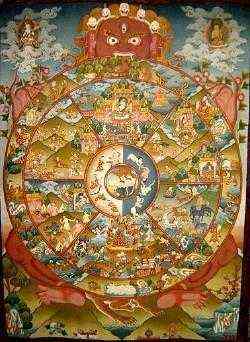
In Thoughts Without a Thinker, Mark Epstein very neatly pulls together various theories of psychotherapy and the aspects of Samsara, the Wheel of Life. This wheel depicts the Six Realms of Existence, through which souls cycle through rebirth. They are: the Human Realm, The Animal Realm, the Hell Realm, the Realm of the Hungry Ghosts, the Realm of Jealous Gods or Titans, and the God Realm. Psychotherapy, he writes, is concerned with reintegrating missing pieces of our experience from which we’ve become estranged. He continues:

This concern with repossessing or reclaiming all aspects of the self is fundamental to the Buddhist notion of the six realms. We are estranged not just from these aspects of character, the Buddhist teachings assert, but also from our own Buddha-nature, from our own enlightened minds. We have ample opportunity to practice the methods of re-possessing or re-membering that are specifically taught in meditation, for we can practice on all of the material of the six realms, on all of the sticking points in our minds. If aspects of a person remain undigested — cut off, denied, projected, rejected, indulged, or otherwise unassimilated — they become the points around which the core forces of greed, hatred, and delusion attach themselves. They are black holes that absorb fear and create the defensive posture of the isolated self, unable to make satisfying contact with others or with the world.

Epstein gives examples connecting theory to realm. Freud et al focused on exposing the animal nature of the passions, such as the Hell-ish nature of paranoia, aggression, and anxiety; insatiable longing (later termed oral craving) depicted by Hungry Ghosts. Humanistic psychotherapy focuses on “peak experiences,” akin to the God Realms. Cognitive, behavioral, and ego psychology can be seen in the competitive Realm of the Jealous Gods. And the Human Realm is the parallel to the psychology of narcissim and questions of identity.

This helps me to understand why I’m uncomfortable when asked what theoretical framework I use in my therapy. Each addresses an important aspect of living, but none of them has ever seemed to completely address all aspects. Therefore, I’ve never wanted to “settle” on just one. This also explains (to me) why I have been intrigued by and drawn to Buddhism for many years. As I developed my professional identity, Buddhism seemed the most inclusive framework. To see the connections made between Eastern and Western thought infuses me with interest.

I’ve only recently settled in to read this book, and it promises rich sustenance.

At Play

I got creative this weekend, and my soul felt refreshed. It’s a reflection of the state of my life right now.

Oh, and this amuses me:

How important are the visual arts in our society? I feel strongly that the visual arts are of vast and incalculable importance. Of course I could be prejudiced. I am a visual art.

–Kermit the Frog

Lord Knows What They’ve Got In Mind

I don’t blog much about political issues here, and any approach is likely to be oblique. As I surfed the web today, I happened across a Shel Silverstein poem that struck me as a perfect depiction of the past four years’ trend in the White House. Satire is a political act. This post is my part.

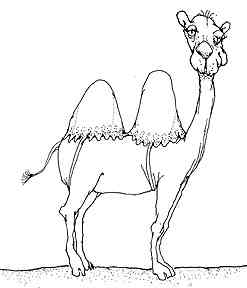
They’ve Put a Brassiere On a Camel

They’ve put a brassiere on a camel,
She wasn’t dressed proper, you know.
They’ve put a brassiere on a camel,
So that her humps wouldn’t show.
And they’re making other respectable plans,
They’re even even insisting the pigs should wear pants,
They’ll dress up the ducks if we give them the chance
Since they’ve put a brassiere on a camel.

They’ve put a brassiere on a camel,
They claim she’s more decent that way.
They’ve put a brassiere on a camel,
The camel had nothing to say.
They squeezed her into it, i’ll never know how,
They say that she looks more respectable now,
Lord knows what they’ve got in mind for the cow,
Since they’ve put a brassiere on a camel.

©1981 Evil Eye Music Poem and drawing by: Shel Silverstein

What’s Left?

Kurt Brobeck of The Coffee Sutras writes inspired entries he dubs “morning verses.” This one struck me as especially eloquent.

Yesterday I felt discouraged.
It hangs over me this morning, as well.
I tell myself chop wood, carry water.
But the woods grow thicker.
The water is over my head.
I have only these old bones
to hack and paddle, picked
clean by time and overuse.
They’re dull. And silence, the clear
spring, well, maybe in the next life.
Here in this one, the birds
tear silence like an old blanket,
hoard it in their nests,
out of reach, woven in twigs
and dead grass. What’s left?
I put my hope in the furious
scouring of storms.

Only Shared Footsteps & Silence

This is particularly lovely to me, and rings true.

But it’s not the same, a friendship of correspondence, a friendship of words. Once you’ve walked alone together, in silence, with a dear, true friend, there’s so much more to say than words can capture. Open mouth, already a mistake. Sometimes only shared footsteps and sun-drenched silence can sum up one’s true sentiments.

–Lorianne Schaub, Hoarded Ordinaries