There are four different explanations of the word spirit. One meaning is essence. The second meaning of spirit is what is understood by those who call the soul spirit when it has left the body on earth and has passed to the other side. The third meaning is that of the soul and mind working together. It is used in this sense when one says that a man seems to be in low spirits. And the fourth meaning of spirit is the soul of all souls, the source and goal of all things and all beings, from which all comes and to which all returns.
–Pir-o-Murshid Hazrat Inayat Khan
From: A Meditation Theme for Each Day
Selected and arranged by Pir Vilayat Inayat Khan
Category Archives: Humanities
Words to Ponder #82
I have dreamed in my life, dreams that have stayed with me ever after, and changed my ideas; they have gone through and through me, like wine through water, and altered the color of my mind.
–Emily Bronte
Haiku
Thoughtful woman, her
gaze fixed on another realm
embraced in sadness.
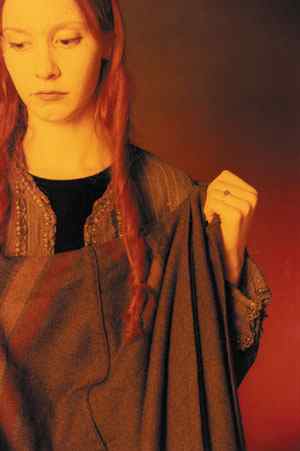
Dave Rentauskas ©2003 / ephotograph
A Gift
Since last Thursday, my personal life is topsy-turvy, with many heavy questions and choices pressing in and refusing to give way. Life can be such a challenge when one is walking the path with someone, trying to negotiate the turns. Work, love, progeny… We live in a world of innumerable choices, and I think that this cripples us. At the least, it weights us with greater responsibility for our decisions.
A friend of mine has great talent for artwork and words. Despite the fact that she cares for her 14-month-old child 24/7, she found time in the past week to make a small book of sorts, and on the pages she drew numerous intricate, colorful mandalas. In addition, she chose several poems and quotes that connected in her heart toward mine, one of which was by one of my favorite authors, May Sarton. Another is a poem written by her mother, who died suddenly when my friend was in college. I went over to visit today and she surprised me with this gift. As soon as I read the first poem I began to cry, because it speaks so perfectly to me of myself, at this age. I cherish my friend’s empathy. I will refrain from sharing the poem her mother wrote, as I don’t have permission to reveal the author’s name. However, here is the poem which touches me deeply.
Now I Become Myself Now I become myself. It’s taken
Time, many years and places;
I have been dissolved and shaken,
Worn other people’s faces,
Run madly, as if Time were there,
Terribly old, crying a warning,
“Hurry, you will be dead before–”
(What? Before you reach the morning?
Or the end of the poem is clear?
Or love safe in the walled city?)
Now to stand still, to be here,
Feel my own weight and density!
The black shadow on the paper
Is my hand; the shadow of a word
As thought shapes the shaper
Falls heavy on the page, is heard.
All fuses now, falls into place
From wish to action, word to silence,
My work, my love, my time, my face
Gathered into one intense
Gesture of growing like a plant.
As slowly as the ripening fruit
Fertile, detached, and always spent,
Falls but does not exhaust the root,
So all the poem is, can give,
Grows in me to become the song,
Made so and rooted so by love.
Now there is time and Time is young.
O, in this single hour I live
All of myself and do not move.
I, the pursued, who madly ran,
Stand still, stand still, and stop the sun!–May Sarton
Existential Theory
One of my favorite therapists and writers is Irvin Yalom, a man of great insight who tells captivating stories. I’ve read nearly all of his books, one of which briefly discusses the aspects of existential psychology. He wrote quite a tome dealing with it in great detail, but I’ll be quoting from the prologue of Love’s Executioner.
On Death
As we grow older, we learn to put death out of mind; we distract ourselves; we transform it into something positive (passing on, going home, rejoining God, peace at last); we deny it with sustaining myths; we strive for immortality through imperishable works, by projecting our seed into the future through our children, or by embracing a religious system that offers spiritual perpetuation.
We know about death, intellectually we know the facts, but we — that is, the unconscious portion of the mind that protects us from overwhelming anxiety — have split off, or dissociated, the terror associated with death.
A nightmare is a failed dream, a dream that, by not “handling” anxiety, has failed in its role as the guardian of sleep. Though nightmares differ in manifest content, the underlying process of every nightmare is the same: raw death anxiety has escaped its keepers and exploded into consciousness.
…though the fact, the physicality, of death destroys us, the idea of death may save us.
On Freedom
Freedom means one is responsible for one’s own choices, actions, one’s own life situation. Though the word responsible may be used in a variety of ways, I prefer Sartre’s definition: to be responsible is to “be the author of,” each of us being thus the author of his or her own life design. We are free to be anything but unfree; we are, Sartre would say, condemned to freedom. Indeed, some philosophers claim much more: that the architecture of the human mind makes each of us even responsible for the structure of external reality, for the very form of space and time. It is here, in the idea of self-construction, where anxiety dwells: we are creatures who desire structure, and we are frightened by a concept of freedom which implies that beneath us there is nothing, sheer groundlessness.
Some people are wish-blocked, knowing neither what they feel nor what they want. Without opinions, without impulses, without inclinations, they become parasites on the desires of others. Such people tend to be tiresome.
Other patients cannot decide. Though they know exactly what they want and what they must do, they cannot act and, instead, pace tormentedly before the door of decision.
Decision invariably involves renunciation: for every yes there must be a no, each decision eliminating or killing other options (the root of the word decide means “slay,” as in homicide or suicide).
On Isolation
One experiences interpersonal isolation, or loneliness, if one lacks the social skills or personality style that permit intimate social interactions. Intrapersonal isolation occurs when parts of the self are split off, as when one splits off emotion from the memory of an event.
One’s efforts to escape isolation can sabotage one’s relationships with other people. Many a friendship or marriage has failed because, instead of relating to, and caring for, one another, one person uses another as a shield against isolation.
Beware of the powerful exclusive attachment to another; it is not, as people sometimes think, evidence of the purity of love. Such encapsulated, exclusive love — feeding on itself, neither giving to nor caring about others — is destined to cave in on itself. Love is not just a passion spark between two people; there is infinite difference between falling in love and standing in love. Rather, love is a way of being, a “giving to,” not a “falling for”; a mode of relating at large, not an act limited to a single person.
On Meaning
The search for meaning, much like the search for pleasure, must be conducted obliquely. Meaning ensues from meaningful activity; the more deliberately we pursue it, the less likely we are to find it; the rational questions one can pose about meaning will always outlast the answers. In therapy, as in life, meaningfulness is a byproduct of engagement and commitment, and that is where therapists must direct their efforts — not that engagement provides a rational answer to questions of meaning, but it causes the questions not to matter.
This encounter, the very heart of psychotherapy, is a caring, deeply human meeting between two people, one (generally, but not always, the patient) more troubled than the other. Therapists have a dual role: they must both observe and participate in the lives of their patients. As observer, one must be sufficiently objective to provide necessary rudimentary guidance to the patient. As participant, one enters into the life of the patient and is affected and sometimes changed by the encounter.
Patienthood is ubiquitous; the assumption of the label is largely arbitrary and often dependent more on cultural, educational, and economic factors than on the severity of pathology. Since therapists, no less than patients, must confront these givens of existence, the professional posture of disinterested objectivity, so necessary to scientific method, is inappropriate. We psychotherapists simply cannot cluck with sympathy and exhort patients to struggle resolutely with their problems. We cannot say to them you and your problems. Instead, we must speak of us and our problems, because our life, our existence, will always be riveted to death, love to loss, freedom to fear, and growth to separation. We are, all of us, in this together.
The Substance Of Matter
All that is constructed is subject to destruction; all that is composed must be decomposed; all that is formed must be destroyed; that which has birth has death. But all this belongs to matter: the spirit that is absorbed by this formation of matter or by its mechanism lives, for spirit cannot die. What we call life is an absorption of spirit by matter. As long as the matter is strong and energetic enough to absorb life or spirit from space, it continues to live and move and be in good condition, but when it has lost its grip on the spirit, when it cannot absorb the spirit as it ought to, then it cannot live, for the substance of matter is spirit.
–Pir-o-Murshid Hazrat Inayat Khan
From: A Meditation Theme for Each Day
Selected and arranged by Pir Vilayat Inayat Khan
Haiku
On the path alone,
branches extend a welcome
as I journey on.

G. L. Wright ©2003 / picture.com
Me Neither
The poet is supposed to be the person who can’t get enough of words like “incarnadine.” This was not my experience.
–Louise Gluck, who was born on this day in 1943; she was appointed U.S. Poet Laureate in 2003
[via Today in Literature]
My Morning Smile
Kurt of The Coffee Sutras gave me a happy moment today when I read:
It was a sentence, I suspect, never before uttered in the annals of the Crieve Hall Youth Athletic Association. Sitting on the aluminum bleachers under the pines that screen the baseball field from the road and the houses opposite, one father, whose son was on the mound, called out, “Release your chi!”
Another Perspective Of Trust
Trust is the daughter of Truth. She has an objective memory, neither embellishing nor denying the past. She is an ideal confidante — gracious, candid, and discreet. Trust talks to people who need to hear her; she listens to those who need to be heard; she sits quietly with those who are skeptical of words. Her presence is subtle, simple, and undeniable.
Trust rarely buys round-trip tickets because she is never sure how long she will be gone and when she will return. Trust is at home in the desert and the city, with dolphins and tigers, with outlaws, lovers, and saints. When Trust bought her house, she tore out all the internal walls, strengthened the foundation, and rebuilt the door. Trust is not fragile, but she has no need to advertise her strength. She has a gambler’s respect for the interplay between luck and skill; she is the mother of Love.
–Ruth Gendler, The Book of Qualities
What Is Trust?
Naive trust is the promise of security – a pact destined to be broken by a universe whose only constant is change. Authentic trust is an expectation of change. Trust is another word for expectation.
When I think about my closest friends, I’m acutely aware of the implicit expectation that they will change, they will evolve, and alas, they will surprise me. Counting on that is authentic trust – trust that is aligned with the reality of impermanence. Only with arms of authentic trust can I embrace the Infinite.
–Jack Ricchiuto of gassho
Zhuzh It Up (I’ll Take It) *
Out of curiosity I tuned into Queer Eye for the Straight Guy several weeks ago and, after acclimating myself to its occasional shrill earnestness, have become quite fond of the Fab 5 and their talent for transforming (i.e., adding a bit of class and polish to) straight men.
One word I especially like, that Carson uses frequently, is zhuzhing, which is defined by Blanche Poubelle:
Zhuzh is primarily a verb in the Queer Eye episodes, and is often used in combination with up, as in “to zhuzh your sleeves up.” The word has spread beyond Queer Eye and seems generally to mean ‘make fashionable’. When applied to the general project of making everything stylish, it sometimes takes the object it, as in “zhuzhing it up for some special occasion.”
Its appeal is summed up nicely:
To an English speaker’s ear, a word with zh at the beginning sounds foreign and/or French, and English speakers associate the French with femininity and fashion. So a word like zhuzh with its two foreign-sounding zh’s has a potent kind of queer aesthetics. It doesn’t sound like the kind of word a ‘real man’ would use, and so it’s particularly attractive to those who don’t care about being perceived as real men.
Perhaps the ultimate appeal of zhuzh is that you can’t imagine George W. Bush ever saying it, much less being able to pronounce it. With the Francophobic, macho Bush administration in power, maybe we all appreciate the diversion of Queer Eye because it celebrates the virtues of style and appearance in a political climate that has precious little of either. Now if we could only get the Fab 5 to re-do our foreign policy….
*With a nod to Austin’s own, The Fabulous Thunderbirds’ rockin’ song Wrap It Up.
Bittersweet Blessing
The Consecration of CoffeeOne day of god
drinking coffee in my patio
nothing is normal–
not the calla
with its penis of gold
nor the iris
like purple lava
a volcano spills.
I find in the depths of the cup
chasubles embroidered
with black moths
& red stains–
the sun fires
a scintillation of silver bullets
& of candles drowned–
there is blood in its shine.
I place the cup on its saucer
with a most tender care
as if it were a chalice
& say the litany:
Guatemala
Nicaragua
El Salvador
& one side of my heart
tastes white & sweet
like cane sugar
& the other,
like coffee,
bitter & black.–Rafael Jesús González
Glorious Ordinary Life
Being Boring If you ask me ‘What’s new?’, I have nothing to say
Except that the garden is growing.
I had a slight cold but it’s better today.
I’m content with the way things are going.
Yes, he is the same as he usually is,
Still eating and sleeping and snoring.
I get on with my work. He gets on with his.
I know this is all very boring.There was drama enough in my turbulent past:
Tears and passion-I’ve used up a tankful.
No news is good news, and long may it last,
If nothing much happens, I’m thankful.
A happier cabbage you never did see,
My vegetable spirits are soaring.
If you’re after excitement, steer well clear of me.
I want to go on being boring.I don’t go to parties. Well, what are they for,
If you don’t need to find a new lover?
You drink and you listen and drink a bit more
And you take the next day to recover.
Someone to stay home with was all my desire
And, now that I’ve found a safe mooring,
I’ve just one ambition in life: I aspire
To go on and on being boring.–Wendy Cope
Haiku
I want to know, child:
how many flavors of joy?
Thirty-two? Or more?
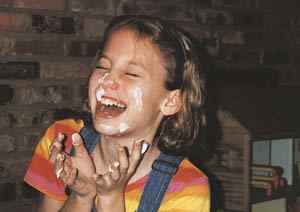
Emily Banks ©2002/ephotograph