
The world is full of people looking for spectacular happiness while they snub contentment.
–Doug Larson
Category Archives: Humanities
Seeing Humans With Empathy
Euan mentioned a conversation he had with another blogger who was deeply disturbed by the images of Nick Berg’s execution. He then made an observation:
I know I have written about this before but yet again I was struck that, bizarrely, I have at least as much compassion for the perpetrators of such acts as their victims.
With any luck, until their untimely death, the victims will have had happy, joyous lives and inhabited a world of love and relationship. Yes they have died a horrible death but now it is over. The perpetrators on the other hand must exist in a world of absolute horror, terror and alienation and their living hell continues.
It is inconceivable to me to inhabit a world where such acts of cold blooded cruelty are OK and I find myself feeling for sorry for people who have created such a living hell for themselves.
I can, abstractly and intellectually, align myself with his position. Having seen the video of the murder, however, I am a long way from feeling it in my soul. Still, it seems worthwhile to attempt, or at least consider.
A Mistake
The conception that the physical body is made of sin and that this is the lowest aspect of being will very often prove to be a mistake, for it is through this physical body that the highest and the greatest purpose of life is to be achieved.
–Pir-o-Murshid Hazrat Inayat Khan
From: A Meditation Theme for Each Day
Selected and arranged by Pir Vilayat Inayat Khan
Haiku
Standing alone, with
just waves and sky to witness
eternity’s show.

“Seastack Second Beach” by Lyle Hoefner ©2003/ ephotograph
To Be Or Not To Be A Mother
You may notice in my sidebar that my “currently reading” list includes five books on pregnancy and motherhood. I’m of an age where I’m considered “past my prime” for it. On the other hand, it’s not out of the question. I’ve set out to make an informed choice. A friend gave me several of her books, and I purchased one on pregnancy for women over 35.
One decision I need to make is if this is truly an endeavor I want to give my life to. Assuming I succeed and bear a healthy child, do I, at this point in my life and career, want to incorporate the vocation of parenthood? One thing I know for certain: I have the capacity to be a marvelous mother, far more so that I would have been in my twenties and thirties. I know who I am, and I like myself. I do believe self-knowledge dovetails with good parenting.
The problem is that there are very real risks with midlife pregnancy. In addition, the possibility increases that my fertility has waned. Do I want a child so much that I will undergo all possible treatments and get into debt? No, I don’t want to go that far. I also need to consider the impact that being an older parent will have on my child. So many questions.
My partner and I have considered adoption, and we haven’t ruled it out. Yet he is keen to try having a biological child first. So we begin by learning in order to make a responsible choice.
I surfed and located several sites offering support for older mothers; there are fewer sites for this population than I’d hoped.
She Knows Network: Midlife Moms
Hip Mama (not just for older moms)
And the books I’m reading:
Pregnancy and Childbirth: The Complete Guide for a New Life
Planning Your Pregnancy and Birth, Third Edition
Mother Shock: Loving Every (Other) Minute of It
Anne Lamott’s book, Operating Instructions: A Journal of My Son’s First Year, also came highly recommended.
First Noble Truth & The Heart Of Christianity
I was raised in the Christian (Catholic) tradition. Over the years I have discovered Buddhist teachings to be compelling, and yet the roots of my spiritual origins run deep. I read a post on another blog which makes me curious to explore more the connections between Christianity and Buddhism.
Suffering, symbolized by the cross, is at the heart of Christianity. Simone Weil calls this penal suffering, suffering inflicted upon one by external force, reducing one to matter. This is a time of penal suffering — of occupying armies, of militant religions, of spineless and duplicitous politicians, of rabid crowds, of jeering, abusive soldiers. The engine of force grinds on day and night, crushing everything in its path.
Suffering is also the first noble truth of Buddhism. Dukkha: the unsatisfactoriness of conditioned phenomena. Birth, old age, illness, grief, despair, death. The vulnerable, mortal body. What is the origin of suffering ? Craving. Clinging. And cessation ? The eightfold path — right understanding, thought, speech, action, livelihood, effort, mindfulness and concentration.
Christ was the consummate Bodhisattva. One could imagine this, from the Bodhisattva vows, in the Sermon on the Mount: Beings are numberless. I vow to save them. Compassion is at the heart of both religions. We are not separate from one another. We are members of the Body of Christ. How can we, then harm one another ?
Craving. Clinging.
The incarnation. God puts on the humiliating mantle of flesh. The latin words from Arvo Part’s ravishing setting of the Nicene Creed — Deo de deum, lumen de lumine, deo vero de deum verum — run through my head. God from God, light from light, true God from True God. Consubstantial. Incarnation: form and emptiness consubstantial. The incarnate God, tortured. Soldiers jeer. High priests, avid to preserve their authority, call for death. The viceroy washes his hands.
Change Your Mind Day
Austin will soon observe its third annual Change Your Mind Day. From the press release:
Buddhism has come to Austin and is here to stay: There are nearly a score of Buddhist organizations in Austin to date, from temples to weekly meditation and discussion groups, representing several Asian ethnicities as well as the new American Buddhism, with growing numbers of ordained monks and nuns along with lay practitioners. To promote awareness of this growing movement in Austin’s religious and cultural landscape, on June 5 “Change Your Mind Day” will bring teachers and representatives from most of Austin’s Buddhist centers to a friendly public setting for a day of introductory talks, meditation instruction, chanting, tea ceremony, Buddhist art, and other events, free of charge to the general public.
For more information, visit Buddhism in Austin. This event is hosted by the Austin Zen Center, sponsored by the Buddhist Peace Fellowship, and presented by Tricycle: the Buddhist Review.
Thanks For The Clarification
Intrinsic enlightenment refers to the idea that all living beings are Buddhas. It does not mean that beings possess a Buddha nature, or that beings are containers in which a seed form of Buddha can be found, as if there were two realities, beings and Buddha. It means that beings are Buddhas, but they are blind, stupid Buddhas who are ignorant of their true nature.
–Francis Cook
[via whiskey river]
The Six Perfections
A Bodhisattva is motivated by pure compassion and love. Their goal is to achieve the highest level of being: that of a Buddha. Bodhisattva is a Sanskrit term which translates as: Bodhi [enlightenment] and sattva [being]. And their reason for becoming a Buddha is to help others. The Bodhisattva will undergo any type of suffering to help another sentient being, whether a tiny insect or a huge mammal. In Shakyamuni Buddhas ‘Perfection of Wisdom in 8,000 Lines’ it states: I will become a savior to all those beings, I will release them from all their sufferings. If this sounds familiar to anyone not acquainted with Buddhism, then you only need to think of the example of Jesus Christ, a true Bodhisattva.
–Lisa Maliga
The mind must become enlightened by generating The Six Perfections.
- generosity
- ethics
- patience
- effort
- concentration
- wisdom
Alfred Adler & Abraham Maslow
In a brief article, “Alfred AdlerÂ’s Life: Five Lessons for Everyone,” Ed Hoffman highlights five of Adler’s personal characteristics that contributed to his extraordinary influence on contemporary psychology. In another article, “Abraham Maslow: Father of Enlightened Management,” Hoffman clarifies the connections among enlightened management, quality products, and psychologically healthy employees. Both articles may be found at http://go.ourworld.nu/hstein/.
Edward Hoffman, Ph.D., a New York City psychologist, is the author of “The Drive for Self: Alfred Adler and the Founding of Individual Psychology” (Addison-Wesley, 1994); “The Right to Be Human: A Biography of Abraham Maslow” (Tarcher/St. Martin’s Press, 1988); and “Future Visions: The Unpublished Papers of Abraham Maslow” (Sage, 1995).
[via Alfred Adler Institutes of San Francisco & Northwestern Washington]
Potter and Clay
The clay works toward the purpose of forming a vessel and so does the potter, but it is the potter’s joy and privilege to feel the happiness of the accomplishment of the purpose, not the clay’s.
–Pir-o-Murshid Hazrat Inayat Khan
From: A Meditation Theme for Each Day
Selected and arranged by Pir Vilayat Inayat Khan
Haiku
This rusted old hulk
found new purpose as a home
for desert dwellers.

“California Desert Ghost” by Ansley Davies ©2003 / ephotograph
Amusing Experiment
For the last few months I’ve been writing a book, so it was easy to have a silent morning, since most of the time Sasha provides my only interaction with another mammal. But by midafternoon, I was missing even the minor human contact I usually had. I called my husband at work. After he said “Hello” and I didn’t say anything, he said, “Oh, it’s you. How’s it going?” Pause. “That well, huh?” Pause. “I love you and you’re very weird.”
The Oneness
Talk as much philosophy as you like,
worship as many gods as you please,
observe ceremonies and sing devotional hymns,
but liberation will never come, even after a hundred
aeons, without realizing the Oneness.–Sankara
What a mystery this Oneness is. My limited intellect only grasps snippets of it. I think that “realizing the Oneness” is not accomplished quickly, and perhaps not entirely while we exist in these bodies, this dimension. I glimpse Oneness when I learn about quantum physics, astronomy, molecular biology, neurophysiology, and mathematics. I also encounter the Oneness when I experience love, awe, and delight. I am with the Oneness not only in my peace, but also in my anger — in my aliveness. I realize Oneness when I consider human civilizations over the millenia, the expanse of geologic time, the insensible grandeur of nature. The Oneness can be thought, felt, tasted, heard. But to apprehend all of this entirely? I haven’t “arrived” at that level of ability. If I did get it all, I think my head might explode!
Yes!
The Universe is a system that creeps up on itself and says “Boo!” and then laughs at itself for jumping.
–Alan Watts
Use Your Swifter Wings
every moment
a voice
out of this world
calls on our soul
to wake up and risethis soul of ours
is like a flame
with more smoke than light
blackening our vision
letting no light throughlessen the smoke and
more light brightens your house
the house you dwell in now
and the abode
you’ll eventually move tonow my precious soul
how long are you going to
waste yourself
in this wandering journey
can’t you hear the voice
can’t you use your swifter wings
and answer the call— Translation by Nader Khalili
“Rumi, Fountain of Fire”
Cal-Earth Press, 1994
The Despotic Ego
Weariness may also begin to set in — this is actually a healthy sign — at the enormous burden of working for the ego. Most of us, before we see this, don’t realize why we’re so tired, or even how tired we are. But we spend our whole day nourishing the ego, being told by it what to do, maintaining and protecting it, being wounded in it. It’s exhausting.
— Larry Rosenberg
[via whiskey river]
Haiku
Warily peeking,
assessing closely, this child
has secrets to tell.

“Girl With The Scarf” by Pawel Bogdal ©2003 / ephotograph
The Psychology of Samsara
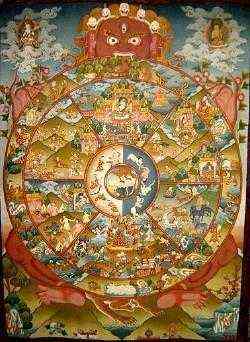
In Thoughts Without a Thinker, Mark Epstein very neatly pulls together various theories of psychotherapy and the aspects of Samsara, the Wheel of Life. This wheel depicts the Six Realms of Existence, through which souls cycle through rebirth. They are: the Human Realm, The Animal Realm, the Hell Realm, the Realm of the Hungry Ghosts, the Realm of Jealous Gods or Titans, and the God Realm. Psychotherapy, he writes, is concerned with reintegrating missing pieces of our experience from which we’ve become estranged. He continues:
This concern with repossessing or reclaiming all aspects of the self is fundamental to the Buddhist notion of the six realms. We are estranged not just from these aspects of character, the Buddhist teachings assert, but also from our own Buddha-nature, from our own enlightened minds. We have ample opportunity to practice the methods of re-possessing or re-membering that are specifically taught in meditation, for we can practice on all of the material of the six realms, on all of the sticking points in our minds. If aspects of a person remain undigested — cut off, denied, projected, rejected, indulged, or otherwise unassimilated — they become the points around which the core forces of greed, hatred, and delusion attach themselves. They are black holes that absorb fear and create the defensive posture of the isolated self, unable to make satisfying contact with others or with the world.
Epstein gives examples connecting theory to realm. Freud et al focused on exposing the animal nature of the passions, such as the Hell-ish nature of paranoia, aggression, and anxiety; insatiable longing (later termed oral craving) depicted by Hungry Ghosts. Humanistic psychotherapy focuses on “peak experiences,” akin to the God Realms. Cognitive, behavioral, and ego psychology can be seen in the competitive Realm of the Jealous Gods. And the Human Realm is the parallel to the psychology of narcissim and questions of identity.
This helps me to understand why I’m uncomfortable when asked what theoretical framework I use in my therapy. Each addresses an important aspect of living, but none of them has ever seemed to completely address all aspects. Therefore, I’ve never wanted to “settle” on just one. This also explains (to me) why I have been intrigued by and drawn to Buddhism for many years. As I developed my professional identity, Buddhism seemed the most inclusive framework. To see the connections made between Eastern and Western thought infuses me with interest.
I’ve only recently settled in to read this book, and it promises rich sustenance.
At Play
I got creative this weekend, and my soul felt refreshed. It’s a reflection of the state of my life right now.
Oh, and this amuses me:
How important are the visual arts in our society? I feel strongly that the visual arts are of vast and incalculable importance. Of course I could be prejudiced. I am a visual art.
–Kermit the Frog