
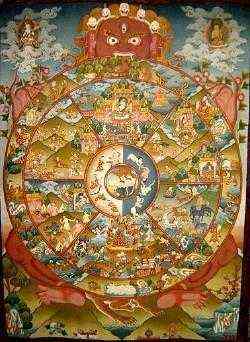
In Thoughts Without a Thinker, Mark Epstein very neatly pulls together various theories of psychotherapy and the aspects of Samsara, the Wheel of Life. This wheel depicts the Six Realms of Existence, through which souls cycle through rebirth. They are: the Human Realm, The Animal Realm, the Hell Realm, the Realm of the Hungry Ghosts, the Realm of Jealous Gods or Titans, and the God Realm. Psychotherapy, he writes, is concerned with reintegrating missing pieces of our experience from which we’ve become estranged. He continues:
This concern with repossessing or reclaiming all aspects of the self is fundamental to the Buddhist notion of the six realms. We are estranged not just from these aspects of character, the Buddhist teachings assert, but also from our own Buddha-nature, from our own enlightened minds. We have ample opportunity to practice the methods of re-possessing or re-membering that are specifically taught in meditation, for we can practice on all of the material of the six realms, on all of the sticking points in our minds. If aspects of a person remain undigested — cut off, denied, projected, rejected, indulged, or otherwise unassimilated — they become the points around which the core forces of greed, hatred, and delusion attach themselves. They are black holes that absorb fear and create the defensive posture of the isolated self, unable to make satisfying contact with others or with the world.
Epstein gives examples connecting theory to realm. Freud et al focused on exposing the animal nature of the passions, such as the Hell-ish nature of paranoia, aggression, and anxiety; insatiable longing (later termed oral craving) depicted by Hungry Ghosts. Humanistic psychotherapy focuses on “peak experiences,” akin to the God Realms. Cognitive, behavioral, and ego psychology can be seen in the competitive Realm of the Jealous Gods. And the Human Realm is the parallel to the psychology of narcissim and questions of identity.
This helps me to understand why I’m uncomfortable when asked what theoretical framework I use in my therapy. Each addresses an important aspect of living, but none of them has ever seemed to completely address all aspects. Therefore, I’ve never wanted to “settle” on just one. This also explains (to me) why I have been intrigued by and drawn to Buddhism for many years. As I developed my professional identity, Buddhism seemed the most inclusive framework. To see the connections made between Eastern and Western thought infuses me with interest.
I’ve only recently settled in to read this book, and it promises rich sustenance.