
If you desire to drain to the dregs the fullest cup of scorn and hatred that a fellow human being can pour out for you, let a young mother hear you call dear baby ‘it.’
–T.S. Eliot
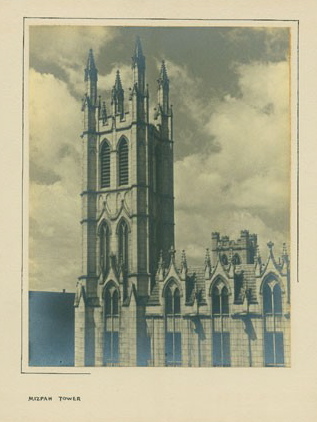
In 1983, I moved out of my parents’ home to stake my claim on adulthood. The place where I spent the next five years of my life was at a women’s hotel in downtown Syracuse called The Mizpah Tower. The First Baptist Church had it built in 1914; it was attached to the church. For many years it served as a residence for the next-door YMCA until it was converted to a women-only hotel in the 1960s. There was a front desk, and every resident was required to leave her key with the desk clerk. No exceptions. My first abode was a large room on the fifth floor facing Jefferson Street; it had a small stall shower and an ancient porcelain sink. Communal kitchens and bathrooms were shared by all residents on each floor.
After about six months, I moved to the penthouse apartment with my significant other.

Trust me, the penthouse was not luxurious, although it afforded an interesting view of nearby buildings, seen below.


The penthouse had old windows with broken sashes, no screens, lead paint, crappy shag carpeting, ants, and radiator heating. The ambient sound was the loud hum of the elevator next to the front door. The shelves in one bedroom were unfinished plywood. The rent cost $300 a month; when it went up to $360 a month, we panicked. We lived on very little then; often a meal was macaroni & cheese with canned peas and sliced hot dogs mixed in. We didn’t own a car. To get groceries, we took a bus to the suburban Wegmans and called for a taxi ride home. We shopped big, because we couldn’t afford the $7 fare more than twice a month. We couldn’t afford real furniture either, as you can see below; my brother was visiting us, and he is reading on our “sofa.”

In 1984, lightning struck the tower opposite the apartment. When I returned home from work, rubble was everywhere, and we were at first told we could not enter the apartment. When we finally received clearance, I spent the better part of a week trembling in fear of the tower falling on us.

The pinnacles were removed that summer.

Later that year we moved to a fourth floor apartment that was less expensive, and because we’d had enough of living the “high life” at the top.
Because money was tight despite each of us having full-time jobs, we both got second jobs as well. Mine was to work Saturday and Sunday from 3:00 to 11:00 p.m. as the desk clerk in the hotel. Basically this involved a lot of sitting alone, reading, and occasionally getting up to take a key or hand one out. One night about 10:00 p.m., two women came in, one holding an infant. The Mizpah was a residence for single women with no dependents only. Children were never allowed, not even to visit upstairs. In the process of explaining the rules, I referred to the baby as “it,” as in, “You cannot take it upstairs to stay even one night.” I had previously referred to the infant as “the baby,” but in the confrontation I was uncomfortable, so “it” is what came out next. I didn’t know the child’s gender, and the clothing gave no clue. Oh, if looks could kill the mother would have done it a hundred times over. She scathingly mocked me for calling the child “it,” and I wound up feeling like some kind of non-feminine freak monster. So I know first-hand of what T.S. Eliot speaks. And of course she went upstairs with the baby anyway. I sure wasn’t going to call the manager or police on her.
The women who lived there were working poor, or elderly and living on a limited income, or sometimes mentally ill and on disability. Room rent was paid weekly. In many ways it was a dreary and depressing place to live, despite the ornately furnished lobby (that no one ever used). At 5:00 p.m. all the downtown stores closed, including small grocery stores. After five years, my SO and I split; I temporarily moved back to my parents’ home to pay off a debt before going to school full-time for my B.A. Not long after we moved out, the church sold the Mizpah and it closed as a residence. The church was briefly converted to an auditorium for music performances but didn’t thrive. The residental halls were abandoned, left to dust and pigeons. It sits unused to this day.
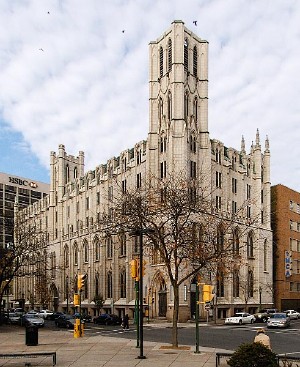
Well, it sounds like a place a novel happens…