
Over, under, through–
water reflects human toil
as night settles in.
Monthly Archives: March 2004

Licking Honey From Thorns
Mortal love is but the licking of honey from thorns.
–Anonymous woman at the court of Eleanor of Aquitaine, (1198), in Helen Lawrenson, Whistling Girl (1978)
One must desire something, to be alive; perhaps absolute satisfaction is only another name for Death.
–Margaret Deland, Florida Days (1889)
Sex itself must always, it seems to me, come to us as a sacrament and be so used or it is meaningless. The flesh is suffused by the spirit, and it is forgetting this in the act of love-making that creates cynicism and despair.
–May Sarton, Recovering (1980)
The concept in Buddhism that desire contributes to our suffering remains complicated to me. The end of the journey — Nirvana — is the state of desirelessness, nothingness. But isn’t the goal of Nirvana a desire in itself? Is Nirvana reached only when one stops caring about it as a destination or accomplishment? I suppose that is when death, as we know it, would happen.
Meanwhile, I like the image of licking honey from thorns. It appeals to attraction to duality — instead of either/or, however, the image suggests both/and. You can have love, if you’re willing to lick the thorns, risking some injury to yourself. Or you can have pain, as long as you understand the sweetness that lies on the other side — not-pain.
The Color of Purity
“The Color of Purity” Inside myself I breathe
the fragrance of the Friend.In the garden last night
an urge ran through my head;
a sun shone out of my eyes;
an inner river began to flow.Lips became laughing roses
without the thorns of existence,
safe from the sword of decay.The trees and plants in the meadow,
which to normal eyes looked fixed and still,
seemed to dance.
When our tall Cypress appeared,
the garden lost itself entirely,
and the plane tree clapped its hands.A face of fire, a burning wine,
a blazing love, all happy together,
and the self, overwhelmed, screaming,
“Let me out of here.”In the world of Unity
there’s no room for number.
But out of necessity number exists
in the worlds of five and four.You can count a hundred thousand
sweet apples in your hands.
If you wish to make them one,
crush them all together!Without thinking of the letters,
listen to the language of the heart.
The color of purity
belongs to the creative Source.
Where the sun of Tabriz sits,
my verses line up like willing slaves.— Version by Kabir Helminski
“Love is a Stranger”
Threshold Books, 1993
Words to Ponder #80
All the way to heaven is heaven.
–St. Catherine of Siena
One Attempt To Answer
The question of life purpose is a frequent topic on this blog and in my life. It’s also a topic central to religion, philosophy, and existential psychology. Today a guest blogger, Cicada, provides a review of a book that attempts to shed light on the subject.
What Should I Do with My Life? (The True Story of People Who Answered the Ultimate Question)
Po Bronson
Random House, 2002
400 pages
–
———————————————
Po Bronson is a writer obsessed with spirit. Much of his work has been about how people struggle to “hang on to [their souls] against the crushing forces of technology, prestige, and greed.” His latest book, What Should I Do with My Life?, continues this study with stunning results.I once thought that “The Question” was probably unique to our society, because our relative level of wealth and the everyday amenities we take for granted are so far beyond that of the average world citizen. In other words, one would be likely to ask The Question only when the basic necessities of life (food, clean water, shelter, and so on) had been achieved. I also thought that knowledge of one’s purpose arrived like an epiphany, clearly and loudly. Bronson’s book convinced me otherwise. “Our purpose doesn’t arrive neatly packaged as destiny,” he writes. “We only get a whisper. A blank, nonspecific urge. That’s how it starts.”
Bronson began asking The Question of himself a couple of years ago, when the television show he wrote for was cancelled. Though his three previous books had all been international bestsellers, he had reached a personal existential crisis of sorts. His fame was built on the successes and excesses of the dotcom revolution, which had gone bust. It was a world he understood—a world he had helped to make famous in his books, The Nudist on the Late Shift and The First $20 Million Is the Hardest.
He’d been proud of his work, but after the crash, Bronson felt guilty about pointing people toward Silicon Valley, responsible for the losses they sustained there. Out of work himself, he could have easily gotten other work in the same vein. Somehow that just didn’t feel right to him. Instead, he found himself asking The Question of others. Within a short time, Bronson began hearing from hundreds of people about their own journeys in search of destiny.
Besides Bronson’s own story, there are fifty-five others in What Should I Do with My Life?. The stories come from all over the world, from people late in their lives and from those just starting out, from men and from women, from people of widely diverse racial and socioeconomic backgrounds. Reading the stories, I realized that The Question is truly an essential part of our makeup, hardwired into our very souls. The search for one’s true calling is evolutionary—the only way to find meaningful answers is to dare to be honest with oneself, regardless of how discomforting the results of that honesty might be.
Critics of What Should I Do with My Life? have complained that it is not a “systematic study” nor a “true self-help book”. Bronson’s writing offers no career counseling, no glib answers, no direction or guidance for his subjects, and is therefore “wrong.” These critics have entirely missed the point of the book, which is that there is no easy answer to The Question, no one-size-fits-all approach to finding one’s true calling.
Bronson’s honesty is a revelation—throughout the book he remains open, vulnerable, puzzled, irritated, and intuitive—and worried about his subjects. We see him bothered about the decisions they make, the direction their lives take, as well as wondering about his own journey. He lays bare his own spirit, revealing how his sterling qualities and foibles alike have affected his path. In the end, I found Bronson’s story one of the most compelling in the book. It’s a great read—not a quick one, because finding the meaning of the stories is left to the reader, but I believe that makes it all the more valuable. What you’ll take away from these studies is personal, just like your own answer to The Question.
This Is Just To Say*
I’ve been reading
the books
that perch on
my bookcase
and thus
my brain is full; I
cannot
write for you
Forgive me
I need a day off
to breathe
and to live
*With gratitude for and acknowledgement of William Carlos Williams for this poem — one of my favorites.
Attitudinal Healing
I was introduced to the concept of attitudinal healing in graduate school. One of my professors brought a copy of To See Differently to class. I began to peruse it and became intrigued by the principles and exercises. Attitudinal healing positions itself as a way of being that heals the mind and facilitates this healing in the world through our relationships. The focus is on changing from within; in other words, the goal is to identify the attitudes which affect us negatively, understand the source (usually fear), and create an internal shift of perspective which then creates alternate behavior.
However, the approach is not the same as cognitive therapy. In fact, these concepts are not new and have been discussed and practiced in myriad ways over thousands of years. The principles espoused are essential tenets of numerous philosophical, ethical, psychological and religious traditions, notably Mahayana Buddhism, Christian Mysticism, and cognitive therapy. Moreover, centers for attitudinal healing do not provide therapy. Their mission is to provide people the opportunity to facilitate their own transformation.
The approach, while sharing some elements of cognitive theory, is more spiritually focused. Centers offer support programs and trainings for people who may be experiencing grief, illness, loss, or relationship issues. It is yet another path toward creating community that, in this fractured age of too much information and too many distractions, certainly can only help. The exercises focus on developing relationship within oneself and with others. There are centers throughout the U.S., and one of them is located here: Austin Center for Attitudinal Healing. The national site can be found here, and from this you can find where other centers are located. There is also a documentary in the works produced by Wakan Films and the Wakan Foundation for the Arts.
The Principles of Attitudinal Healing
- The essence of our being is LOVE.
- Health is inner peace. Healing is letting go of fear.
- Giving and receiving are the same.
- We can let go of the past and of the future.
- Now is the only time there is and each instant is for giving.
- We can learn to love others and ourselves by forgiving rather than judging.
- We can become love finders rather than fault finders.
- We can choose and direct ourselves to be peaceful inside regardless of what is happening outside.
- We are students and teachers to each other.
- We can focus on the whole of life rather than the fragments.
- Since love is eternal, death need not be viewed as fearful.
- We can always perceive others and ourselves as either extending love or giving a call for help.
Woman Soul
The Indigenous Women’s Network will host their First Annual Alma de Mujer Spring Festival. The event is scheduled for Saturday, March 20, 2004 from 9:00 a.m. to 4:30 p.m. The suggested donation is $5, though children, elders, and single mothers may attend for free. There will be organic plants for sale, food, music, games for children, and other festivities.
They also need volunteers for the event.
Established in 1985, the mission of the IWN is:
In our vision of rebuilding sustainable Indigenous communities, IWN along with her Indigenous sisters internationally focuses on what we commonly believe are the inherent rights of Indigenous peoples: (1) our right to self determine our social, political and economic status, (2) the recognition and respect to our ancestral lands and territories, (3) the recovery of traditional health care practices and access to health care (4) intellectual and cultural property rights and the right to control the biological diversity of our territories.
Shame On Christof Loy
American soprano opera singer Deborah Voigt has been denied the opportunity to sing at the Royal Opera House at Covent Garden in London, because she does not fit the casting director’s vision of the character and cannot “fit into the little black cocktail dress chosen for the character.”
The reason?
… as audiences are graying, opera houses are looking for ways to pack in a younger crowd. Casting directors trying to make opera hip may be turned off by “big hips,” like those Ms. Voigt admits to owning.
Creative Spelunking
The other day I met with a friend for tea, and discussion meandered to the topics of personal growth and journaling. She hadn’t journaled in a long time and wanted to start again. We tossed around ideas about how to creatively tap into and inspire ourselves in places we feel stuck. I mentioned to her a book I owned, that I’ve just discovered is also online. The author is Lucia Capacchione; she has written The Creative Journal as well as The Power of Your Other Hand, among many other books.
I told my friend I’d search online for links related to this; I’ve just emailed the following to her:
I also suggested a collage party, or a “bad art” party (where the point is to have fun creating without obsessing over whether it’s good enough). She liked that idea. I know several people who would respond enthusiastically to an invitation. Now I just need to do it.
Haiku
Buddha beginning.
Grow up, forget, find once more:
essence glows within.
This Is Me, Sometimes
A Journey When he got up that morning everything was different:
He enjoyed the bright spring day
But he did not realize it exactly, he just enjoyed it.And walking down the street to the railroad station
Past magnolia trees with dying flowers like old socks
It was a long time since he had breathed so simply.Tears filled his eyes and it felt good
But he held them back
Because men didn’t walk around crying in that town.Waiting on the platform at the station
The fear came over him of something terrible about to happen:
The train was late and he recited the alphabet to keep hold.And in its time it came screeching in
And as it went on making its usual stops,
People coming and going, telephone poles passing,He hid his head behind a newspaper
No longer able to hold back the sobs, and willed his eyes
To follow the rational weavings of the seat fabric.He didn’t do anything violent as he had imagined.
He cried for a long time, but when he finally quieted down
A place in him that had been closed like a fist was open,And at the end of the ride he stood up and got off that train:
And through the streets and in all the places he lived in later on
He walked, himself at last, a man among men,
With such radiance that everyone looked up and wondered.–Edward Field, 1924
Awesome
Here is one of the best descriptions of awe I’ve come across.
Awe is an intuition for the dignity of all things, a realization that things not only are what they are but also stand, however remotely, for something supreme.
Awe is a sense for the transcendence, for the reference everywhere to mystery beyond all things. It enables us to perceive in the world intimations of the divine,…to sense the ultimate in the common and the simple; to feel in the rush of the passing the stillness of the eternal. What we cannot comprehend by analysis, we become aware of in awe.
–Abraham Joshua Heschel
I want to experience more awe in my life. This is one reason I have returned to my faith journey. Actually, I’m beginning to understand that I’ve always been on it, even during those years I was actively pursuing understanding through secular education and avoiding religion, especially Christianity. God’s imprint is on my soul. S/He has always been here, within me. I am simply re-awakening to this gnosis.
Words to Ponder #79
What happens to the hole when the cheese is gone?
–Bertolt Brecht
The Right To Be Here
In my own work and with others, the issue of being has arisen, specifically the sense of uncertainty about one’s right to be here, to exist. What, you say? How can a person question her right to exist? It’s not like any of us had a choice.
Here’s my take on it. Simply not having chosen to be here doesn’t mean one is wanted by those who are responsible for one’s care. An infant is ultimately dependent on its caregivers for survival and nurturance. Children detect rejection or acceptance even before they develop language and thought. If there is, in the child’s life, a caregiver who is resentful, resistant, neglectful, or outright hostile to the child’s presence, this is conveyed and the child senses it.
The theory that psychologists have explored and tested is called Parental Acceptance-Rejection Theory. The theory is divided into sub-theories. The first focuses on personality, and these questions are posed:
- First, what happens to children who perceive themselves to be loved or unloved by their parents? More specifically, is it true, as the subtheory postulates, that children everywhere — in different sociocultural systems, racial or ethnic groups, genders, and the like — respond in essentially the same way when they perceive themselves to be accepted or rejected by their parents?
- Second, what are adults like who had been accepted or rejected in childhood? That is, to what degree do the effects of childhood rejection extend into adulthood and old age?
The second sub-theory pertains to coping:
- What gives some children and adults the resilience to emotionally cope more effectively than most with the experiences of childhood rejection?
The third sub-theory considers the sociocultural systems of parent-child relationships by asking:
- Why are some parents warm and loving and others cold, aggressive, neglecting/rejecting? Is it true, for example — as PARTheory predicts — that specific psychological, familial, community, and societal factors tend to be reliably associated the world over with specific variations in parental acceptance-rejection?
- In what way is the total fabric of society as well as the behavior and beliefs of individuals within society affected by the fact that most parents in that society tend to either accept or reject their children? For example, is it true, as PARTheory predicts, that a people’s religious beliefs, artistic preferences, and other expressive beliefs and behaviors tend to be universally associated with their childhood experiences of parental love and love withdrawal?
The interesting aspect of this theory is that it has been examined cross-culturally and longitudinally (over time) for patterns.
A major factor shaping this theory is called “the warmth dimension of parenting.” This dimension explains the quality of the “affectional bond” between parents and children. Using the verbal and physical behaviors as indicators of feeling, warmth can defined on a continuum. On one end are behaviors marked by comfort, concern, acceptance, affection, nurturance, support, and love. These include hugs, kisses, and praise, as well as lovingly responding to the child’s basic needs.
The other end is identified as rejection, displayed either by absence or withdrawal of warm feelings and behaviors, and/or by actively hostile and hurtful behaviors toward the child. These include physically hostile behaviors such as hitting, pinching, throwing things, pushing, or verbal hostility, such as sarcasm, shouting, mocking, saying humiliating things to or about the child.
So, if a child experiences the latter, chances are rejection will be experienced, and this is internalized on a deep, often unconscious, pre-verbal level. It’s important to note that even within loving families, children sometimes experience hurtful words and behavior. What the theory is looking at is an overall pattern. It’s also worth noting that acceptance/rejection can be studied from the subjective perspective (what the child reports feeling) and a behavioral perspective (what behaviors are observed by another person). Further, what the child perceives and what is may differ. In some situations of abuse, the child may not experience this as anything but normal, and might therefore not feel rejected. (Perhaps this is what contributes to resiliency, and some children’s ability to overcome and thrive.)
Any rejection acted out by a parent is about that parent’s fears and not about the one rejected. But a child can’t know that; she has not developed the separate identity which permits this observation. Thus, she grows up feeling different, outside, misunderstood, and really unsure of her own identity, boundaries, and wants. These are deeply rooted beliefs, the core of personality, so changing this takes time. It is via the primary caregiver that a child learns of her worth in the world. A child with rejecting parents may still learn about her own agency if there are other adults who provide acceptance and mentoring, another way of being for the child to model.
Facets of Depression
Nell Casey, Unholy Ghost: Writers on Depression (New York: Perennial Harper Collins, 2002. Pp. ix, 299.)
If you are seeking a “Chicken Soup for the Depressed Soul” brimming with uplifting stories, this book is not the source.
Unholy Ghost reflects the ordeal of depression via the perspectives of those coping with it. The DSM-IV provides a skeletal structure for understanding the diagnosis. These essays add flesh to the framework. The reader is given an opportunity to intimately connect with each writer’s experience of anguish. Some might criticize these essays as self-absorbed and declare the writers to be imperfect. Well, that’s the point. This book is about personal involvement, revealing humans who try to genuinely articulate their journeys. Among many viewpoints, the reader will grapple with the issue of taking medication while pregnant, what it is like to be an African American woman who is depressed, how one person’s “failed” suicide led to a reckoning with life, trying to understand the heritability of depression, and the general strange reality of living with this heavy companion.
This book does not contain answers. It is ponderous and sometimes disconsolate reading. What it does is invite the reader to walk alongside each writer and learn vicariously what depression can be. As a person who lives with major depression and dysthymia, I was fascinated by these voices and heartened by their company. As a psychotherapist, these essays will be a valuable tool for me in educating people about the dimensions of depression.
Haiku
Secrets nest, waiting
behind a humble white door;
treasures? or torments?
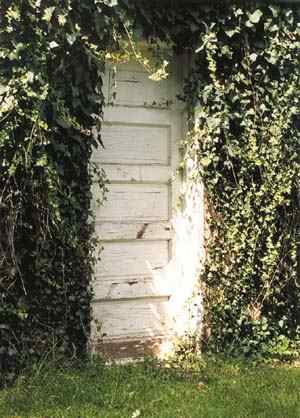
“The Ivy Door” by Monica Rhoades © 2002 / ephotograph.com
Intimacy With God
I recently wrote about the pursuit of happiness and centering prayer. Andy then asked me to elaborate on where my search has taken me. I read a book by the same man whom I referenced in that post, Father Thomas Keating; here are some thoughts on it.
It’s a book titled Intimacy With God, in which he quotes (very briefly) Carlos Castaneda.
I would never in my wildest dreams have imagined a Roman Catholic priest finding anything Castaneda said worthy. I’m impressed.
The book is an excellent introduction to the concept of contemplative prayer in the Christian tradition, and its emergence to meet the needs of disaffected Catholics (and later, Protestants) seeking a more meaningful, deeper connection with the divine. Keating explains the practice in clear terms and in the context of Christian doctrine. For someone like myself, it has introduced a way of praying that combines my core beliefs and spiritual roots in Christianity with the meditative aspects that the Eastern religions foster (and to which I am drawn).
I also find appealing his use of Centering Prayer as a relationship with God, the “Divine Therapist,” which implies the friendship, trust, and intimacy inherent in psychotherapy. The process of contemplative prayer is to consent to God healing us, by resting in Its presence while the Holy Spirit manifests Herself in us. In the state of deep rest, undigested emotional material arises (due to relaxed defenses) from the unconscious and is evacuated, bringing one a step closer to intimacy — union in love — with God. Keating remarks that this is a lifelong process and practice. He clarifies the distinction between clinical depression and the periods of “dark nights of the soul” which imply that the transformation is occurring. He also recognizes that while psychology and spirituality overlap, each “has a distinct emphasis and integrity that needs to be respected.”
Many of Keating’s words enlightened me, but this statement is one I want to note, because it presents a simple truth:
All spiritual exercises are designed to reduce the monumental illusion that God is absent. Not so. We just think so. Since the way we think is the way we usually act, we live as if God were absent. Whatever we can do to contribute to the dissolution of that confusion furthers our spiritual journey.
For those curious to learn more about Christian prayer, for their own journey or simply to learn more about what Christians believe and live, I highly recommend this book.
When Insomnia Hits
In these early hours when sleep
has eluded me, I sit
listening to the far-off pulse of
trains, whistling Pied Piper-like
of distant lands and
the resurrection of another day.
The Mission of Marriage
In marriage there is no escape from the dark corners of another human being. There is no escape from the mirror another casts on my own sorry state. However exalted my intentions — however ready I am to quote some spiritual wisdom from some great author or text — marriage, by design, offers me a context in which to see through the mirage of my own defenses. It summons into awareness the fears, the resentments, the disillusion, the sheer difficulty that comes with the fact of being human. …marriage calls us to abandon our longing for the perfect; for our partner’s perfection, and also for our own. As we open to our own imperfections we can begin to have mercy on those of others. Our imperfections, after all, are what join us to the human race. In letting our frailty be part of our experience of ourselves without judgment or criticism — it’s the way things are, after all — we may begin to know compassion, both for ourselves and the world. The willingness to live with eyes open, fearing neither what you will see in the other nor what they will see in you — this is part of the savage grace that is marriage.
–Roger Housden, Ten Poems to Open Your Heart